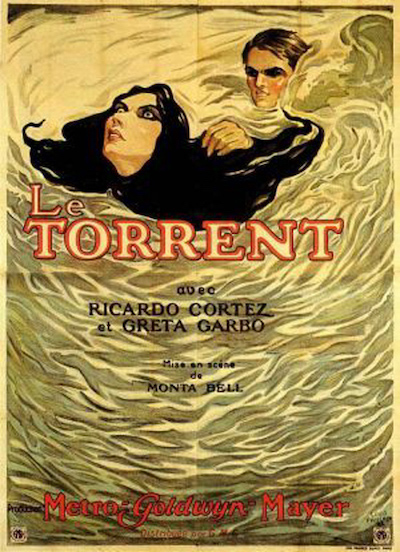
A young girl and her father are kicked out of their house by a cruel noblewoman, and the girl’s heart is broken when her sweetheart, the noblewoman’s son, won’t go to Paris with them. After becoming an opera star in Paris, the girl returns to her homeland and finds her romance with the nobleman rekindled.Read More »
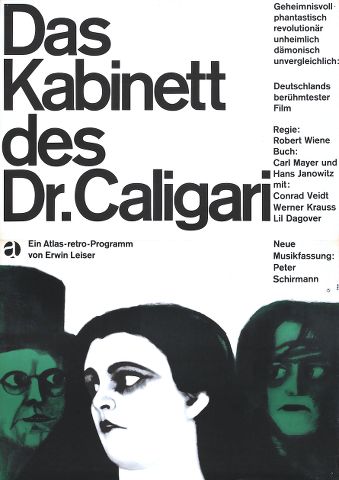
Thwarted by his despotic uncle from continuing his love affair, a young man turns to thoughts of murder. Experiencing a series of visions, he sees murder as a normal course of events in life and kills his uncle. Tortured by his conscience, his future sanity is uncertain as he is assailed by nightmarish visions of what he has done.Read More »
Quote:
Around 1900, the issues of poverty and poor relief were the source of heated controversy. This DVD illustrates in seven chapters how examinations of the ‘Social Question’ were presented in magic lantern slide sets and early films. On the screens of auditoriums, Sunday schools, music-halls, cinemas and churches, visitors could witness orphans freezing to death in the snow, drunkards plunging their families into misery and helpless old people begging for a scrap of bread. Audiences experienced poignant moving pictures in performances with music, singing and recitations. The photographic and film industries delivered glass slide sets and films in very large runs on a variety of themes relating to poverty.Read More »
Mike Pinsky, DVDVerdict wrote: Russian film poet Evgeni Bauer combined the technical virtuosity of D.W. Griffith with the haunting terror of Edgar Allan Poe and the artist’s eye of Johannes Vermeer. He is — perhaps — the greatest film director you have never heard of. During his brief four-year career, Evgeni Bauer created macabre masterpieces. They are dramas darkly obsessed with doomed love and death, astonishing for their graceful camera movements, risqué themes, opulent sets and chiaroscuro lighting. Tragically, Bauer died in 1917, succumbing to pneumonia after breaking his leg.Read More »
Dave Kehr, Chicago Reader wrote:
Charles Chaplin’s best-loved film, with the tramp down-and-out (as usual) in Alaska, where he looks for gold, falls in love with a dance-hall girl (Georgia Hale), eats his shoes for Thanksgiving dinner, and ends up a millionaire. The blend of slapstick and pathos is seamless, although the cynicism of the final scene is still surprising. Chaplin’s later films are quirkier and more personal, but this is quintessential Charlie, and unmissable. The film has been issued in several different forms with different sound tracks and cuts, including a 72-minute version butchered by Chaplin himself in the 40s. Hold out for the 1925 original, which runs 82 minutes.Read More »
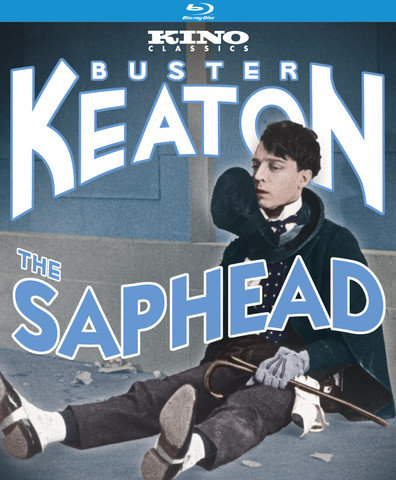
The Saphead is a 1920 comedy film featuring Buster Keaton. It was the actor’s first starring role in a full-length feature and the film that launched his career.
The plot was a merging of two stories, Bronson Howard’s play The Henrietta and the novel The New Henrietta by Victor Mapes and Winchell Smith, which was meant to be an adaption of Howard’s play. Read More »
Way Down East (1920) is a silent film directed by D. W. Griffith and starring Lillian Gish. It is one of four film adaptations of the melodramatic 19th century play Way Down East by Lottie Blair Parker. There were two earlier silent versions, and one sound version in 1935, starring Henry Fonda.
Griffith’s version is particularly remembered for its exciting climax in which Lillian Gish’s character is rescued from doom on an icy river. Some sources, quoting newspaper ads of the time, say a sequence was filmed in an early color process, possibly Technicolor or Prizmacolor. Read More »
Quote:
The Forty-First, Boris Lavrenyev’s novella, written in only two days, has proven enduringly popular. It tells the story of a young woman snarpshooter fighting with the Reds in Turkestan. She misses her forty-first victim, a handsome White lieutenant, and ends up escorting him, by boat, into captivity across the Aral Sea. A storm, however, strands the two on an island. Sick with pneumonia, the lieutenant is nursed back to health by his Red escort, and the two fall in love. At the last, however, Mariutka shoots him dead when he tries to escape, thus making him “the forty-first.”
Sorok pervyy had been filmed as a silent, from the author’s own script, by Yakov Protazanov in 1927.Read More »
Here is an HDTV rip of the brand new digitally restored version of the absolute masterpiece “The Cabinet of Dr. Caligari”. The film has been restored using the original camera negative, the result premiered on February 9th 2014 at the 64th Berlin International Film Festival.
New York composer and multi-instrumentalist John Zorn presented a new composition on the Karl Schuke organ at Berlin’s philharmonic to accompany the film. This is the version that has been shown at the festival with his music. Read More »