Satyajit Ray

  • Satyajit Ray – Aparajito (1956) (HD)

    1951-1960ClassicsDramaIndiaSatyajit Ray

    Description from Criterion site:
    Satyajit Ray had not planned to make a sequel to Pather Panchali, but after the film’s international success, he decided to continue Apu’s narrative. Aparajito picks up where the first film leaves off, with Apu and his family having moved away from the country to live in the bustling holy city of Varanasi (then known as Benares). As Apu progresses from wide-eyed child to intellectually curious teenager, eventually studying in Kolkata, we witness his academic and moral education, as well as the growing complexity of his relationship with his mother. This tenderly expressive, often heart-wrenching film, which won three top prizes at the Venice Film Festival, including the Golden Lion, not only extends but also spiritually deepens the tale of Apu.Read More »

  • Satyajit Ray – Shakha Proshakha aka The Branches of the Tree (1990)

    1981-1990AsianClassicsIndiaSatyajit Ray

    Synopsis
    This bittersweet story is one of the last two films directed by acclaimed Bengali Satyajit Ray (1921-1992). In the story, Ananda Majumdar (Maradan Bannerjee) is the very moral and upright 70 year old patriarch of a family, with four grown sons. His father and one of his sons live at home with him, and his other three sons live elsewhere. When he collapses during a banquet being given in his honor, the sons and their families gather at his bedside at home. There, while their father lies for the most part comatose, the boys reveal to each other exactly what they’ve been up to without the sugar coating they’ve been giving their father. The oldest boy has been embezzling from the company he runs, another one is losing money for fun at the racetrack, and yet another has given up a decent job in order to become an actor.Read More »

  • Satyajit Ray – Nayak AKA The Hero (1966) (HD)

    Satyajit Ray1961-1970ClassicsDramaIndia
    Nayak (1966) (HD)
    Nayak (1966) (HD)

    Arindam, a matinee idol, is going by train to collect an acting award. On the train, he is confronted by Aditi, a journalist who somewhat unwillingly starts to take his interview. Arindam, won over by Aditi’s naivete, starts to disclose his past, his fears and his secrets.Read More »

  • Satyajit Ray – Apur Sansar (1959)

    1951-1960ClassicsDramaIndiaSatyajit Ray

    Quote:
    “The World of Apu” is the third and final installment in the film trilogy of Satyajit Ray’s (Pather Panchali, Aparajito and Apur Sansar) Apu has grown to manhood and has been forced to give up his studies and find employment. Unable to find work, he is writing a novel based on his life. In a representation of an arranged marriage Apu nobly stands in for a distraught bridegroom. He had never seen his wife before the ceremony but together they find brief happiness. Tragedy again befalls Apu as his pregnant wife dies in childbirth. His son is brought into the world but blamed by his father for his mothers death. Apu matures, overcomes and sets forth with his boy, Kajal, to Calcutta to continue his adventure and start a new beginning.Read More »

  • Satyajit Ray – Sadgati AKA Deliverance (1981)

    Satyajit Ray1981-1990DramaIndia

    In this interesting look at the differences in the indian caste system, an untouchable Dukhi (played by Om Puri) approaches the village Brahmin to request him to set an auspicious date for his daughter’s upcoming wedding according to the Hindu astrology. The Brahmin promises to perform the task in exchange of Dukhi slaving over household chores in return. (-Artificial Eye)Read More »

  • Satyajit Ray – Sikkim (1971)

    1971-1980DocumentaryIndiaSatyajit Ray

    BACKGROUND
    Sikkim is a 1971 Indian documentary about the nation of Sikkim, directed by Satyajit Ray. The documentary was commissioned by the Chogyal (King) of Sikkim at a time when he felt the sovereignty of Sikkim was under threat from both China and India. Ray’s documentary is about the sovereignty of Sikkim. The film was banned by the government of India, when Sikkim merged with India in 1975. In 2000, the copyright of the film was transferred to the Art and Culture Trust of Sikkim. The ban was finally lifted by the Ministry of External Affairs (MEA) in September 2010. In November 2010 the director of the Kolkata film festival stated that upon filming the documentary for the first time, he received an injunction from the court of Sikkim again banning the film.Read More »

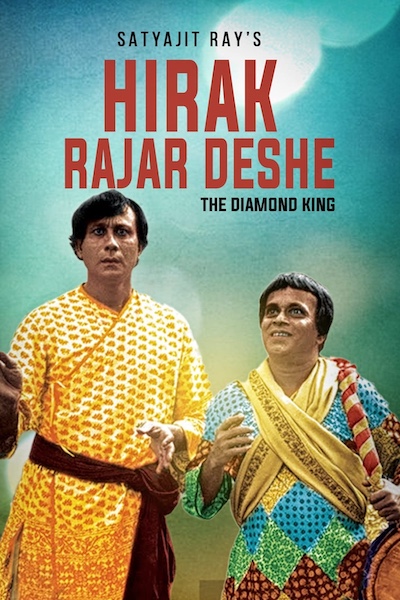
  • Satyajit Ray – Heerak Rajar Deshe aka Kingdom of Diamonds (1980)

    1971-1980AsianClassicsIndiaSatyajit Ray

    Synopsis

    Hirak Rajar Deshe is the second movie of the Goopy Gyne Bagha Byne series directed by Satyajit Ray. An unique aspect of the film is that most of the dialogues exchanged by the protagonists of the film are rhyming. Satyajit Ray was initially apprehensive whether this approach would be liked by people as it was a novel one but it was a great success.Read More »

  • Satyajit Ray – Jalsaghar AKA The Music Room (1958)

    Satyajit Ray1951-1960DramaIndiaMusical

    Quote:
    Jalsaghar opens to the shot of a large, ornate, candlelit chandelier, precariously swaying from the momentum of its cumbersome weight. It is a vestige of the fading grandeur of Huzur Biswambhar Roy’s (Chhabi Biswas) cherished jalsaghar – the elegant entertainment room where guests listen to the performance of traditional musicians amid eroded columns and peeling plaster. In early twentieth century India, it is also a symptom of Roy’s aristocratic obsolescence. Roy lounges on his empty rooftop terrace, overlooking his inherited property, now worthlessly reduced to marshland, staring idly into space, smoking his hookah pipe. Read More »

  • Satyajit Ray – Abhijaan AKA The Expedition (1962)

    Satyajit Ray1961-1970DramaIndia

    Quote:
    Abhijan was Satyajit Ray’s most popular film in Bengal: a “conscious” effort to communicate with a wider audience. The project was originally conceived by his friends and Ray stepped in when they panicked at the prospect of directing. Ray’s mastery turned a starkly conventional plot into a subtly nuanced story which topped the Bengali box office for months.Read More »

Back to top button