

Quote:
Alexander Hammid’s intimate study of a female cat and the birth and maturation of her five kittens.Read More »
Quote:
Alexander Hammid’s intimate study of a female cat and the birth and maturation of her five kittens.Read More »
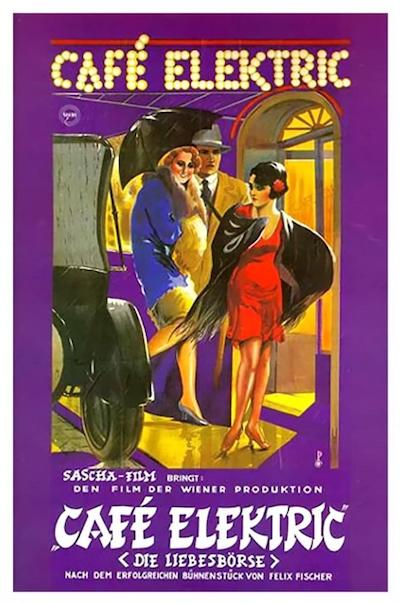
Silvia Breuss wrote:
It is one of those hidden big-city asylums where light-shy existences meet. Many paths lead into the demimonde of Café Elektric, but only a few lead out again. Women looking for the buyers of their bodies in the glow of the street lamps find their way in, as do night owls and all kinds of sinister figures. Truth meets deception here, drive meets dreams and feelings, possession and money meet dependence. Gustav Ucicky’s atmospherically dense “film of manners”, still captivating today in its direct and unsentimental portrayal of the Viennese milieu, with the young Willi Forst and Marlene Dietrich in her first leading role, was intended to show “how easy it is in our time to stray from the right path”. The signpost for three great careers.Read More »

This film comes from the Schloss Archive of His Highness, Herr Graf Ferdinand von Galitzien:

Quote:
Born Franz Wygand Wüstenhöfer in Malstatt (Saarland), Hofer began his career as a stage actor and playwright in 1909. A year later he began working as a screenwriter for Messter’s Henny Porten series and for directors such as Viggo Larsen—Die schwarze Katze [The Black Cat] (1910)—and Walter Schmidthässler—Das Weib ohne Herz [The Woman Without a Heart] and Der Zug des Herzens [The Pull of the Heart] (both 1912).Read More »

IMDB:
A poor woman, with no money for Christmas presents, tucks her three children in for the night, on Christmas Eve. Later, a poor, old beggar comes to her door and she lets him in to rest and warm up. When he suddenly leaves, she follows him to the front door of a church, where she finds an abandoned baby. The woman takes the baby home to care for it, even though she has almost nothing. Her acts of kindness are repaid with a Christmas miracle. Written by Detour 1945 Read More »
Although Georges Méliès’ The Conjuror (L’ Impressionniste fin de siècle) was was one of his earliest movies, it’s also an excellently realized example of Méliès’ basic style of cinematic magic.
The Conjuror revisits a scene that Méliès had explored before, and is basically a cinematic adaptation of the traditional magic trick “making the assistant disappear”. Méliès first presented this scene in his 1896 film The Vanishing Lady, which used simple camera stop-substitution to achieve the affect (no motion involved, and no in-camera dissolve). Méliès revisited the idea in his 1898 film The Magician, which made further use of the substitution effect, which by that time was only one of many effects that Méliès was using in his films.Read More »
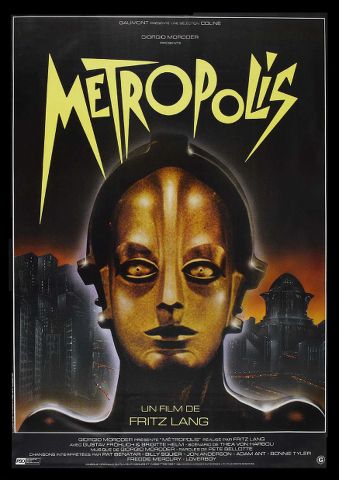
“Metropolis is not one film, Metropolis is two films joined by the belly, but with divergent, indeed extremely antagonistic, spiritual needs. Those who consider the cinema as a discreet teller of tales, will suffer a profound disillusion with Metropolis. Whait it tells us is trivial, pretentious, pedantic, hackneyed romanticism. But if we put before the story the plastic-photogenic basis of the film, then Metropolis will come up to any standards, will overwhelm us as the most marvelous picture book imaginable.”
— Luis Buñuel: Metropolis. In: Great Film Directors. Edited by Leo Braudy, Morris Dickstein. New York 1978, p. 590Read More »
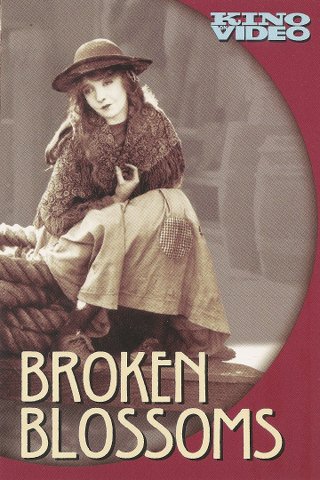
Don Druker, Chicago Reader wrote:
One of D.W. Griffith’s most beautiful films, a 1919 tale of the chaste love of a Chinese man (Richard Barthelmess) for the frail daughter (Lillian Gish) of a loutish boxer. It perfectly fuses all the elements of Griffith’s style: tender drama played off against scenes of violence; a rich, operatic sense of character and emotion; and a dreamlike acting style, given particular force by the subtlety of Gish’s performance and the strength of Barthelmess’s.Read More »

Somewhere in Southern Bavaria Xaver wants to marry Gretel, but her father Kohlhiesel wants his elder daughter Liesel to marry first. The problem is, nobody wants to marry her, because she’s too brutal. Seppel suggests, that he should marry Liesel first, get rid of her and then he can marry Gretel…Read More »

A more than pleasant, funny and touching short(ened) burlesque comedy of young Y. Ozu.
Two friends provide shelter to an orphan girl they have accidentally knocked down.Read More »