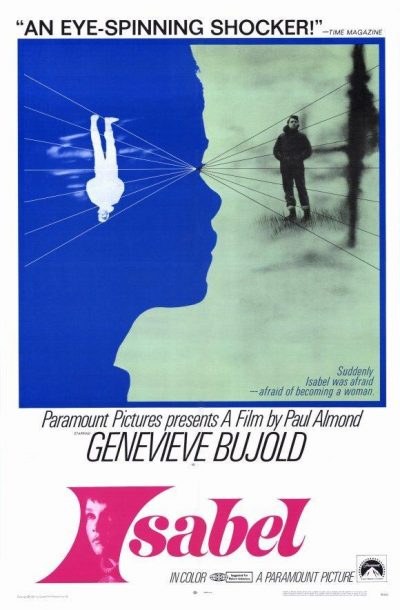

A woman believes she is beginning to lose her mind when she begins seeing ghosts and spirits.
As a comment on religious repression, familial ostracism, and subliminal incestuous urges, this film might have some value.Read More »
A woman believes she is beginning to lose her mind when she begins seeing ghosts and spirits.
As a comment on religious repression, familial ostracism, and subliminal incestuous urges, this film might have some value.Read More »

Cardoza’s death, a candidate for mayor of a village chief enemy and Rosauro Castro, leads to Mr. Garcia Mata to undertake an investigation. Upon arriving realizes that even the whole town, including the mayor, lives in fear by the chief and only achieved revenge end the injustices committed by Rosauro Castro.Read More »

EP.1 – IL DELITTO AL PONTE DE NEULLY
EP.2 – GIAN GIOVEDÌ’
EP.3 – LA FIGLIA DEL GHIGLIOTTINATO
EP.4 – GIUSTIZIA!
“Not many Italian silent films structured in episodes have survived, though a good many were made (see Monica Dall’Asta, “La diffusione dei film a episodi in Europa”, in Storia del cinema mondiale. Vol. 1: L’Europa. I. Miti, luoghi divi, Einaudi, 1999, p.309). Most of them were based on foreign models, particularly French, and some were direct reworkings. One such case is Il Fiacre n. 13, from the novel of the same title by Xavier Henri Aymon Perrin, Count of Montépin, a highly prolific and much-loved author whose books were vehicles for the depiction of social inequality, narrating stories of love, death, betrayal, blackmail, and redemption. Read More »

Synopsis:
The film interprets a story from the Uttara Kanda of the epic poem Ramayana, where Rama sends his wife, Sita, to the jungle to satisfy his subjects. Sita is never actually seen in the film, but her virtual presence is compellingly evoked in the moods of the forest and the elements. The film retells the epic from a feminist perspective, and is about the tragedy of power and the sacrifices that adherence to dharma demands, including abandoning a chaste wife.Read More »

Quote:
On a movie set, in a factory, and at a hotel, Godard explores the nature of work, love and film making. While Solidarity takes on the Polish government, a Polish film director, Jerzy, is stuck in France making a film for TV. He’s over budget and uninspired; the film, called “Passion,” seems static and bloodless. Hanna owns the hotel where the film crew stays. She lives with Michel, who runs a factory where he’s fired Isabelle, a floor worker. Hanna and Isabelle are drawn to Jerzy, hotel maids quit to be movie extras, people ask Jerzy where the story is in his film, women disrobe, extras grope each other off camera, and Jerzy wonders why there must always be a story.Read More »

Synopsis:
A couple uses extremely black comedy to survive taking care of a daughter who is nearly completely brain dead. They take turns doing the daughter’s voice and stare into the eyes of death and emotional trauma with a humor that hides their pain.Read More »

“”People living near a by-station, sincerely envied passengers of the passing trains. Arina, a homely lonely woman of about 40 was a cook at the station. Once the pointsman Gomozov dropped in to see her in the kitchen. The lonely man had recently lost his family and asked her to sew a couple of shirts for him. And then he asked her to come to his place in the evening to have some tea and talk just out of boredom. Arina left him at daybreak. But soon people at the station learnt about their relationship…”” kinoglaz.frRead More »

Lucas has invented a new computer language but at the same time he has been informed about his strange terminal illness during which he has been gradually losing his memory. Shortly after that he meets Blanche who acts as a medium in a bizarre traveling show. Dying Lucas follows her to the sea resort where they spend together several days and nights.Read More »

Quote:
Six queer teenagers struggle to get along with each other and with life in the face of varying obstacles.
Fernando F. Croce wrote:
Gregg Araki once described Totally F***ed Up, his follow-up to the 1992 New Queer Cinema staple The Living End, as a “rag-tag story of fag-and-dyke teen underground…a kind of cross between avant-garde experimental cinema and a queer John Hughes flick.” The statement attests not only to Araki’s committed radicalism, but also to his sense of how the politics of pop culture play to alienated youth. He probably loved a rave from a San Francisco paper hailing the film as “a ‘90s version of The Breakfast Club.”Read More »