After eight years of marriage to Liyan – once rich but now a shadow of his former self following a long, ruinous war – Yuwen does little except grocery and medication shopping. A surprise visit from Liyan’s friend Zhang re-energises the household, but also stirs up long-suppressed feelings and resentments.Read More »
Synopsis:
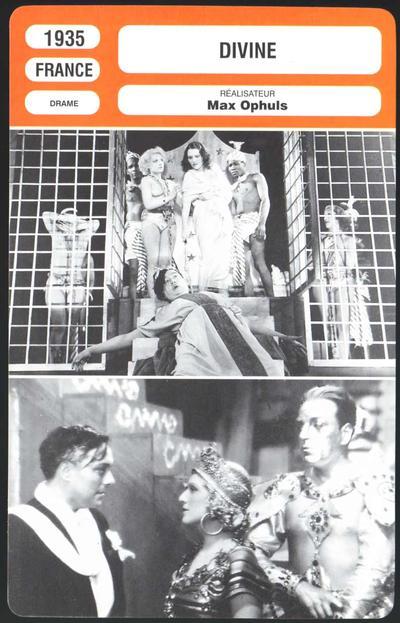
Ludivine Jarisse is a young woman who lives a contented but unexciting life in the country. One day, she is visited by Roberte, an old friend who has made a career for herself as an actress at a Paris music hall, L’Empyrée. Roberte intends to take a break and invites her friend to take her place. Ludivine readily accepts, and soon becomes a musical hall diva under the name Divine, although she is at first reluctant to expose herself in the revealing costumes she is given. One of her colleagues attempts to take advantage of her naivety, but when she resists, he implicates her in a drugs trafficking affair. Divine remains untainted by all this vice and falls in love with an honest milkman, Antonin. He offers to marry her and she is finally able to leave the music hall to start a new life, back in the country.Read More »
Untitled and without any crew credits, this 32-minute silent documentary takes you on a tour of MGM in 1925, meeting the people who create the movies, and watching some of them do it. I found it fascinating, especially when some of the moviemakers were identified by the inter-titles. It was nice to be able finally to attach a face to some familiar names such as writers Agnes Christine Johnston, Jane Murfin, Waldemar Young and others who are identified and shown in closeups. I noted that Howard Hawks was included as a writer – he didn’t start directing until later. Less interesting were the showing of groups of unidentified crew members: about 50 cameramen lined up in a row, each hand cranking their cameras, seemed to serve no useful purpose. Unlike the writers, who were identified individually, the directors were all identified first in an inter-title, and the camera then panned across them standing in a row, but you could not tell which name belonged to which director. I did recognize Erich von Stroheim, but only because he was also a famous actor. When the actors and actresses were introduced as a group by inter-titles, it was much more fun, because identifying them became a game. I also saw three unlisted actors: Ford Sterling, William Haines and Sojin, and there are probably others.Read More »
IMDb user:
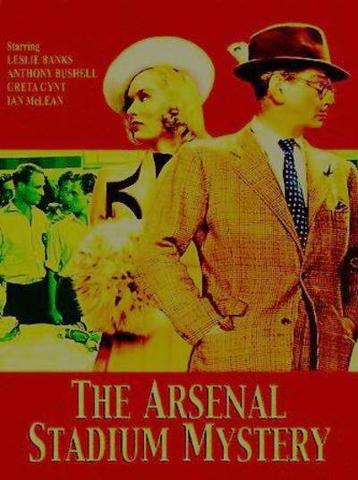
There are several reasons to relish this curio. It was an apprentice work by Thorold Dickinson, the Hitchcock assistant and cutter who would shoot “Gaslight” and “The Queen of Spades” before becoming Britain’s first professor of film. It is one of the earliest sports movies to feature real sportsmen – acting very woodenly, as befits stiff-upper-lip soccer stars. It is anchored by a mischievously eccentric performance by Leslie Banks, who a few years later was to be the magnificent Chorus of Olivier’s “Henry V”.Read More »
Quote:
Sure, this sci-fi action drama has its cheesy moments but it remains one of the most beloved genre flicks of the 1970s. Your humble editor (at the tender age of 9) saw this on the big screen when it was first released. It’s been a personal fave — a cherished guilty pleasure, if you will — ever since.
This is the second film based on Richard Matheson’s novel I Am Legend, the first being the 1964 Italian production The Last Man on Earth starring Vincent Price. That film, actually adhering more closely to the novel, had Price’s sole survivor besieged by blood-drinking vampires spawned by a deadly plague; they’re repelled by garlic and Price drives stakes through their hearts to kill them. The Charlton Heston vehicle eschews such horror elements in favor of action, more befitting the actor’s swaggering, tough guy screen image. There aren’t any vampires in The Omega Man. Instead our hero is pitted against a fanatical cult of bio-mutants — light-sensitive albinos — with a religious zeal to destroy the last “normal” human left alive.Read More »
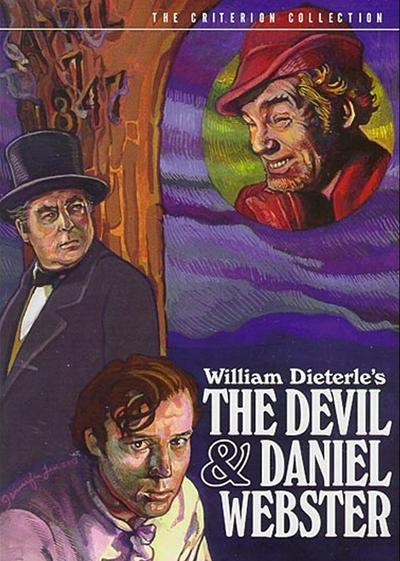
Quote: Jabez Stone is a hard-working farmer trying to make an honest living, but a streak of bad luck tempts him to do the unthinkable: bargain with the Devil himself. For seven years of good fortune, Stone promises “Mr. Scratch” his soul when the contract ends. When the troubled farmer begins to realize the error of his choice, he enlists the aid of the one man who might save him: the legendary orator and politician Daniel Webster. Directed with stylish flair by William Dieterle, The Devil and Daniel Webster brings the classic short story by Stephen Vincent Benét to life with inspired visuals, an unforgettable Oscar-winning score by Bernard Herrmann, and a truly diabolical performance from Walter Huston.Read More »
Quote: Directed by Monta Bell, who deserves to be remembered alongside Von Stroheim and other directorial giants of the era, the picture stars Bell’s favorite actress, Norma Shearer, in a dual role. She plays a rich girl, Florence, and a poor girl named Molly, a gangster’s moll.
Having the same actress play both roles is the brilliant touch. The women, of course, look alike, yet no one in the film notices. In the eyes of the world they’re totally different people. The audience, however, sees them as through the eyes of an omniscient observer — recognizing plainly that these women are, essentially, the same.Read More »
Plot Synopsis by Hal Erickson James Thurber wasn’t too happy with the Sam Goldwyn film adaptation of his 1939 short story The Secret Life of Walter Mitty, but the Technicolor musical comedy proved to be a cash cow at the box office. Danny Kaye stars as Walter, a milquetoast proofreader for a magazine publishing firm. Walter is constitutionally incapable of standing up for himself, which is why his mother (Fay Bainter) has been able to arrange a frightful marriage between her son and the beautiful but overbearing Gertrude Griswold (Ann Rutherford). As he muses over the lurid covers of the magazines put out by his firm, Walter retreats into his fantasy world, where he is heroic, poised, self-assured, and the master of his fate. Glancing at the cover of a western periodical, Walter fancies himself the two-gun “Perth Amboy Kid”; a war magazine prompts Walter to envision himself as a fearless RAF pilot; and so on. Read More »
Plot:
A rebellious youth, sentenced to a boy’s reformatory for robbing a bakery, rises through the ranks of the institution through his prowess as a long distance runner. During his solitary runs, reveries of his life and times before his incarceration lead him to re-evaluate his privileged status as the Governor’s prize runner. Read More »