1971-1980

  • Stéphane Marti – Allegoria (1979)

    1971-1980ExperimentalFranceQueer Cinema(s)Short FilmStéphane Marti

    Quote:
    “A filmmaker and academic, Stephane Marti has pursued cinema as a visual art form, divorced from the codes of the dominant narrative cinema, since 1976. He is a passionate and militant advocate of Super-8, a filmmaking tool which he has used for 30 years.

    His work has been shown in festivals and international presentations and has elicited numerous articles and interviews. His flamboyant, baroque and sensual style focuses principally on the Body and the Sacred.Read More »

  • Pierre Grunstein – Tendre Dracula (1974)

    1971-1980ExploitationFranceHorrorPierre Grunstein

    Quote:
    Two writers and their girlfriends visit the castle of an actor who specializes in playing vampire roles. As the night progresses, they begin to wonder if the man is an actor playing a vampire, or a vampire playing an actor.Read More »

  • Vivienne Dick – Staten Island (1978)

    1971-1980CultExperimentalUSAVivienne Dick

    29f7c043f76a2bde437fd0d52a185152

    “Born in Donegal, Ireland, Vivienne Dick moved to New York in 1975. There she became part of a group of filmmakers affiliated to the music and aesthetics known as ‘No Wave’. Shot mainly on Super-8, Dick’s films from this period feature many people and musicians from the No Wave movement in New York, such as Lydia Lunch, Pat Place, James Chance and Ikue Mori. Invoking the spirit of ’60s underground filmmakers, her work betrays an interest in individual transgression, urban street life, kitsch and pop culture. Multilayered and open-ended, the work is framed from a female perspective, with an overriding concern for social conditioning and sexual politics”.Read More »

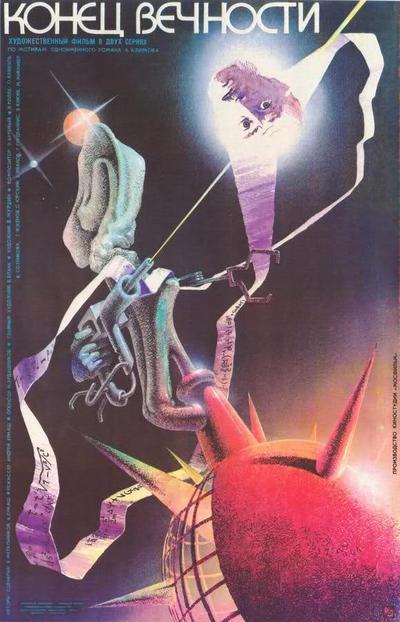
  • Andrei Yermash – Konets vechnosti AKA The End of Eternity (1987)

    1971-1980Andrei YermashSci-FiUSSR

    Quote:
    Based on a novel by Isaac Asimov, the film deals with the idea that some people could get immortality by means of controlling the time periods inside the special lab-city called “Vechnost”. They look like people but they are trained to work for Vechnost forever, as a part of its mechanism. They correct time holes, help people from other times to solve their problems by means of a special mind operating system. Everyone from Vechnost is immortal and they live in a very futuristic looking place in the center of time . As some periods of time get blocked from them, two engineers are sent to solve the problem but the operation starts to go wrong.Read More »

  • Amos Poe – The Foreigner (1978)

    USA1971-1980Amos PoeArthouseThriller

    Underground filmmaker Amos Poe (“Blank Generation”) wrote and directed this punk-flavored thriller about a terrorist agent whose mission in New York exposes him to constant danger and a bizarre array of friends and enemies. Eric Mitchell, Patti Astor star, with appearances by The Cramps and Debbie Harry.Read More »

  • Peter Weir – The Plumber (1979)

    1971-1980AustraliaComedyPeter WeirThriller

    Weir made this plumber-from-hell telemovie directly after Picnic at Hanging Rock. Although feeling somewhat like an extended short film that pushes the limits of credibility when stretched into a longer narrative format (would anyone really put up with a plumber this bad, assuming that a plumber could be this bad) it is for the most part diverting thanks to the performances of Judy Morris as the stay-at-home wife and particularly Ivor Kants as the plumber and Weir’s skill (he also penned the script) in keeping us guessing as to where the story is going or even in a Hitchcock-like way, what kind of film we are watching, thriller, horror or comedy. Less convincing are the scenes with Robert Coleby as the over-preoccupied husband and university dork but at least stylistically they have a naïve charm. As a side interest the film also manifests Weir’s preoccupation with the primitive/civilized opposition and of course, water. – BHRead More »

  • Frans Zwartjes – Pentimento (1979)

    1971-1980ExperimentalFrans ZwartjesNetherlands

    Free Image Hosting at www.ImageShack.us

    29f7c043f76a2bde437fd0d52a185152

    Description: This film is dominated by an icy blue. In a monumental building a group of scientists submit women to obscure and inhuman experiments, in which sexuality and cruelty constantly merge into one another. When the film was released, this horrifying game of power and powerlessness was condemned severely by a militant group of feminists. The criticism was undeserved. After all, ‘Pentimento’ is an art-historical term for a hidden image underneath the actual image giving an indication of how the latter evolved to its current state. The film does not endorse the lopsided power relations in our world but actually challenges them.Read More »

  • Frans Zwartjes – Living (1971)

    1971-1980ExperimentalFrans ZwartjesNetherlandsSilent

    29f7c043f76a2bde437fd0d52a185152

    Living (1971), Zwartjes’ own favourite film is the much praised climax of his series Home Sweet Home, in which he explores the rooms of his new house in The Hague. ‘Living has this weird, indefinable atmosphere’, Zwartjes said in an interview. ‘The strange way people move around and the whining music with it…’ The film is a demonstration of Zwartjes’ virtuoso camera work. He plays the main character and at the same time operates the camera, which is hand-held while he films himself. Zwartjes: ‘I was strong as a horse in those days.’ Two persons, Zwartjes and his wife Trix, move aimlessly through the house. Living was filmed with an extremely wide-angle lens (a 5.7) that suggests a powerful atmosphere of alienation.”Read More »

  • Lina Wertmüller – Pasqualino Settebellezze aka Seven Beauties (1975)

    Drama1971-1980ComedyItalyLina Wertmüller

    Lina Wertmüller’s harrowing 1976 film stars Giancarlo Giannini as a petty crook with seven unattractive sisters to support, and it features a picaresque, World War II-era journey through a prison asylum, army service, and a Nazi concentration camp. Wertmüller is more indulgent in highbrow sadomasochism than she is real profundity, but there’s no denying that the film is powerful in its story of subjugation and survival. A climactic scene in which Giannini saves his skin at the camp by seducing its disgusting female commandant is unnervingly honest. Giannini became a ’70s international icon partially on the basis of this work.Read More »

Back to top button