Silent

  • J. Searle Dawley – Frankenstein (1910)

    1901-1910HorrorJ. Searle DawleySilentThe Birth of CinemaUSA

    Frankenstein, a young medical student, trying to create the perfect human being, instead creates a misshapen monster. Made ill by what he has done, Frankenstein is comforted by his fiancée but on his wedding night he is visited by the monster. A fight ensues but the monster, seeing himself in a mirror, is horrified and runs away. He later returns, entering the new bride’s room, and finds her alone.Read More »

  • Tod Browning – West of Zanzibar (1928)

    1921-1930AdventureSilentTod BrowningUSA

    For 18 years Phroso, known as Dead Legs by his cronies, plots his revenge, becoming a pseudo-king in East Africa, nearby where Crane has set up an ivory business. When the daughter is grown, having lived in a brothel in Zanzibar thanks to Dead Legs, Phroso put his plan into action, resulting in revenge and retribution all around.Read More »

  • Tod Browning – The Unholy Three (1925)

    1921-1930CrimeSilentTod BrowningUSA

    Lon Chaney — the Man of a Thousand Faces — used his makeup skills, astonishing physicality and profound empathy to create Quasimodo, the Phantom of the Opera and more of the Silent Era’s greatest horror roles. In this hypnotic mix of creepiness and crime, he plays a ventriloquist who dons a granny disguise to team with a strongman and a little person in a bizarre robbery scheme that ends in murder. The film marks an even more fateful alliance than that of the Unholy Three: the collaboration between Chaney and director Tod Browning, who would helm seven more Chaney movies before making Sound Era horror history with Dracula and Freaks.Read More »

  • Yervant Gianikian & Angela Ricci Lucchi – Uomini, anni, vita aka Menschen, Jahre, Leben (1990)

    1981-1990Angela Ricci LucchiDocumentaryExperimentalGermanyYervant Gianikian

    Synopsis:
    Uomini, anni, vita (People, Years, Life) is an allegorical film about the subservience of the people of the Caucasus (both Christian and Muslim alike) in general and Armenians in particular by the Soviet State. Mother Russia even makes on appearance in the beginning of the film in the form of a Saint, with all the Caucasian peoples being made to bow down to her.Read More »

  • Robert Wiene – Das Cabinet des Dr. Caligari AKA The Cabinet of Dr. Caligari (1920)

    Germany1911-1920HorrorRobert WieneSilentWeimar Republic cinema

    Francis, a young man, recalls in his memory the horrible experiences he and his fiancée Jane recently went through. It is the annual fair in Holstenwall. Francis and his friend Alan visit The Cabinet of Dr. Caligari, an exhibit where the mysterious doctor shows the somnambulist Cesare, and awakens him for some moments from his death-like sleep. When Alan asks Cesare about his future, Cesare answers that he will die before dawn. The next morning Alan is found dead. Francis suspects Cesare of being the murderer, and starts spying on him and Dr. Caligari. The following night Cesare is going to stab Jane in her bed, but softens when he sees the beautiful woman, and instead of committing another murder, he abducts her. Read More »

  • Nina Agadzhanova & Lev Kuleshov – Dva-Buldi-dva aka Two-Buldi-Two (1929)

    Drama1921-1930Lev KuleshovNina AgadzhanovaSilentUSSR

    “A father and son, both clowns, are to perform together for the first time, but the civil war separates them, and the elder Buldy, tempted for a moment to acquiesce to the White forces, casts his lot with the revolution. At the climax Buldy Jr. escapes the Whites thanks to flashy trampoline and trapeze acrobatics; the gaping enemy soldiers forget to shoot. Even Kuleshov’s more naturalistic films show flashes of kinetic, stylized acting. A partisan listens to a boy while draping himself over a door. A Bolshevik official answers the phone by reaching across his chest, twisting his body so the unused arm can hike itself up, right-angled, to the chair.”
    by David BordwellRead More »

  • Emilio Ghione – I topi grigi (1918) (HD)

    1911-1920CrimeEmilio GhioneItalySilent

    Quote:
    I topi grigi, an eight-part serial produced by Tiber Film in Rome, is part of the complex saga of Za la Mort, an apache and outlaw who was the protagonist of 12 films, four serials, three novels and various theatrical shows created between 1914 and 1930 by Emilio Ghione (1879-1930).
    Thanks to his alter ego Za, Ghione would eventually become a genuinely popular star. On one hand he incarnated the role of fearless hero and was the emblem of muscular masculinity. On the other he was also a natural performer in the role of a dandy in several melodramas set in the salons of the decadent, contemporary nobility – a setting reflecting the D’Annunzio-inspired atmosphere of the period.Read More »

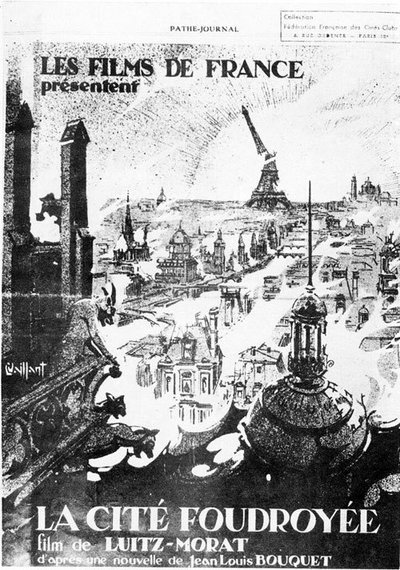
  • Luitz-Morat – La Cité foudroyée AKA The City Destroyed (1924)

    1921-1930FranceLuitz-MoratSci-FiSilent

    A crazed scientist planning to rule the world decides to destroy the city of Paris with his lightning/ray gun.Read More »

  • Kazimir Gertel – Iz-pod svodov mecheti AKA From Under the Vaults of the Mosque (1927)

    1921-1930DramaKazimir GertelSilentUSSR

    From Under the Vaults of the Mosque (Rus. Iz-Pod svodov mecheti) by Kazimir Gertel’ (Uzbekkino, 1927)

    The action takes place in Turkestan at the end of the imperial period. Oberuchev (L. Lazarev), a cotton manufacturer from St. Petersburg, goes to Moscow to sign a delivery contract with the army before going back to Turkestan, his “homeland.” Together with his assistant Yastrebetskii (A. Poliakov), Oberuchev exploits the local population with the connivance of the local bais. An old man, Pir Nazar (A. Khojaev), is one of his victims and has to sell his belongings to pay off his debts.Read More »

Back to top button