

A wax museum hires a writer to give the sculptures stories. The writer imagines himself and the museum owner’s daughter in the stories.Read More »
A wax museum hires a writer to give the sculptures stories. The writer imagines himself and the museum owner’s daughter in the stories.Read More »

Quote:
“The rule of coal is gone. The bios plants will provide power to the world from today!” In this rediscovery of Weimar cinema, a dystopian vision of unfettered capitalism that is eerily contemporary, a coal miner makes a Faustian pact with the otherworldly Algol, an alien who teaches him how to harness the energy of his home star and become the most powerful man on earth. Together they become megalomaniacal CEOs of the “Bios-Werke,” lording over the nations of the world by monopolizing renewable energy and by turning workers into slaves.Read More »

Quote:
The story is set in a leafy village of Peloponnese, on the fabled hillsides of mount Helmos, around places that inspired a German poet to write: “Everything changed in Greece / Time changed everything / Not only did it change/ flock and shepherd.” Here lies the property of Kyr-Mitros, a rich peasant who lives with his son, Thymios, and his adopted daughter, Astero. The two kids grow up together, supporting each other and becoming good friends. Overtime, their friendship evolves into something deeper and more intimate. However, their dreams and wishes come to an end by tough Kyr-Mitros’ master-plan. When Stamos, a prosperous herder, comes to town, he falls in love with Astero and takes her with him. Will there be a twist of fate? Driven by guilt and watching his son withering, Kyr-Mitros reveals an important secret… This pastoral romance mesmerized audiences of the time. The screenplay is based on a literary piece by Pavlos Nirvanas, published under the title Ramona.Read More »

Two thieves, the Blackbird and West End Bertie, fall in love with the same girl, a French nightclub performer named Fifi. Each man tries to outdo the other to win her heart.Read More »

At the Opera of Paris, a mysterious phantom threatens a famous lyric singer, Carlotta and thus forces her to give up her role (Marguerite in Faust) for unknown Christine Daae. Christine meets this phantom (a masked man) in the catacombs, where he lives. What’s his goal? What’s his secret?Read More »

Born on the fourth of July, 1900, the future holds unlimited potential for newborn John Sims. But dreams soon fade with the death of his father when John is but a lad. Like many before him, John sets out to make his mark in New York City, but ends up a faceless worker (#137) in a large office of a large business. Still he is happy with his fate and soon meets a young woman named Mary on a blind double date. Things take their course and they soon marry and live in a small apartment. Soon John is bickering with Mary and finds that he has no love for the in-laws. When the marriage looks like a bust, he finds that Mary is with child and he stays. After 5 years, he has a son and a daughter and the same dead end job. When tragedy strikes, John must find the conviction to continue or lose what little he has left.Read More »

Quote:
In the middle of an economic crisis, the workers are living in poverty and struggling to find a little happiness and get a warm meal. Mother Krause lives with her two grown-up children, as well as a shady “bed lodger” and his lover – a prostitute with a child – on just a few square metres. In next to no time, tensions build up, and soon crime is involved too. Mother Krausen’s painstakingly preserved order collapses. This story has lost hardly any of its relevance. In those days, columns of marching workers calling out “Join the ranks!” indicated a possible way out. But the older generation went to the dogs.Read More »
Quote:
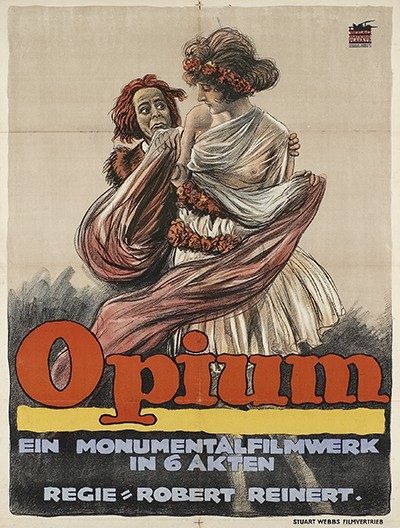
English doctor Professor Gesellius is in China researching the effects of opium. He frees a young woman named Sin from a den of inequity run by Nung Chiang. When he sails for home with the girl, Chiang swears vengeance. In England, it emerges that Sin is the illegitimate daughter of one of Gesellius’ colleagues, whose son is having an affair with the doctor’s wife. The son is poisoned and Gesellius becomes a murder suspect. He flees to India with Sin, pursued by the vengeful Nung Chiang … Read More »

The last person to die on New Year’s Eve before the clock strikes twelve is doomed to take the reins of Death’s chariot and work tirelessly collecting fresh souls for the next year. So says the legend that drives The Phantom Carriage (Körkarlen), directed by the father of Swedish cinema, Victor Sjöström (The Wind), about an alcoholic, abusive ne’er-do-well (Sjöström himself) who is shown the error of his ways and the pure-of-heart Salvation Army sister who believes in his redemption. Based on a novel by Nobel Prize winner Selma Lagerlöf, this extraordinarily rich and innovative silent classic (which inspired Ingmar Bergman to make movies) is a Dickensian ghost story and a deeply moving morality tale, as well as a showcase for groundbreaking special effects.Read More »