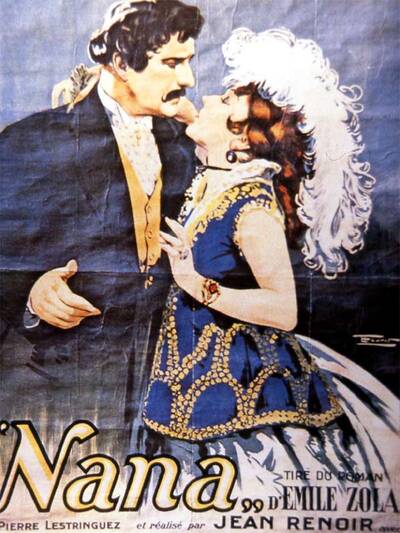

Nana (1926)
When the vivacious and beautiful Nana bombs at the Théâtre des Variétés, she embarks on the life of a courtesan, using her allure and charisma to entice and pleasure men.Read More »
Nana (1926)
When the vivacious and beautiful Nana bombs at the Théâtre des Variétés, she embarks on the life of a courtesan, using her allure and charisma to entice and pleasure men.Read More »

A chivalrous British officer takes the blame for his cousin’s embezzlement and journeys to the American West to start a new life on a cattle ranch.Read More »

Quote:
Despite the fact that, contrary to Bettauer’s book, the film is more a comedy rather than a real plea against antisemitism, and that it includes pretty negative archetypes against Jews, screenings of the film were actually subject to disturbances by NSDAP members. Furthermore Bettauer, who had not approved the changes made by Brelauer, was assassinated a few months later by a Nazi who, although accused as an “assassin”, had to spend only a few months in various mental hospitals and was released in 1927 without further requirements.Read More »

Yay! Another Danish silent melodrama. Actually, this is a particularly superior example. The Danish Film Institute’s website, from which this copy comes, descrbes it thusly:
Quote:
A wealthy young man, Edgar, sees a shopgirl, Ellen, and is immediately attracted to her. He buys her flowers. They meet next Sunday and, presumably, often thereafter. Three months later Ellen is pregnant. The couple decide to marry, and Edgar tells his mother. His father convinces him not to marry Ellen and sends him away to visit friends in the country. The daughter of the family he visits, Lily, gets him to write to Ellen when she finds out about her. Edgar’s fahter, however, has convinced Ellen’s former employer, to whom the letters have been sent, to turn them over to him. When Edgar gets no reply from Ellen, he secretly returns to the city. Read More »
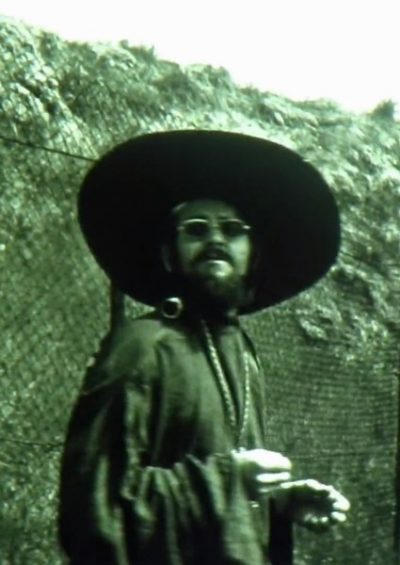
“A clever parody on a foreign film.”Read More »

Quote:
The Songs are a cycle of silent color 8mm films by the American experimental filmmaker Stan Brakhage produced from 1964 to 1969. They are seen as one of Brakhage’s major works and include the feature-length 23rd Psalm Branch, considered by some to be one of the filmmaker’s masterworks and described by film historian P. Adams Sitney as “an apocalypse of imagination.” One of the filmmaker’s most overtly political films, 23rd Psalm Branch is often interpreted as being Brakhage’s reaction to the Vietnam War.Read More »
An experimental film with various flashing lights, colors, and World War II footage. This is part of the Song series by Stan Brakhage.Read More »

Quote:
In the summer of 1924 Claude Friese-Greene, a pioneer of colour cinematography, set out from Cornwall with the aim of recording life on the road between Land’s End and John O’Groats. Entitled The Open Road, his remarkable travelogue was conceived as a series of shorts, 26 episodes in all, to be shown weekly at the cinema.
Claude’s experimental colour process failed to reach a large audience owing to heavy flicker and colour fringing. Following on from the BBC’s recent documentary The Lost World of Friese-Greene, the BFI National Archive has restored a special compilation of highlights from the journey, using digital intermediate technology to remove the technical defects of the original.Read More »

Sorok Serdets is a 49 minute politprosvet film centered on electrical power plants, the new beating hearts planned for Soviet society and economy.
The infotainment flick is full of both creative metaphors and rather rude suggestions towards the bourgeois and capitalists, conveying historical materialism in a bombastic way that anyone can understand. The most prominent metaphor, a horse transformed by technology into a factory, connects peasant toil to industrialization. And it goes on to contextualize the early 20s grain famines, NEP, and Stalin’s new 5-year-plan phases, and it gets you on board for the role of electrification in the development of a workers’ state in the Soviet Union.Read More »