

By 1993, cinema had become a language unto itself; it was a language that was made up of not only words, but also sounds and images. As cinema history continues, the language has expanded time after time due to the talents and experiments of master filmmakers such as Jean-Luc Godard. All throughout his vast, decade spanning career, Godard has made film upon film, and with each decade of Godard that passes by, the more radical his style becomes. If ever there was a filmmaker that I could say took the cinematic language to Joycean heights, that filmmaker is, without question, Godard. With “Oh, Woe Is Me”, Godard practically makes the cinematic equivalent of James Joyce’s “Finnegans Wake” by crafting a masterpiece that works as a perplexing jigsaw puzzle, one injected with all kinds of clever jokes as well as sections of poetic beauty. (From IMDb)Read More »
Philosophy
-
Jean-Luc Godard – Hélas pour moi AKA Oh, Woe Is Me (1993) (HD)
1991-2000ArthouseFranceJean-Luc GodardPhilosophy -
Abdul Latif Salazar – Al-Ghazali: The Alchemist of Happiness (2004)
2001-2010Abdul Latif SalazarDocumentaryPhilosophyUnited Kingdom
Exploring the life and impact of the greatest spiritual and legal philosopher in Islamic history, this film examines Ghazali’s existential crisis of faith that arose from his rejection of religious dogmatism, and reveals profound parallels with our own times. Ghazali became known as the Proof of Islam and his path of love and spiritual excellence overcame the pitfalls of the organised religion of his day. His path was largely abandoned by early 20th century Muslim reformers for the more strident and less tolerant school of Ibn Taymiyya. Combining drama with documentary, this film argues that Ghazali’s Islam is the antidote for today’s terror. Written by Abdul Latif SalazarRead More »
-
Noam Chomsky – Neo-Liberalism: An Accounting (2017)
2011-2020Noam ChomskyPhilosophyPoliticsUSA
Neo-Liberalism: An Accounting is UMass Crotty Hall Inaugural Lecture by Noam Chomsky. It was recorded April, 2017.Read More »
-
Noam Chomsky & Lawrence Krauss – An Origins Project Dialogue: Science, Mind and Politics (2015)
2011-2020Noam ChomskyPhilosophyPoliticsUSA
Quote:
Join intellectual giant Noam Chomsky and noted physicist and public intellectual Lawrence Krauss for an intimate evening of conversation at the Origins Project Dialogue. Science, Mind, and Politics is a candid and unscripted conversation on contemporary issues on the nature of humanity, the power of science and the mind, and global social justice.Read More » -
Danièle Huillet & Jean-Marie Straub – Quei loro incontri AKA These Encounters of Theirs (2006)
2001-2010Danièle Huillet and Jean-Marie StraubExperimentalItalyPhilosophy
In the last feature-length collaboration between Straub and Huillet before Huillet’s death in 2006, villagers from across the length of Italy — a peasant, a postmaster, a theater director, a mayor, a rope maker — gather in the Tuscan countryside to recite the five final scenes of Cesare Pavese’s Dialogues with Leucò.
Published in 1947, just two years after the Holocaust and the Second World War and two years before Pavese’s suicide, the Dialogues offer a series of meditations on human destiny, both comical and tragic, between ancient Greek mythological figures. Desperate in their hunger for immortality, mortals are blind to the gift of being human — of their ability to experience joy and suffering; to feel a passing breeze or the touch of another body; to name, remember, and act.Read More »
-
Stephen Segaller – Jung on film (1957)
1951-1960DocumentaryPhilosophyStephen SegallerSwitzerland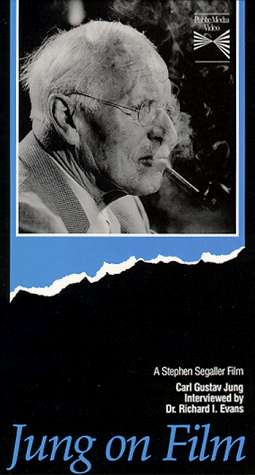
Here a short description:
This compelling film represents a rare record of an original genius. In Jung on Film, the pioneering psychologist tells us about his collaboration with Sigmund Freud, about the insights he gained from listening to his patients’ dreams, and about the fascinating turns his own life has taken. Dr. Richard I. Evans, a Presidential Medal of Freedom nominee, interviews Jung, giving us a unique understanding of Jung’s many complex theories, while depicting Jung as a sensitive and highly personable human being.Read More » -
Alexander Kluge – Jeder Zirkus hat ein Ende (2018)
2011-2020Alexander KlugeGermanyPhilosophyTV
Alexander Kluge: Jeder Zirkus hat ein Ende
10vor11 Kulturmagazin, 25./26.6.18, RTLDie 1509. und zugleich letzte Ausgabe des Kulturmagazins 10 VOR 11. Zum Abschied mit Überlänge. Mit Hannelore Hoger, Thomas Gottschalk, Friedrich Kittler, Dirk Baecker, Andrea Komlosy, Jürgen Kocka, Olli Schulz, Helge Schneider, Michel Serres, Niklas Luhmann, Heiner Müller, Hans-Thomas Janka, Andrea Kunder, David Gross (Nobelpreisträger), Rainer Weiss (Nobelpreisträger), Karin Mölling, Sir Henry, Sophie Rois, Präsident Trump und vielen anderen Gästen. Mit viel Musik, Information, Dialog, Bildern und Zusammenarbeit mit Partnern. Von Philosophie über Kunst und Wissenschaft bis zur “Abrüstung vom Sinnzwang”. So nah sind sich Helge Schneider und Michel Serres sonst nirgends gekommen.Read More »
-
Neten Chokling – Milarepa (2006)
2001-2010ArthouseBhutanNeten ChoklingPhilosophyPhilosophy on Screen
Quote:
The Tibetan film Milarepa, produced in 2006 is set in the magnificent Spiti Valley high in the Himalayas in the Zanskar region close to the border between India and Tibet. Directed by Neten Choklin, a Lama from Western Bhutan who has previously worked with Khyentse Norbu on the films such as The Cup and Travellers and Magicians, the film is the first part about the adventurous formative years of the legendary buddhist mystic, Milarepa (1052-1135) who is one of the most widely known Tibetan Saints, but whom set out for vengeance and retribution.
Read More » -
Guy Debord – In girum imus nocte et consumimur igni AKA We Spin Around the Night Consumed by the Fire (1978)
1971-1980ArthouseFranceGuy DebordPhilosophyThe Films of May '68
Quote:
Guy Debord’s final film, In girum imus nocte et consumimur igni (1978) (a Latin palindrome meaning ‘We go round and round in the night and are consumed by fire’), is structured as a dual reflection on the misery of (then) contemporary cinema, and the memory of those revolutionary moments that might have led to another cinema. The central image of the film is the charge of the light brigade, from Michael Curtiz’s 1936 film of the name, which figures the adventure of the Situationists. This is not simply an image of heroic futility, but the image of the evanescent eruption of the Situationists into history. In his commentary Debord argues that the film is organized by two elemental themes: water, as the representation of the flowing time, and fire, as the representation of momentary brilliance, in which water always drowns out this ‘fire.’ While it would be quite possible to give this a quasi-mystical reading it is, in fact, deeply political.Read More »
