
Quote:
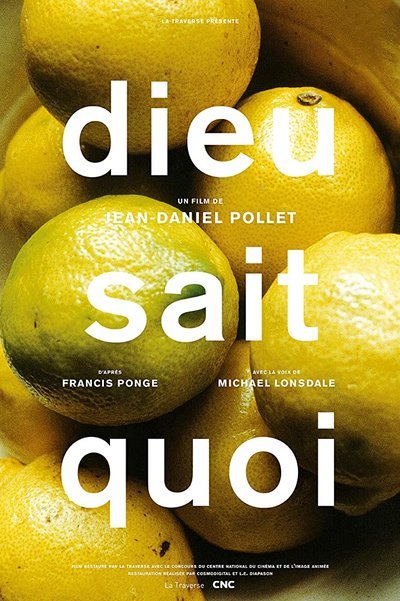
Dieu sait quoi can be described as a cinematographic essay managing to convey Francis Ponge’s approach to the world, his special relation between silent objects and speech, defining the space of life and knowledge.Read More »
Quote:
Dieu sait quoi can be described as a cinematographic essay managing to convey Francis Ponge’s approach to the world, his special relation between silent objects and speech, defining the space of life and knowledge.Read More »

This film by Guy E. Debord is based on his 1967 book of the same title both of which convey ideas about the consumer capitalism’s mode of production and the effects on everyday life. Though both sources use a different means of communication they both powerfully convey the ideas of the situationists. I wont rant on about the ideas contain within this film which are quite profound and have influenced heavily on the Anti-Capitalist movement and post-structuralism through thinkers like Jean Baudrillard. The structure of the film itself is a series of shots from Hollywood films to soviet “collective hero” film experiments to soft-core porn(nothing past topless) to archival footage of historical events(e.g. May 68 revolt in France) and representations of everyday life. Read More »

Explores the life and work of the Austrian novelist, playwright and political activist, Peter Handke.Read More »

Quote:
A robot messenger (Tilda Swinton) is sent to earth to appeal to humans to live in peace. Originally designed to go to MIT, by mistake she ends up in Amman, Jordan during the Black September riots of 1970. Sullivan, a British journalist, (Bill Paterson) comes to her aid when she is found wandering without papers following a bombing and grants her refuge in his hotel room. But there she tells him she is a robot, sent as a peace envoy from another planet. He is not sure whether to believe her story or not, but finds her unusual view of the world appealing. They examine the human condition in a series of incredibly insightful and entertaining conversations.Read More »

” Cinema plus Psychoanalysis equals the Science of Ghosts” – Jacques Derrida
“At first I thought that ghosts would be forgotten in this new electronic age. But as things turn out, they began to use electronic gadgets for their own purpose. Now they often fly down telephone lines, jump on radio waves, and take you by surprise when you are listening to music. There are many recorded cases of ghosts appearing in electrical shops…”
GHOSTDANCERead More »

A doctor, a sculptor and a football player trying to win the love of desenatoare models, suffering from incurable disease. But this does not preclude it from working on hand in a clothes factory. Of the three candidate, the young woman prefers the more modest, based with the family.Read More »

In the time of the Roman Empire’s waning, decadent, self-indulgent days, the Algerian-born Catholic convert Augustine was appointed Bishop of Hippo in Roman North Africa. Seeing his own time, with its widespread poverty, greed and materialism, the Vietnam War, reflected in this fifth-century world, Roberto Rossellini turned his series of present-tense histories to the figure of Augustine, the splendid result being Agostino d’Ippona.Read More »

F I L M I N F O
1. Samuel Beckett made a single work for projected cinema. It’s in essence a chase film; the craziest ever committed to celluloid. It’s a chase between camera and pursued image that finds existential dread embedded in the very apparatus of the movies itself. The link to cinema’s essence is evident in the casting, as the chased object is none other than an aged Buster Keaton, who was understandably befuddled at Beckett and director Alan Schneider’s imperative that he keep his face hidden from the camera’s gaze. The archetypal levels resonate further in the exquisite cinematography of Academy Award-winner Boris Kaufman, whose brothers Dziga Vertov and Mikhail Kaufman created the legendary self-reflexive masterpiece Man With a Movie Camera. Commissioned and produced by Grove Press’s Barney Rosset, FILM is at once the product of a stunningly all-star assembly of talent, and a cinematic conundrum that asks more questions than it answers.Read More »

This Ecological Fairy Tale, with live actors and talking animals tells the story of a colonel (Paolo Villaggio) who is entrusted with a large estate of woodlands until his schoolboy nephew comes of age. Disregarding local tradition and the practice of his esteemed deceased brother, the military man decides to selectively cut the old growth timber. He is confronted with the protestations of the tree spirits (Giulio Brogi) and the local townsfolk, to no avail. Over their objection he releases the unpredictable wind from the cave to which it has been confined, and even wishes for the early demise of his nephew so he can own the woods outright. But he comes to value human contact more, starts to come to terms with most of the spirits, and reverses some plots to get rid of his nephew. A bit like a live action Hayan Miyazaki tale such as Princess Mononoke, but not so violent.Read More »