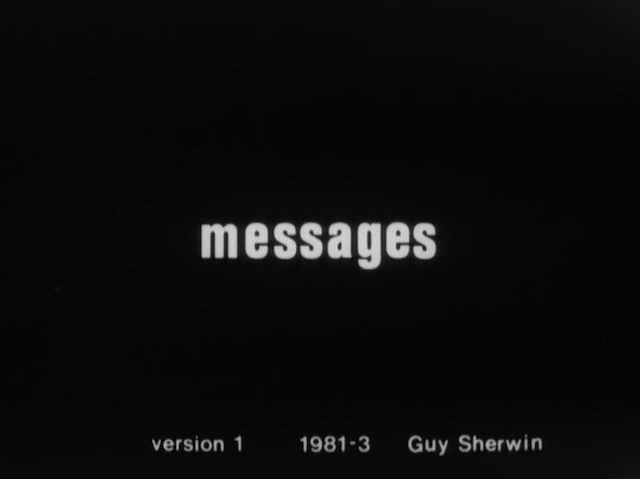
Quote: A response to my young daughter’s discovery of language and to her questions about the world.
Messages was made over a 3 year period, when my daughter Maya was first learning to talk and write.
It was my first film that involved gathering material around a central theme. That theme was not constant, but shifted its ground between ideas to do with childhood, with language, or with visual perception.Read More »
Quote: Four young people are trying to understand why their friend, a young woman, committed a suicide. A film made up of disconnected scenes weaving between past and present. The title of the film comes from a poem by Stuart Perkoff which tells that some young people felt (around 1960) that everything is against them, so much that even the trees in the parks and streets seemed to them like guns pointing at their very existence. – Jonas MekasRead More »
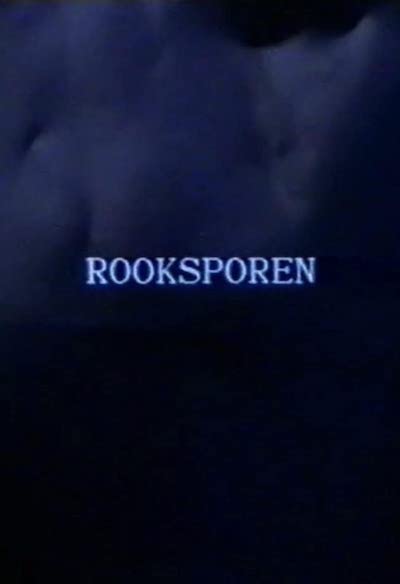
Quote: The central character in Rooksporen is a woman who finds herself facing an interrogator. Around these interrogation scenes are scenes in which 26 witnesses (from A to Z) are introduced: first in their houses and then in a space adjacent to the interrogation room. The questioner has an ambiguous identity and function: he directs his questions at the woman and then turns away only listening and watching as a sounding-board, to the witnesses. And the witnesses also have an elusive identity. Who or what they are remains unclear, they exist thanks to the sensuality and/or obscurity of their language. It is also far from clear what the woman is accused of. Most witnesses eventually think she is guilty, but what of remains the question. Read More »
Quote: A female prostitute and thief makes her way through the city with a female GDR spy. Frankfurt, 1974. It’s Carnival time. At the same time police forcibly evict students from occupied buildings).Read More »
From peterrosepicture.com The man who could not see far enough (1981, 16 mm film, color, sound) uses literary, structural, autobiographical, and performance metaphors to construct a series of tableaux that evoke the act of vision, the limits of perception, and the rapture of space. Spectacular moving multiple images; a physical, almost choreographic sense of camera movement; and massive, resonant sound have inspired critics to call it “stunning” and “hallucinatory.” The film ranges in subject from a solar eclipse shot off the coast of Africa to a hand-held filmed ascent of the Golden Gate Bridge, and moves, in spirit, from the deeply personal to the mythic. “The man who could not see far enough” has won major awards of distinction at numerous festivals both here and abroad, including the Oberhausen, Edinburgh, American, and Sydney Film Festivals, has been broadcast nationally, and is in collections at Centre Pompidou in Paris and at Image Forum in Tokyo.Read More »
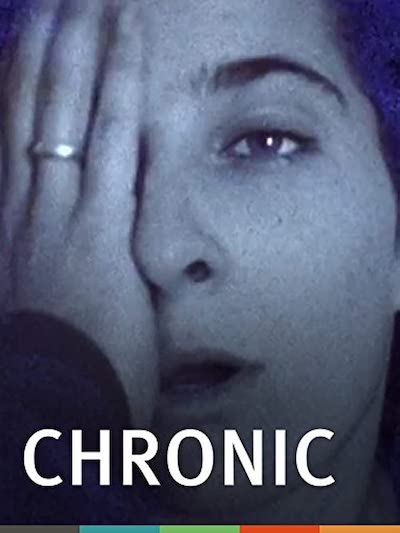
Quote: Chronic is an experimental narrative of one young woman living with “so-called” mental illness. Beautiful and skillful, it probes her misogynistic and violent surroundings for the motives behind her compulsive self-mutilation.Read More »
Quote: One of the most vertiginous of Markopoulos’s interior landscape studies, Himself as Herself is based loosely on Balzac’s Séraphita. The film consists of a shimmering, nearly plotless evocation of gender identity in flux, and it contains some of Markopoulos’s most haunting, densely interlaced images. Markopoulos portrays a hermaphrodite body, its movements, postures and gestures or expressions, a study of a highly stylized inner landscape that takes Bresson’s ideals to their ultimate conclusions. This film is dedicated to the American artist Emlen Pope Etting and features a musical excerpt from Poulenc’s “Gloria.”Read More »
Quote: In 2007, Matthew Barney and Jonathan Bepler began a new collaborative project inspired by American author Norman Mailer’s 1983 novel Ancient Evenings, set in pharaonic Egypt. The project was conceived as a nontraditional opera with a series of one-time-only live acts performed across the American landscape over a five-year period. This opera developed as a film titled River of Fundament, which combines documentation of the three live acts with scenes set in a reconstruction of Norman Mailer’s brownstone apartment in Brooklyn Heights.Read More »
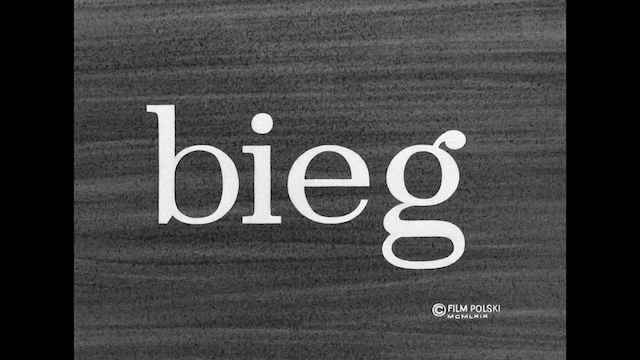
Quote: The race does not begin at the start line, it does not end at the finish line either. The camera observes the participants of the Polish 4×100 metres relay team, getting ready for the race and slowing down after the finish line. The competition would not exist without the following stages: mobilization, full of anxiety, and composure of the red-hot organism. Interestingly enough, they are observed really rarely. “Bieg” is a film directed by Bohdan Kosiński, a classic of the Polish school of documentary. Kosiński was associated with the Documentary Film Studios, he began his professional career with the so-called black series (“Miasto na wyspach”, 1958). Read More »