

Synopsis:
The story concerns the romance between Carmela and Antonio. Faced with the hostility of their parents, they symbolically shed themselves of all responsibilities to others in a climactic act of stark-naked bravado.
Read More »
Synopsis:
The story concerns the romance between Carmela and Antonio. Faced with the hostility of their parents, they symbolically shed themselves of all responsibilities to others in a climactic act of stark-naked bravado.
Read More »
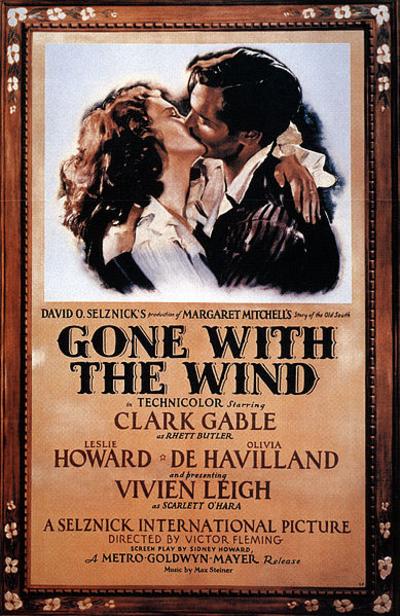
Gone With the Wind boils down to a story about a spoiled Southern girl’s hopeless love for a married man. Producer David O. Selznick managed to expand this concept, and Margaret Mitchell’s best-selling novel, into nearly four hours’ worth of screen time, on a then-astronomical 3.7-million-dollar budget, creating what would become one of the most beloved movies of all time. Gone With the Wind opens in April of 1861, at the palatial Southern estate of Tara, where Scarlett O’Hara (Vivien Leigh) hears that her casual beau Ashley Wilkes (Leslie Howard) plans to marry “mealy mouthed” Melanie Hamilton (Olivia de Havilland). Despite warnings from her father (Thomas Mitchell) and her faithful servant Mammy (Hattie McDaniel), Scarlett intends to throw herself at Ashley at an upcoming barbecue at Twelve Oaks. Alone with Ashley, she goes into a fit of histrionics, all of which is witnessed by roguish Rhett Butler (Clark Gable), the black sheep of a wealthy Charleston family, who is instantly fascinated by the feisty, thoroughly self-centered Scarlett: “We’re bad lots, both of us.” The movie’s famous action continues from the burning of Atlanta (actually the destruction of a huge wall left over from King Kong) through the now-classic closing line, “Frankly, my dear, I don’t give a damn.” Holding its own against stiff competition (many consider 1939 to be the greatest year of the classical Hollywood studios), Gone With the Wind won ten Academy Awards, including Best Picture, Best Director, Best Screenplay, Best Actress (Vivien Leigh), and Best Supporting Actress (Hattie McDaniel, the first African-American to win an Oscar). The film grossed nearly 192 million dollars, assuring that, just as he predicted, Selznick’s epitaph would be “The Man Who Made Gone With the Wind.” (AMG)Read More »

Quote:
Winner of the International Peace Prize at the 1953 Berlin Film Festival and considered “one of the really important postwar Japanese films, Where Chimneys Are Seen focuses primarily on the interconnected lives of two couples in a lower-middle-class neighborhood in Senju, a poor industrial section of Tokyo. The narrative is structured as a series of juxtaposed scenes that dramatize this connection and show the cause and effect of events on the couples’ lives. As part of this structure, there is the central motif of the chimneys and the kinds of “lyrical” interludes for which Gosho is famous.Read More »

Gueule d’Amour
Made partly while Grémillon was working at the Ufa Studios in Berlin, this film features the young Jean Gabin as a foreign-legion Casanova – the “lady killer” Lucien Bourrache – who meets his match in the mysterious seductress Madeleine (Mireille Balin). The sizzling electricity between Gabin and Balin made Gueule d’amour a rare popular success for the director.Read More »

Beautiful, 24 October 2003
Author: Bruce Karam (Bruce.Karam) from Tucson, Arizona 85710 USA
A beautiful story of love, that reminded me of Greta Garbo’s “Anna Christie”. I loved Vilma Bankee’s voice and accent. I felt that the film was charming in it’s “innocence” and simplicity, while dealing with a very complex issue. I hope that I may someday see it again.Read More »

Review (amazon.com)
Un celebre baritono incontra sul piroscafo che lo conduce dall’America in Italia, una non meno celebre pianista. Costei è ricchissima e superba. Il baritono se ne innamora ma soffre per l’alterigia di lei. Poiché la ragazza ha beffato alcuni cantanti che si sono esibiti durante un concerto a bordo, il baritono si rifiuta di cantare, ed anzi, se la ragazza non promette di starsene rinchiusa nel camerino della Scala, egli è deciso a non partecipare alle recite liriche per cui è stato scritturato a Milano. Per quanto altezzosa la ragazza, che ricambia segretamente i sentimenti dell’uomo, si reca durante il suo debutto nel camerino di lui. Intanto un famoso critico nega qualunque valore al nuovo cantante, anche perché è geloso dell’interessamento che la ricca ereditiera dimostra per lui. Il cantante, d’accordo con la direzione del teatro, si presenta in una nuova opera sotto il nome di un suo collega polacco, di cui il critico è entusiasta. Durante l’intervallo egli, alla presenza di tutti, svela la propria identità al critico stesso che aveva tessuto pubblicamente le lodi dell’interprete straniero. Dopo questa vittoria egli ha modo di conoscere i veri sentimenti della ragazza di cui è innamorato. I due concluderanno l’avventura con il matrimonio.Read More »

Three young women leave their chauvinist boyfriends, set up their own living situation in a luxurious apartment and revel in their sexual freedom.
This film is also known as Suprêmes jouissances. The director Claude Mulot is credited as Frédéric Lansac.Read More »

Plot Synopsis by Hal Erickson
Cary Grant delivered Oscar-calibre performances all his life, but only when he played against type in None But the Lonely Heart did the Academy Awards people break down and give him a nomination. Grant plays a restless, irresponsible cockney who seeks a better life but doesn’t seem to have the emotional wherewithal to work for such a life. The hero’s shiftlessness extends to his love life; musician Jane Wyatt genuinely cares for him, but he prefers the company of fickle gangster’s ex-wife June Duprez. June’s former husband George Coulouris convinces Grant that the quickest means to wealth is a life of crime, but Grant drops this aspect of his life to take care of his terminally ill mother Ethel Barrymore. While Cary Grant did not win the Oscar he so richly deserved for None But the Lonely Heart, Ethel Barrymore did cop the gold statuette. Written and directed by Clifford Odets, None But the Lonely Heart unfortunately lost money for RKO, which could have used a little extra cash after paying the expenses of temporarily closing Ms. Barrymore’s Broadway play The Corn is Green.Read More »

Synopsis:
Based on the classic novel by Murasaki Shikibu, written over 1000 years ago. Genji, the son of the emperor, has gained renown among the nobility of Kyoto for his charm and good looks, yet he cannot stop himself from pursuing the one object of desire he must never obtain: his father’s young and beautiful bride. Following the tragic consequences of his obsession, Genji wanders from one affair to another, always seeking some sort of resolution to his life.
— IMDb.Read More »