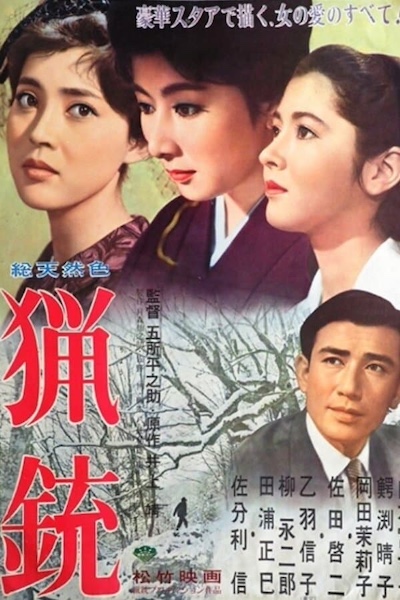
Three young women make a suicide pact, but grow to have a better understanding of themselves. The final collaboration between director Gosho Heinosuke and screenwriter Shiina Rinzo (who had previously made “Where Chimneys Are Seen” together).Read More »
This is the story of Kiyoshi Yoshida, who feels estranged from both parents after his father returns from war. How the boy adapts to life with the virtual stranger his father has become is the film’s focus.A young boy has formed an idealized image of his father, who has yet to be repatriated from Russia. When they finally meet they fail to get along. The boy withdraws more and more into himself, and the picture is concerned with how the two gradually develop a love for each other.Read More »
A rarely seen but important 1965 work by Heinosuke Gosho.
Some remarks by Arthur Nolletti, in his book The Cinema of Gosho Heinosuke: Laughter Through Tears:
Gosho’s most critically acclaimed film of the 1960s… Ranked seventh in Kinema Jumpo’s “Best Ten” poll, it is rightly considered to be one of his most powerful works. Set on the Shimokita Peninsula in the northernmost area of Honshu, the film tells a stark and harrowing tale. Oshima Ayako (Yoshimura Jitsuko), a young woman in her teens, lives in a small, impoverished fishing village. Her father, Matsukichi (Yoshida Yoshio), is too ill to work. As a result, her mother, Kikuno (Sugai Kin), sells her to a nearby brothel. There she quickly is stripped of her innocence and illusions…Read More »
Followed by Shindo: kohen Ryota no maki, available here: The eldest daughter of a noble family is in love with an aviator while being courted by a fellow aristocrat she thinks is a dullard.Read More »
Plot: Heinosuke Gosho evokes in this film the family conflicts engendered by the eternal problem of a father who projects his professional desires on the life of his son. The sister Machiko is the essential link that will allow everyone to apologize to each other and achieve reconciliationRead More »
Synopsis: Mr. Mito (Shuji Sano), a Tokyo businessman, is demoted and sent to Osaka. There, he finds lodging in the titular inn, and makes the acquaintance of many of the town’s citizens. Notable among them are the maids at the inn, a hard-drinking geisha, and a mysterious woman Mito encounters at the mailbox. In Japan, director Gosho’s name is synonymous with melancholy and finding laughter through tears; An Inn at Osaka bears up that reputation. The struggle to stay afloat in life, especially financially, is a running theme of the film, as all of the characters struggle with looming poverty and gnawing loneliness, but it all ends with a kind of quiet triumph.Read More »