Quote:
Jenny and Dale Williams have been married ten years and parents of a
nine-year-old daughter, “Cookie” Williams. They live well, have
separate careers, are surrounded by sophisticated friends, and are
afflicted with overattentive in-laws on each side. Celebrating their
tenth anniversary,this, of course, means it is time to tell each other
they want a divorce from each other. They talk about it. They talk to
their friends about it. The friends and in-laws talk to them and to
each other and to anyone who will listen about it.Read More »
Classics
-
Lewis Allen – The Perfect Marriage (1947)
1941-1950ClassicsComedyLewis AllenScrewball ComedyUSA -
Roberto Rossellini – India: Matri Bhumi [French version] (1959)
1951-1960ClassicsDocumentaryFranceRoberto RosselliniQuote:
India runs counter to all usual cinema: here the image is only the complement of the idea that provokes it. India is a film of absolute logic, more Socratic than Socrates. Each image is beautiful not because it is beautiful in itself, like a shot in [Eisenstein’s] Que viva Mexico!, but because it is the splendor of the true and because Rossellini starts with the truth. There where the others won’t arrive except in twenty years perhaps, he has already gone on from.India embraces world cinema, as the theories of Riemann and Planck embrace geometry and classical physics. In a coming issue [of Cahiers du Cinéma], I shall prove why India is the creation of the world.
Jean-Luc GodardRead More » -
Viktor Tourjansky – La Peur AKA Vertige d’un soir AKA Fear (1936)
1931-1940ClassicsDramaFranceViktor TourjanskyIMDb:
Gaby Morlay is Irène, the wife of a famous and wealthy lawyer (Charles Vanel), who falls briefly for a young and handsome pianist (Georges Rigaud) while on vacations on the French Riviera. When she comes back to her married life in Paris, she falls prey to a blackmailer, the pianist’s jealous former mistress, while her husband’s behavior becomes more and more unpredictable… Charles Vanel is as usually very good as the betrayed and yet not so innocent husband, a part he has played often. Garboesque Gaby Morlay is less convincing (more theatrical) as his wife. I guess there is nothing to expect from this movie but its premise, which is a melodrama in the French pre-war upper bourgeoisie, with a set of good actors of that time (a special mention to Suzy Prim as the “mistress”, charmingly vulgar, a real Parisian bird), leading men in tuxedos and ladies dressed in lamé gowns and furs. Read More »
-
Alfred Hitchcock – I Confess (1953)
USA1951-1960Alfred HitchcockClassicsThriller

Synopsis: Based on the turn-of-the-century play Our Two Consciences by Paul Anthelme, Hitchcock’s I Confess is set in Quebec. Montgomery Clift plays a priest who hears the confession of church sexton O.E. Hasse. “I…killed…a man” whispers Hasse in tight closeup–and, bound by the laws of the Confessional, Clift is unable to turn Hasse over to the police. But police-inspector Karl Malden has a pretty good idea who the guilty party is: all evidence points to Clift. It seems that the dead man had been blackmailing Anne Baxter, who was once in a factually innocent, but seemingly exploitable compromising position with Clift. Tried for murder, Clift is released due to lack of evidence, but he is ruined in the eyes of the community. Then it is Hasse’s turn to make that One Fatal Error. I Confess is frequently dismissed as a lesser Hitchcock, due mainly to the quirky performance of Montgomery Clift (who, it is said, steadfastly refused to take direction). Today, four decades removed from its on-set intrigues, the film has taken its place as one of the best of Hitchcock’s “between the classics” efforts. — Hal EricksonRead More »
-
Luis Trenker – Der verlorene Sohn AKA The Prodigal Son (1934)
1931-1940ClassicsDramaGermanyLuis TrenkerThird Reich CinemaPLOT: “Mountain-film” specialist Luis Trenker plies his trade with his usual expertise in the Austrian Velorene Sohn (Prodigal Son). Trenker himself plays the leading role of Tonia Feuersinger, a Tyrolean mountaineer bound and determined to scale the American Rockies. He also wants to journey to the States to court pretty American tourist Lillian Williams (played by pretty American actress Marian Marsh). Leaving his broken-hearted local girlfriend (Maria Andergast) behind, Tonio treks to New York, but never quite makes it to the Rockies; instead, he gets a welding job on a skyscraper, then achieves success as a prizefighter. In the end, however, he realizes that his heart is still in the Tyrol and thus returns to the arms of his hometown sweetheart. Though aimed at the German-speaking clientele, Verlorene Sohn was financed in Hollywood by Universal Pictures.
-allmovie.comRead More » -
D.W. Griffith – Intolerance: Love’s Struggle Throughout the Ages (2007 Restoration) (1916)
1911-1920ClassicsD.W. GriffithSilentUSAFilmreference review
“Critical judgment remains sharply divided on Intolerance, D. W. Griffith’s most expensive and flamboyant spectacle. Those critics who pronounce the film a failure generally point to the four stories, which, they claim, are thematically too diverse to be effectively collated. Taking their cue from Eisenstein’s famous indictment, they argue that the film suffers from purposeless fragmentation and thematic incoherence. Others, notably Vachel Lindsay, Georges Sadoul, Edward Wagenknecht, and more recently Pauline Kael, list Intolerance among the masterworks, stressing its formal complexity, experimental daring, and thematic richness. René Clair, taking a middle position, writes, “it combines extraordinary lyric passages, realism, and psychological detail, with nonsense, vulgarity, and painful sentimentality.”Read More » -
Howard Hawks – The Big Sleep [Prerelease] (1945)
1931-1940ClassicsFilm NoirHoward HawksUSAThis is the 116 min. version that IMDB calls the director’s cut.
The following describes the main differences between the two versions and why two versions were created:
After the film was completed, it was shelved while Warner Bros. worked to release a backlog of war-related films. It was decided that since the war was drawing to a close, public interest in these films would substantially lessened after its conclusion, whereas The Big Sleep had no such obvious issues of time sensitivity which would require a more immediate release. (A careful eye will spot many indications of The Big Sleep being shot during the war, such as ration stamps and dialogue, and pictures of president Franklin Delano Roosevelt.)Read More » -
Jean Renoir – La nuit du carrefour AKA Night at the Crossroads (1932)
1931-1940ClassicsCrimeFranceJean RenoirPlot (from Allmovie):
La Nuit du Carrefour (A Night at the Crossroads) may well be the least known of Jean Renoir’s sound films. Adapted from a novel by Georges Simenon, the story concentrates on a gang of thieves who utilize a cross-road garage as the hideaway. During their last caper, the gang has accidentally murdered a jewel thief, and the heat is on. Winna Winifred, the beautiful ringleader of the gang, makes the fatal mistake of falling in love with Pierre Renoir (the director’s brother), the detective who’s been assigned to bring her in. The only one of Renoir’s productions to thoroughly qualify as a “crime picture,” La Nuit du Carrefour was often dismissed by the director, who felt that he was so successful in creating a “mysterious atmosphere” that no one understood what was going on (He did, however, enjoy working with Georges Simenon, who became a lifelong friend).-Read More » -
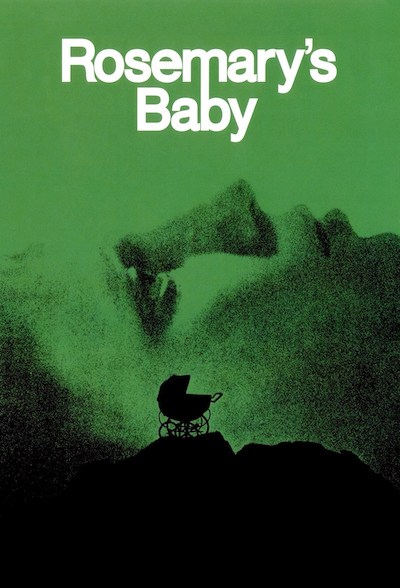
Roman Polanski – Rosemary’s Baby (1968)
1961-1970ClassicsHorrorRoman PolanskiUSAQuote:
A young couple move into an apartment, only to be surrounded by peculiar neighbors and occurrences. When the wife becomes mysteriously pregnant, paranoia over the safety of her unborn child begins to control her life.Read More »