1921-1930

  • John Ford – Men Without Women (1930)

    1921-1930ActionDramaJohn FordUSA

    Synopsis:
    Aboard the U.S. submarine S13 in the China seas, Chief Torpedoman Burke goes about his duties. In actuality, he is Quartermaine, the infamous former commander of the British ship Royal Scot, which was sunk by Germans with a Field Marshal aboard. Quartermaine had told his sweetheart that the Field Marshal would be aboard, not knowing that she was an informant for the enemy. When the S13 sinks, Burke takes charge when the commander, Ensign Price, is unable to command. Burke must keep his mates alive long enough on the bottom of the sea for rescuers to arrive.Read More »

  • Grigori Aleksandrov & Sergei M. Eisenstein – Oktyabr AKA October AKA Ten Days That Shook the World (1928)

    Politics1921-1930Grigori Aleksandrov and Sergei M. EisensteinSergei M. EisensteinSilentUSSR

    Description: Expanding on his editing experiments in Battleship Potemkin (1925), Sergei Eisenstein melded documentary realism with narrative metaphor to depict the pivotal events of the Russian Revolution in October (1927). Commissioned to commemorate the 10th anniversary of the 1917 October Revolution, Eisenstein focused on a few key events from February 1917 to October 1917. Underlining the symbolic importance of those episodes, Eisenstein constructed October as an elaborate “intellectual montage,” deriving meaning from the metaphorical or symbolic relationships between shots. Drawing out narrative time through cutting, Eisenstein turns an opening drawbridge into a sign of the divisive struggle in St. Petersburg. Similarly exaggerating the time that it takes provisional leader Kerensky to climb a palatial staircase, and intercutting shots of Kerensky with a Napoleon statue and a mechanical peacock, Eisenstein satirically reveals Kerensky’s imperial hubris and vanity. Read More »

  • Alfred Zeisler – Der Schuß im Tonfilmatelier AKA The Shot in the Talker Studio (1930)

    1921-1930Alfred ZeislerCrimeGermanyWeimar Republic cinema

    29f7c043f76a2bde437fd0d52a185152

    IMDB:
    During the shooting of a jealousy scene on a soundstage, one actress is murdered. Due to the fact that the male star of the movie had a relation with the victim and the female star is now his fiance, he is suspected by the police. Written by Stephan Eichenberg

    During the production of an early movie using not only pictures but also sound an actress is murdered. The arriving inspectors do not only have to get to know the circumstances of the crime but also the new conditions: how “sound-movies” are made, to solve the crime. Written by katharina_strehl public.uni-hamburg.deRead More »

  • John Ford – The Iron Horse [US Version] (1924)

    1921-1930EpicJohn FordUSAWestern

    allmovie wrote:
    David Brandon (James Gordon) is a surveyor in the Old West who dreams that one day the entire North American continent will be linked by railroads. However, to make this dream a reality, a clear trail must be found through the Rocky Mountains. With his boy Davy (Winston Miller), David sets out to find such a path, but he’s ambushed by a tribe of Indians led by a white savage, Peter Jesson (Cyril Chadwick); while the boy manages to escape, David is killed. Years later, the adult Davy Brandon (George O’Brien) still believes in his father’s dream of a transcontinental railroad, and legislation signed by President Abraham Lincoln has made it an official mandate.Read More »

  • J. Soares – A Filha do Advogado aka The Daughter of the Lawyer (1926)

    1921-1930BrazilDramaJ. SoaresSilent

    Free Image Hosting at www.ImageShack.us

    29f7c043f76a2bde437fd0d52a185152

    “In Recife, Dr. Paulo is an important lawyer that has a daughter, Heloísa, with his paramour and living in the country. A few days before traveling to Europe, Dr. Paulo asks to a close friend to bring Heloísa to Recife. Meanwhile, his bohemian and irresponsible son Helvécio meets Heloísa, and without knowing that she is his sister, he tries to rape her, and she kills him. Heloísa is arrested and goes to trial without any evidence to prove that she self-defended her honor” Written by Claudio Carvalho, Rio de Janeiro, Brazil ( IMDB)
    Read More »

  • Various – Avant-Garde: Experimental Cinema of the 1920s & 1930s [Disc 2] (2005)

    1921-1930ArthouseExperimentalFranceVarious

    Quote:
    The 24 avant garde shorts of the 1920s and ’30s chosen for this Kino set from the collection of curator Raymond Rohauer span the gamut of movements and styles—dada, surrealism, city symphony, environmental terrarium, direct exposure. The diversity already makes the proposition of plowing through the pair of discs from start to finish not only daunting but perhaps ill-advised. Especially when lurking among the unassailable landmarks of silent avant garde cinema like Joris Ivens’s Regen (an evocative socio-environmental replication of the civic reaction to a rainy downpour on city streets) and Fernand Léger’s Ballet Méchanique (a rhythmic Parisian melange that’s kaleidoscopic in both its prismatic cinematography and its undulating circles of repetition) are at least two (possibly three) works that aim to take the piss out of the concept of non-narrative art cinema. The Hearts of Age, Orson Welles’s fraternal collaboration with William Vance (made when Welles was a mere 19 years of age), is a backyard farce that Welles later admitted to Peter Bogdanovich was made in benign mockery of the Buñuel/Dali collaborations that were inescapable in the day, though it scarcely owes any tangible debt to the style of Un Chien Andalou.Read More »

  • Various – Avant-Garde: Experimental Cinema of the 1920s & 1930s [Disc 1] (2005)

    Arthouse1921-1930ExperimentalFranceVarious

    Quote:
    The 24 avant garde shorts of the 1920s and ’30s chosen for this Kino set from the collection of curator Raymond Rohauer span the gamut of movements and styles—dada, surrealism, city symphony, environmental terrarium, direct exposure. The diversity already makes the proposition of plowing through the pair of discs from start to finish not only daunting but perhaps ill-advised. Especially when lurking among the unassailable landmarks of silent avant garde cinema like Joris Ivens’s Regen (an evocative socio-environmental replication of the civic reaction to a rainy downpour on city streets) and Fernand Léger’s Ballet Méchanique (a rhythmic Parisian melange that’s kaleidoscopic in both its prismatic cinematography and its undulating circles of repetition) are at least two (possibly three) works that aim to take the piss out of the concept of non-narrative art cinema. The Hearts of Age, Orson Welles’s fraternal collaboration with William Vance (made when Welles was a mere 19 years of age), is a backyard farce that Welles later admitted to Peter Bogdanovich was made in benign mockery of the Buñuel/Dali collaborations that were inescapable in the day, though it scarcely owes any tangible debt to the style of Un Chien Andalou.Read More »

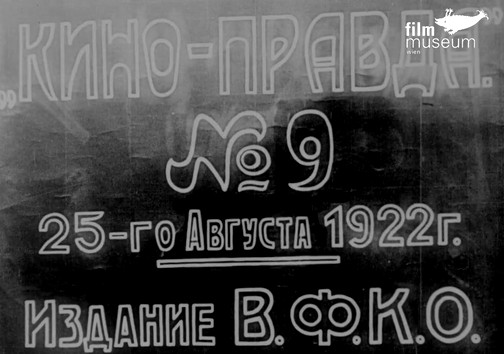
  • Dziga Vertov – Kino-Pravda No. 9 (1922)

    1921-1930DocumentaryDziga VertovSilentUSSR

    29f7c043f76a2bde437fd0d52a185152

    Quote:
    Between 1922 and 1925, a total of 23 issues of Dziga Vertov’s newsreel series Kino-Pravda (Kino-Truth) appeared (albeit irregularly and in very few copies). Vertov’s goal was to create a kind of “screen newspaper”; the title is a tribute to the newspaper Pravda founded by Lenin. Just like the Kinonedelja newsreel series (1918–19), the Kino-Pravda issues offer a fascinating insight into the early Soviet Union and demonstrate the rapid development of Vertov’s film language.

    The 22 surviving issues (No. 12 is lost) have been digitized and subtitled in German and English by the Austrian Film Museum in 2017/18 and are now available online.Read More »

  • Dziga Vertov – Kino-Pravda No. 8 (1922)

    1921-1930DocumentaryDziga VertovSilentUSSR

    29f7c043f76a2bde437fd0d52a185152

    Quote:
    Between 1922 and 1925, a total of 23 issues of Dziga Vertov’s newsreel series Kino-Pravda (Kino-Truth) appeared (albeit irregularly and in very few copies). Vertov’s goal was to create a kind of “screen newspaper”; the title is a tribute to the newspaper Pravda founded by Lenin. Just like the Kinonedelja newsreel series (1918–19), the Kino-Pravda issues offer a fascinating insight into the early Soviet Union and demonstrate the rapid development of Vertov’s film language.

    The 22 surviving issues (No. 12 is lost) have been digitized and subtitled in German and English by the Austrian Film Museum in 2017/18 and are now available online.Read More »

Back to top button