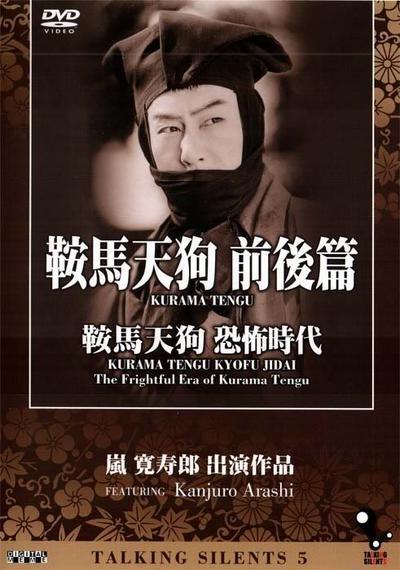

It is 1862 and many young rebellious samurai oppose the Tokugawa Shogunate, strongest among them is Kurama Tengu with his friends Kichibei and Sugisaku, but facing them is the powerful Isamo Kondo and the Shinsengumi.Read More »
It is 1862 and many young rebellious samurai oppose the Tokugawa Shogunate, strongest among them is Kurama Tengu with his friends Kichibei and Sugisaku, but facing them is the powerful Isamo Kondo and the Shinsengumi.Read More »

From Channel 4 Film:
Early British Hitchcock which has the future master of suspense trying to make a living with this faithful adaptation of O’Casey’s classic play, chronicling the ups and downs of an Irish family in the Dublin of the 1920s. Most of it is a straight filming of the play – and was acknowledged as such by Hitchcock – even though handsomely photographed and acted. When the action opens up towards the end, Hitch gets a chance to flex his cinematic muscle with a predictably dramatic ending.Read More »

Art Cinema Corporation production; distributed by United Artists Corporation. / Produced by Joseph M. Schenck. Screenplay by Sam Taylor, with dialogue by George Scarborough, from the short story “La Paiva” by Karl Gustav Vollmoeller. Set design by William Cameron Menzies. Costume design by Alice O’Neill. Theme song “Where Is the Song of Songs for Me?” by Irving Berlin. Cinematography by Karl Struss. Assistant cameraman, G.W. Bitzer. Intertitles by Gerrit Lloyd. Edited by James Smith. Music arrangement by Hugo Riesenfeld. Read More »

A nobleman, posing as a necktie salesman, falls in love with the daughter of a circus puppeteer, even though he is already married to the daughter of his country’s war minister.Read More »
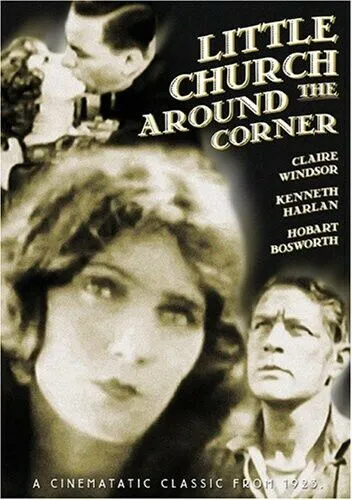
The Little Church Around the Corner is important as the first major financial success for the fledgling Warner Bros. studios. Kenneth Harlan plays a mining-town clergyman who falls in love with his benefactor’s daughter. He is about to settle into a life of cozy complacency when a group of miners come to his doorstep, asking that the minister plead to the owners for better living conditions. To prove himself to be “one” with the miners, Harlan moves into their shanty community. This causes a rift with his sweetheart’s father, who happens to be one of the owners. A cave-in, an angry mob and a supposed miracle are part and parcel of this 1923 adaptation of the war-horse Marion Russell play, which is directed with a sure, subtle hand by William A. Seiter. ~ Hal EricksonRead More »
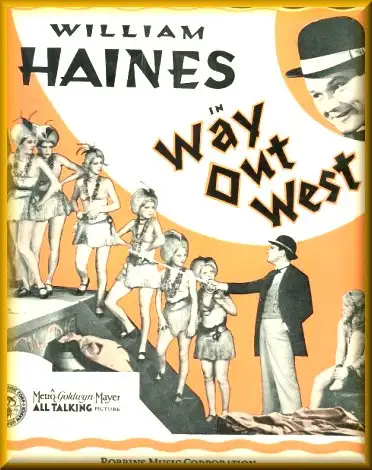
Plot/Synopsis: from ROVI
A pleasant enough western parody starring one of the victims of sound, William Haines, Way Out West is the story of a carnival huckster forced to work on a western ranch in order to repay a couple of cowboys he once fleeced. There’s a sandstorm, a fist-fight with the ubiquitous crooked foreman (Charles Middleton), a pretty female ranch owner (Leila Hyams), and sundry other western clichés thrown in to prove the star’s manly qualities.The light-weight Haines played many such roles, but reshuffling due to sound (not to mention a quarrel with MGM studio head, Louis B. Mayer), ended his career. Haines later became a fashionable interior decorator. ~ Hans J. Wollstein, RoviRead More »

Quote:
The movie begins with the discovery of a yoghi who, after being brought back to life by a maharajah, promises to do anything his saviour’s heart desires. Bizarrely, what the nobleman wants is for the yoghi to transport himself to the west and bring back an architect capable of building a magnificent mausoleum for his princess.Read More »

The jealous & vindictive Rajah of Bengal continues to manipulate the fates of his three English captives in his mad scheme to punish his faithless wife.
THE Indian TOMB: THE TIGER OF BENGAL is a perfect example of the grand German cinema epics created during the silent era. Berlin film mogul Joe May turned the full resources of his modern 50-acre Maytown studio near Berlin over to the production, using 300 workmen to create the lavish sets necessary to tell such an exotic tale.Read More »

IMDb user comments:
75 years after the release of EROTIKON, I had a chance to see it in a modern cinema in Wroclaw (Poland). The wonderful experience was intensified by the live background music played by the members of Prague Archa theater. It was a lovely return to the end of silent era, the year 1929. The film EROTIKON, made by Gustav Machaty, caused controversy among the audiences of that time. What particularly shocked them was the way the director showed love scenes. Some admired it, some condemned it and, as a result, it was underrated and lost for years. Fortunately, the copy was found in the 1980s and restored for today’s audience who can admire the genius of Machaty.Read More »