1921-1930

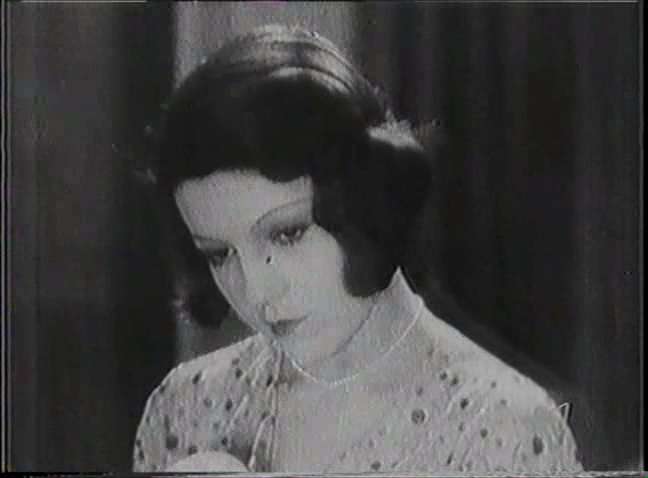
  • Yuri Zhelyabuzhsky – Papirosnitsa ot Mosselproma aka The cigarette girl of Mosselprom [+Extras] (1924)

    Comedy1921-1930SilentUSSRYuri Zhelyabuzhsky

    29f7c043f76a2bde437fd0d52a185152

    Review
    Though many casual film fans are of the opinion that the Russian silent cinema began and ended with Montage and Propaganda, several charming romantic comedies and dramas emanated from the Soviet film industry of the 1920s. The Cigarette Girl of Mosselprom tells the tale of a young man who falls in love with the title character (Yulia Solnsteva). She becomes a famous film star, and herself falls in love–not with the hero, but with her cameraman. No one ever gets what he or she truly wants in the story, though they continue to pursue their lost dreams to the bitter end. Revelling in The Unexpected throughout, Cigarette Girl of Mosselprom is capped by an adroit surprise ending. (Hal Erickson, All Movie Guide)
    Read More »

  • Oskar Fischinger – Oskar Fischinger: Ten Films (1926-1947)

    USA1921-19301931-19401941-1950AnimationExperimentalOskar Fischinger

    Spirals (1926)
    Study no. 6 (1930)
    Study no. 7 (1931)
    Kreise (1933)
    Allegretto (1936-43)
    Radio Dynamics (1942)
    Motion Painting No. 1 (1947)

    and 3 Early Films:

    Wax Experiments (1921-26)
    Spiritual Constructions (1927)
    Walking from Munich to Berlin (1927)

    Special Features
    * Never-released early experiments, animation drawings and tests
    * Home movies of Oskar, Elfriede and Hans Fischinger in the Berlin Studio, c. 1931
    * Biographical Photographs
    * A Selection of Paintings by Fischinger
    * Film notes by Fischinger and others
    * Biography
    * Preserved films, high definition digital transfers and digitally remastered audio

    Decades before computer graphics, before music videos, even before “Fantasia” (the 1940 version), there were the abstract animated films of Oskar Fischinger (1900-1967), master of “absolute” or nonobjective filmmaking. He was cinema’s Kandinsky, an animator who, beginning in the 1920’s in Germany, created exquisite “visual music” using geometric patterns and shapes choreographed tightly to classical music and jazz. (John Canemaker, New York Times)Read More »

  • John Ford – Cameo Kirby (1923)

    1921-1930ClassicsJohn FordSilentUSA

    29f7c043f76a2bde437fd0d52a185152

    The director formerly known as Sean O’Feeney is billed as John Ford for the first time here, and he helps make this one of John Gilbert’s best pre-MGM features. Cameo Kirby (John Gilbert), once a man of high social standing, has become a professional gambler and works the Mississippi riverboats of the 1800’s. An old man (William E. Lawrence) is being cheated in a crooked card game, and Kirby gets involved in the play, with the intention of giving the man his money back. Unaware of Kirby’s plans, the old man commits suicide. It turns out that Kirby’s sweetheart (Gertrude Olmstead) is the man’s daughter. But in spite of the tragedy, she comes to understand Kirby’s altruistic motives. Based on a story by Booth Tarkington, the melodrama is offset by solid performances and an exciting paddle-wheeler river race (a bit of action that one would expect from John Ford). An 18-year-old Jean Arthur made her movie debut in this film as a bit player. ~ Janiss Garza, All Movie Guide
    Jean Arthur – Ann Playdell; Engenie Ford – Mme. Dauezac; Alan Hale – Colonel Moreau; William E. Lawrence – Colonel Randall; Jack McDonald – Larkin Bruce; Gertrude Olmstead – Adele Randall; Phillips Smalley – Judge Playdell; Richard Tucker – Cousin AaronRead More »

  • Victor Sjöström – A Lady to Love (1930)

    1921-1930ClassicsDramaUSAVictor Sjöström

    29f7c043f76a2bde437fd0d52a185152

    Beautiful, 24 October 2003
    Author: Bruce Karam (Bruce.Karam) from Tucson, Arizona 85710 USA
    A beautiful story of love, that reminded me of Greta Garbo’s “Anna Christie”. I loved Vilma Bankee’s voice and accent. I felt that the film was charming in it’s “innocence” and simplicity, while dealing with a very complex issue. I hope that I may someday see it again.Read More »

  • Mario Camerini – Rotaie aka Rails (1929)

    1921-1930DramaItalian Cinema under FascismItalyMario CameriniSilent

    http://img444.imageshack.us/img444/8472/vlcsnap4056820.png

    29f7c043f76a2bde437fd0d52a185152

    A young honeymooning couple are lured away to a seaside resort by a high-society sleazeball, who has plans to seduce the girl, while at the same time her hubby in desperation stakes all his money on the roulette wheels.Read More »

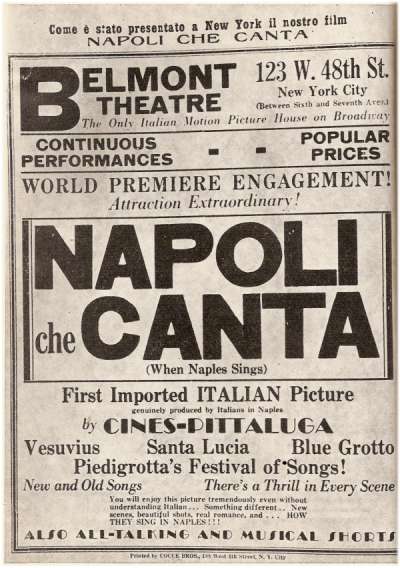
  • Roberto Roberti – Napoli che canta AKA When Naples sings (1926)

    1921-1930DocumentaryItalian Cinema under FascismItalyRoberto RobertiSilent

    http://img38.imageshack.us/img38/9932/naple.png

    29f7c043f76a2bde437fd0d52a185152

    From il cinema muto italiano 1923-1931:
    Si tratta di una antologia di canzoni napoletane, interprete dai maggiori cantanti dell’epoca, i quali seguirono alcune prime visioni, cantando direttamente sotto lo schermo.

    Translation:
    This is an anthology of Neapolitan songs, singers from the major interpreter of the time, which followed some premieres, singing directly below the screen.Read More »

  • Eduard Tisse – Frauennot – Frauenglück AKA Misery and Fortune of Women [Excerpt] (1929)

    1921-1930DramaEduard TisseSergei M. EisensteinShort FilmSwitzerland

    Free Image Hosting at www.ImageShack.us

    29f7c043f76a2bde437fd0d52a185152

    Description:
    This short film shows the contrast between the good conditions in which a rich woman makes a abortion and the miserable and dangerous condition in which a poor woman has to do an abortion.Read More »

  • Vsevolod Pudovkin – Konets Sankt-Peterburga AKA The End of St. Petersburg (1927)

    1921-1930DramaSilentUSSRVsevolod Pudovkin

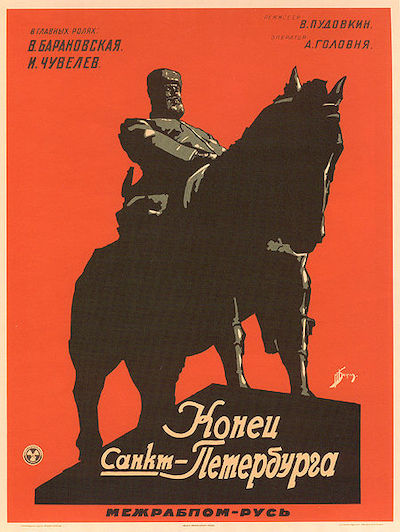
    Filmed to commemorate the tenth anniversary of the 1917 Russian revolution, End of St. Petersburg was the second feature-length effort of director V. I. Pudovkin. Utilizing many of the montage techniques popularized by his contemporary Sergei Eisenstein, Pudovkin details the fall of St. Petersburg into the hands of the Bolsheviks during the revolution. Unlike Eisenstein, Pudovkin concentrates on individuals rather than groups (his protagonist is a politically awakened peasant played by Ivan Chuvelyov) humanizing what might otherwise have been a prosaic historical piece. The mob scenes, though obviously staged for ultimate dramatic impact, are so persuasive that they have frequently been excerpted for documentaries about the Russian Revolution, and accepted by some impressionable viewers as the real thing. Filmed just after his 1926 masterwork Mother, The End of St. Petersburg was followed by the equally brilliant Storm Over Asia.
    — allmovie.comRead More »

  • Leo McCarey – Mama Behave (1926)

    1921-1930ComedyLeo McCareySilentUSA

    http://img692.imageshack.us/img692/1594/vlcsnap2012032211h04m40.png

    29f7c043f76a2bde437fd0d52a185152

    Funny, Entertaining. Charley Chase is great!, 4 April 2005
    Author: chris-glo from So.CA
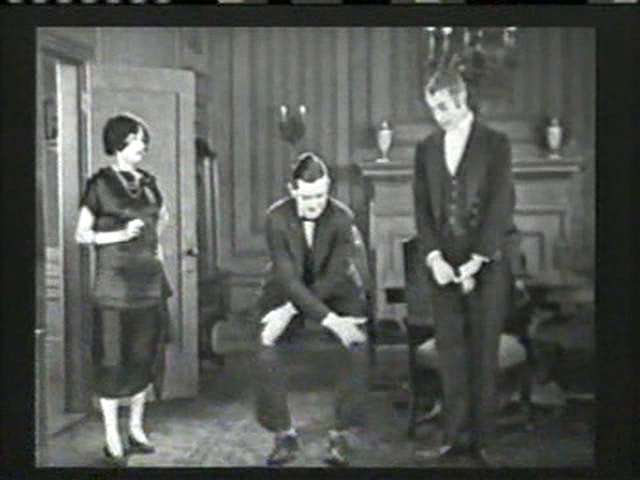
    I happened to catch this on TCM one day – what a scream! A very entertaining short. Charley Chase was very talented! My husband and I try to watch the “silents” whenever we can but have mostly watched dramas with the bigger stars such as Valentino, Garbo, Chaney, etc. It is really a shame that the younger people today do not take the time to watch and appreciate the ones really responsible for the success of the movie industry. Back then, without sound to convey feelings with the spoken word, it took, I think, a great more amount of talent as an actor or actress to get the point across in mime. Facial expression and body movements were the only way this could be achieved. Just for fun, watch a new movie with the sound off. I think you would be surprised to find that you cannot follow it very well. Anyway, if you get the chance, check out silent movies. They are better than you think. And Charley Chase? I will be looking for more of his movies.Read More »

Back to top button