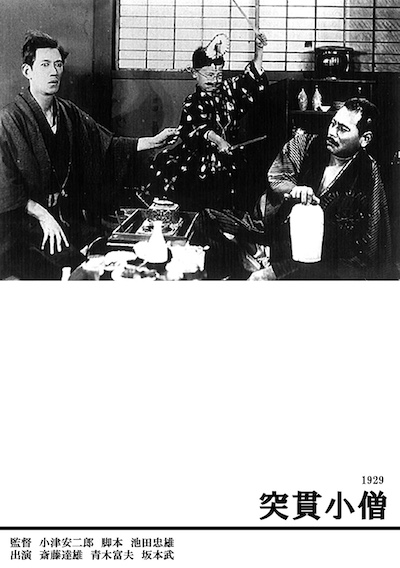
Tatsuo Saitô

  • Yasujirô Ozu – Tokkan kozô AKA A Straightforward Boy (1929)

    Yasujiro Ozu1921-1930ComedyJapanSilent
    Tokkan kozô (1929)
    Tokkan kozô (1929)

    Quote:
    One of the earliest surviving silent comedies by master filmmaker Yasujiro Ozu, A Straightforward Boy is a rambunctious, adorable kidnapping caper now screening in a new restoration that restores to it eight long-lost and recently rediscovered minutes. The short features one of the all-time great child actors, Tomio Aoki, at age six and in his first starring role as the titular boy all too happy to be abducted – so long as his petty-crook captors (Tatsuo Saitô and Takeshi Sakamoto) are willing to endure his company. Aoki’s extraordinary career would go on to include over 300 films, from Ozu’s 1932 I Was Born, But… to Seijun Suzuki’s 2001 Pistol Opera.Read More »

  • Heinosuke Gosho – Hanayome no negoto AKA The Bride Talks in Her Sleep (1933)

    1931-1940AsianComedyHeinosuke GoshoJapan

    Five friends make a pact to stick together through school, agreeing to graduate at the same time and to marry at the same time…Read More »

  • Yasujirô Ozu – Shukujo wa nani o wasureta ka AKA What Did the Lady Forget? (1937)

    1931-1940ClassicsComedyJapanYasujiro Ozu

    Synopsis:
    An affluent medical professor, Komiya, and his bossy wife, Tokio, are to look after Setsuko, their high-spirited niece from Osaka. Setsuko is a liberated woman who does what she wants, including smoking, even though she is a minor. On Saturday, the professor does not feel like going to his weekend golf game, but his wife packs him off anyway. So he leaves his bag at the apartment of his student Okada, and goes to a bar with a friend. Setsuko traces him there, and insists that he take her to a geisha house. When she gets rather tipsy, the professor calls Okada to take her home, while he sleeps at Okada’s. The wife becomes suspicious of Setsuko when she sees Okada bringing her home, and also of her husband when she discovers that he did not go golfing.Read More »

  • Heinosuke Gosho – Jinsei no onimotsu aka Burden of Life (1935)

    1931-1940AsianDramaHeinosuke GoshoJapan

    Quote:
    “Rooted in “salaryman” comedy and family drama, Burden of Life represents a marked advance over Gosho’s previous three shomin comedies. It placed sixth in the 1935 Kinema Jumpo polling, and has been praised by Burch for its seriousness and slice-of-life quality. Concurring with this judgment, John Gillett finds the film “imbued with a naturalistic tone and ‘lived in’ visual texture quite beyond American and European cinema.” David Owens is similarly enthusiastic, adding, “As is typical of the best Japanese directors, Gosho concentrates on developing characters rather than plot. Each of the family members is carefully drawn and each grows before us as an individual, surpassing the sort of character typing that was usual for family melodramas.” These comments effectively sum up the film’s most notable achievement.”Read More »

  • Yasujirô Ozu – Rakudai wa shitakeredo aka I flunked but… (1930)

    1921-1930ComedyJapanYasujiro Ozu

    Yasujirô Ozu wrote:
    One could say this is the flip side of I Graduated, But… The student-protagonist scribbles his crib notes on his shirt sleeve, but the day of his graduation exam, the girl at his boarding house unwittingly takes the shirt to the launderette So naturally, he flunks. However, those who pass and graduate in high spirits cannot land any job, while the ones who flunked can continue to bum around living off their parent’s money. It’s a vignette. Although Ryu Chishu has appeared in my previous films, it was the first time I let him have a go at a more significant role.Read More »

  • Yasujiro Ozu – Otona No Miru Ehon – Umarete Wa Mita Keredo AKA I Was Born, But… (1932)

    1931-1940ComedyJapanSilentYasujiro Ozu

    Otona no miru ehon – Umarete wa mita keredo / 大人の見る繪本 生れてはみたけれど

    PLOT: Two young brothers become the leaders of a gang of kids in their neighborhood. Ozu’s charming film is a social satire that draws from the antics of childhood as well as the tragedy of maturity.Read More »

Back to top button