

Made in Milan is a 1990 short documentary film about fashion designer Giorgio Armani preparing for a show and discusses his ideas about fashion, his family history and the city of Milan it was directed by Martin Scorsese.Read More »
Made in Milan is a 1990 short documentary film about fashion designer Giorgio Armani preparing for a show and discusses his ideas about fashion, his family history and the city of Milan it was directed by Martin Scorsese.Read More »

In 1979, while making his epochal Holocaust film, “Shoah,” Claude Lanzmann filmed this interview with Maurice Rossel, a Red Cross doctor from Switzerland who, having visited Auschwitz and Theresienstadt in 1944, gave the latter a highly favorable report. Lanzmann questions Rossel insistently about the deceptions that the Germans forced the Jewish inmates of Theresienstadt to perpetrate for Rossel’s benefit—which fooled the doctor completely. Lanzmann culminates his interview by reading a speech with which the Jewish “mayor” of the concentration camp had welcomed Rossel, which, though vague enough to pass unnoticed by the German captors, resounds unambiguously as a thinly veiled cry for help—and an exhortation to Rossel to not be deceived by appearances. Rossel is easy to despise and easier to mock, but the cold light of his detachment serves as a reminder of the tyrannical deceits that, even now, conceal atrocities. Released in 1997.Read More »

In 1930s Poland, it was traditional for some Christian boys to live for a time with Jewish families in order to learn a trade from Jewish craftsmen. For this reason, Ivan has gone to live on a large estate with Abraham and his family, has learned Yiddish, and has become Abraham’s best friend. But the anti-Semitism born of poverty, ignorance, and superstition is fierce in this community of and the two boys run away into the countryside to flee an imminent conflict. Journeying together in a menacing environment, they reveal their innocence and inseparability.Read More »
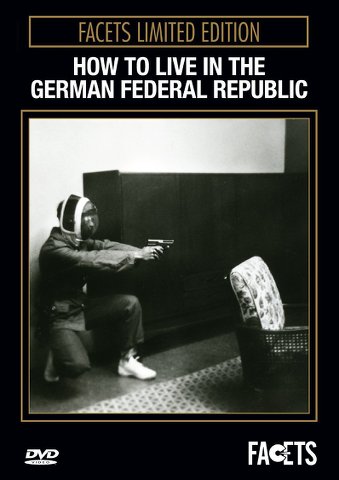
Sterile practice
7 August 2010 | by oOgiandujaOo (United Kingdom)
My only previous experience of Farocki prior to watching Leben – BRD (How to live in the FRG) was Die Bewerbung (The Interview). The subject of that documentary film was the preparing of people who had difficulty finding work for job interviews. The movie highlighted how unnatural it was to be in a situation where you had to sell yourself (the training provides promotion of an unnatural self-awareness), where you have to project a compliant image for the Procrustean corporate scrutiniser. Leben – BRD expands on this limited scenario to provide a number of training scenarios. This includes training people to kill, provide obstetric care, separate those involved in domestic arguments etc. All this is interspersed with factory images of equipment being tested for longevity (for example a car door being opened and closed a thousand times by machine). It all comes off as quite banal and sterile programming. There is no room for personality, there is no room for personal connection. I’ve heard how feeling is something that has been outsourced to professionals (psychiatrists), here the psychiatrists are just as impersonal, running a child through a quick-march battery of standardised tests, getting a patient to draw a time series graph of the progression of their phobia, incapable of providing what the patient needs, a shoulder to cry on, someone to hug and understand.Read More »
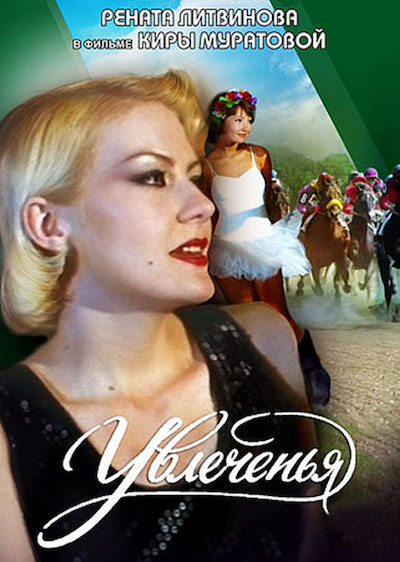
Passions is a 1994 romantic comedy by Russian-Ukrainian director Kira Muratova based on the novellas of Boris Dedyukhin.
Blonde Lilia and brunette Violetta are fascinated by horse racing, and the young racers are more than a little attracted to them, too. However, the worlds of sporting and romance don’t always coexist peacefully as the two girls learn the hard way through a series of touching, surreal, and sometimes heartbreaking encounters. One of the most beautifully photographed Russian films in recent years, this acclaimed modern classic was hailed at numerous film festivals including the Berlin Film Festival and Russia’s Kinotavr Festival, where it won the Jury and Critics Prizes.Read More »

Description: The short is made in a typical Muratova style that merges surrealism and reality into a mesmerizing act full of understatement and metaphor.
Some trivia: this is nominally Muratova’s first short. However, she herself considers it her fourth – she prefers to think of her Three Stories as three short films instead of a single feature.
The film was made with no budget whatsoever – all Muratova was given were the camera and the film stock. None of the actors were paid. The rumor has it that the film was shot in Muratova’s own apartment.Read More »

In 1992, Wenders possibly bewildered a good portion of his fans by making a 30 minute short for children, titled Arisha, the Bear and the Stone Ring. It’s a fable about the Bear leaving Berlin (it’s the city’s emblem), featuring Wim Wenders dressed as Santa Claus…
SYNOPSIS
The story description posted on Wenders’ website reads as follows:
The bear leaves Berlin. He’s fed up. On the way, two Russian ladies – Anna and her daughter, Arisha – hire him as their driver. During the trip, a Santa Claus who cannot stand Christmas, and then a Vietnamese family, join the group whose destination is a spot by the sea. There, on the beach, lies a stone ring, which wants to be found.
Read More »

A former inspector on his last day with the department is called in to investigate a child murder. A suspect soon confesses to the crime, but knowing that the confession came only after the man was browbeaten in a relentless, 20-hour interrogation, the inspector’s keen police instincts tell him that the man is not the real murderer and that there is a serial killer at work, with the girl’s murder being related to other child murders that occurred in the area. However, he is alone in his assessment and the police close the case.Read More »

Quote:
Conceived as the ultimate road movie, this decades-in-the-making science-fiction epic from Wim Wenders follows the restless Claire Tourneur (Solveig Dommartin) across continents as she pursues a mysterious stranger (William Hurt) in possession of a device that can make the blind see and bring dream images to waking life. With an eclectic soundtrack that gathers a host of the director’s favorite musicians, along with gorgeous cinematography by Robby Müller, this breathless adventure in the shadow of Armageddon takes its heroes to the ends of the earth and into the oneiric depths of their own souls. Presented here in its triumphant 287-minute director’s cut, Until the End of the World assumes its rightful place as Wenders’ magnum opus, a cosmic ode to the pleasures and perils of the image and a prescient meditation on cinema’s digital future.Read More »