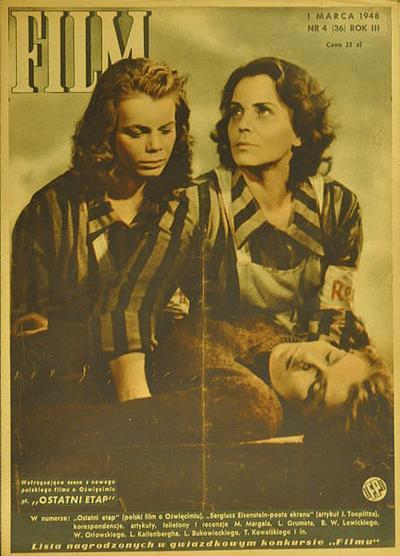
Martha Weiss, a Jew, is sent to Auschwitz concentration camp with her family. On the first day of their arrival Martha is, by a coincidence, chosen as an interpreter, but her entire family is killed. Waiting for the Red Army to deliver them from the prison camp, the film depicts Martha and her friends’ struggling life under the tyranny of camp guards and equally bad ‘capos’, administrative personnel chosen from among the prisoners.Read More »
1940s
-
Wanda Jakubowska – Ostatni etap AKA The Last Stage (1948)
1941-1950DramaPolandThe Female GazeWanda JakubowskaWar -
Leslie Arliss – A Man About the House (1947)
1941-1950DramaLeslie ArlissUnited KingdomStoryline
Agnes and Ellen Isit, two poor English sisters, unexpectedly inherit from their uncle a rich estate near Naples, complete with big villa and manly Italian majordomo. The latter, Salvatore, makes use of his Latin charm to seduce Agnes, who soon turns from prim spinster to passionate lover. Ellen observes the romance with amusement first before realizing how little considerate Salvatore becomes after marrying Agnes. Worse, Agnes’s health starts deteriorating. Worried about her sister, she contacts Dr. Ben Dench, a family friend…Read More » -
Charles Vidor – A Song to Remember (1945)
Drama1941-1950Charles VidorMusicalUSAQuote:
A Song to Remember is a 1945 Columbia Pictures biographical film which tells a ficitonalised life story of pianist and composer Frédéric Chopin.
The film starred Paul Muni, Merle Oberon, Cornel Wilde, Stephen Bekassy and Nina Foch.Quote:
Review from IMDb:
“A Song to Remember” is supposed to be the life of Chopin but in fact, very little in it is historically accurate. It’s still a beautiful, emotional, and sumptuous movie, filled with the heavenly music of Chopin played by Jose Iturbi.
“A Song to Remember” helped to popularize Chopin’s romantic, passionate music and launched Cornel Wilde’s star into the heavens. Though he’s never done much for me personally, he cuts a dashing figure as Chopin.Read More » -
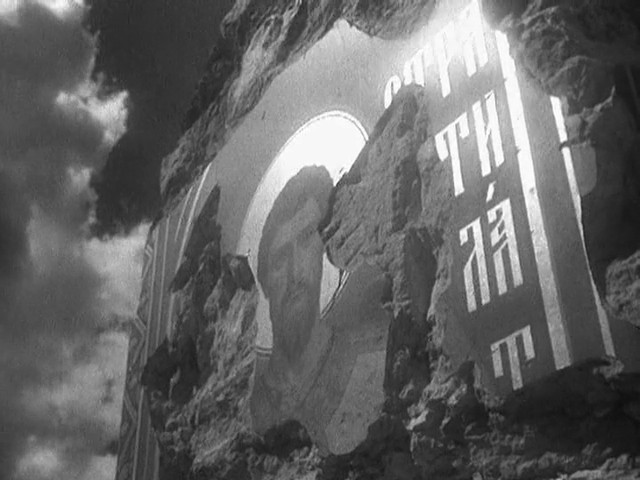
Aleksandr Dovzhenko & Yuliya Solntseva – Pobeda na Pravoberezhnoi Ukraine i izgnaniye nemetsikh zakhvatchikov za predeli Ukrainskikh sovietskikh zemel AKA Victory in Soviet Ukraine (1945)
Documentary1941-1950Aleksandr DovzhenkoUSSRWarYuliya SolntsevaYuliya Solntseva and Aleksandr DovzhenkoDescribes the Russian attack against the Germans, which drove them away from the Dneiper river, and finally out of Ukraine.Read More »
-
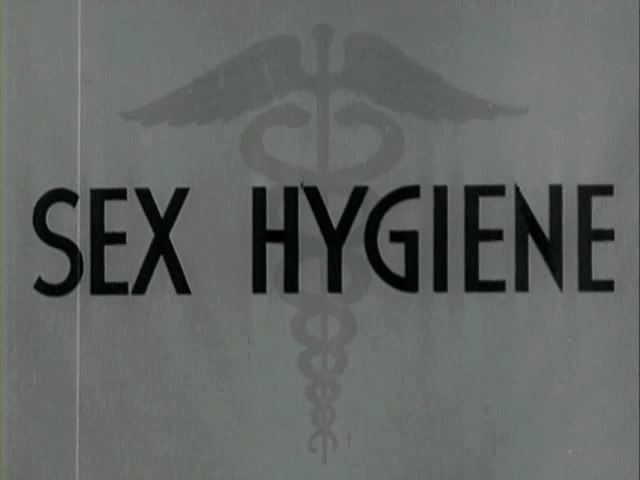
John Ford & Otto Brower – Sex Hygiene (1941)
1941-1950DocumentaryJohn FordOtto BrowerUSASearching for John Ford by Joseph McBride wrote:
Shot quickly at Fox and ready for use by March 1941, the black and white Sex Hygiene is suitably horrifying but also somewhat tongue in cheek. Coing directly from making Tobacco Road, Ford was in a bawdy mood when he filmed the scenes of the soldiers (including George Reeves, later known as TV’s Superman) playing pool in an army canteen before one young man makes the mistake of slipping off to a brothel. The results of his and others’ sexual follies are displayed in a graphic illustrated lecture by a medical officer intoned in stentorian fashion by Charles Trowbridge, who later was promoted by Ford to admiral and/or general in They Were Expendable, When Willie Comes Marching Home and The Wings of Eagles. Perhaps it is fitting that the one Ford film dealing explicitly with sexual themes makes the subject seem so thoroughly revolting.Read More » -
Mary Ellen Bute & Ted Nemeth – Tarantella (1940)
1931-1940ExperimentalMary Ellen Bute and Ted NemethShort FilmUSAQuote:
This new medium of expression is the Absolute Film. Here the artist creates a world of color, form, movement and sound in which the elements are in a state of controllable flux, the two materials (visual and aural) being subject to any conceivable interrelation and modification. – Mary Ellen ButeRead More » -
Alfred Hitchcock – Under Capricorn (1949)
Drama1941-1950Alfred HitchcockThrillerUSA

Quote:
Although John Colton’s and Margaret Linden’s onscreen credit reads “by”, they had actually written an unproduced and unpublished play based on Helen Simpson’s novel. The novel was adapted for the screen by Hume Cronyn and was the basis for the screenplay. In this film, Alfred Hitchcock continued to experiment with long takes, a technique that he began in Rope, which was also adapted by Cronyn. Ingrid Bergman’s monologue, during which she relates the story of her marriage to “Flusky,” the subsequent shooting of her brother and their experiences in Australia, lasts nine and one-half minutes and was shot in one take.Read More » -
Nicholas Ray – They Live by Night (1948)
1941-1950Film NoirNicholas RayUSAJohn Greco wrote:
Three men escape from prison, two seasoned bank robbers T-Dub (Jay C. Flippen) and Chickamaw (Howard Da Silva) along with young Bowie (Farley Granger) who was innocently convicted of murder. The three men rob a bank. When Bowie is injured he is brought to Chickamaw’s brother’s place where he meets Keechie (Cathy O’Donnell), Chickamaw’s tomboyish niece. After another bank job, the young lovers take off to get away from Bowie’s two thug partners and a life of crime. Unlike Bowie, his two cohorts quickly blow their share of the money and want Bowie for another bank job which goes bad resulting in T-Dub’s death. Bowie and Keechie are again running only this time instead of running to a new life they are running from the law and straight toward a tragic end.Read More » -
Marcel Carné – Les visiteurs du soir AKA The Devil’s Envoys (1942)
1941-1950ClassicsFantasyFranceMarcel Carné

Quote:
A work of poetry and dark humor, Les visiteurs du soir is a lyrical medieval fantasy from the great French director Marcel Carné. Two strangers dressed as minstrels (Arletty and Alain Cuny) arrive at a castle in advance of court festivities—and are revealed to be emissaries of the devil, dispatched to spread heartbreak and suffering. Their plans, however, are thwarted by an unexpected intrusion: human love. Often interpreted as an allegory for the Nazi occupation of France, during which it was made, Les visiteurs du soir—wittily written by Jacques Prévert and Pierre Laroche, and elegantly designed by Alexandre Trauner and shot by Roger Hubert—is a moving tale of love conquering all.Read More »