1920s

  • John S. Robertson – Dr. Jekyll and Mr. Hyde (1920)

    John S. Robertson1911-1920HorrorSilentUSA
    Dr. Jekyll and Mr. Hyde (1920)
    Dr. Jekyll and Mr. Hyde (1920)

    Considered by many to be the first great American horror film, John S. Robertson’s DR. JEKYLL AND MR. HYDE allowed stage legend John Barrymore to deliver his first virtuoso performance on film. Blending historic charm with grim naturalism, this version of DR. JEKYLL AND MR. HYDE is one of the more faithful of the many screen adaptations of Stevenson’s story (though greatly influenced by T.R. Sullivan’s popular stage treatment), recounting a visionary scientist’s ill-fated attempts to unleash the human mysteries that dwell beneath the shell of the civilized self.Read More »

  • Louis Feuillade – Parisette (1921)

    Louis Feuillade1921-1930FranceSilent
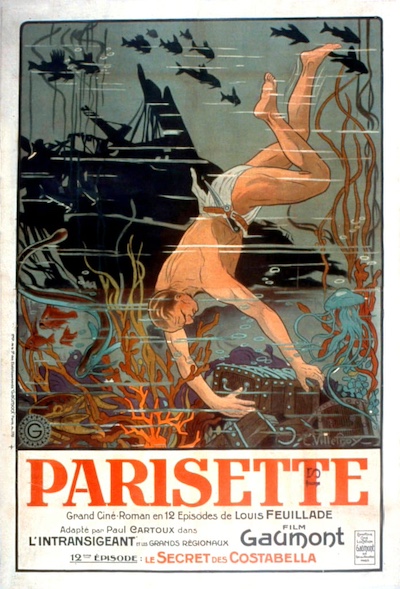
    Parisette (1921)
    Parisette (1921)

    1 – Manoela
    Quote:
    In Portugal, Joaquim de Costabella, a deposed marquis, lives with his pious granddaughter Manoëla. When banker Alvarez comes to ask for Manoëla’s hand in exchange for renewing his drafts, the marquis throws him out. That same night, Alvarez’s house is burglarized and murdered…Read More »

  • A.W. Sandberg – Nedbrudte nerver AKA The Hill Park Mystery (1923)

    A.W. Sandberg1921-1930DenmarkMysteryScandinavian Silent CinemaSilent
    Nedbrudte nerver (1923)
    Nedbrudte nerver (1923)

    Quote:
    Police reporter Erik Brandt is sent off for some rest and recreation after solving a murder under the nose of the police. But his well-earned holiday turns out to be a lot more hectic than planned, when the resort is rocked by as string of brutal murders. An attractive young lady who captures Brandt’s heart might be involved. (stumfilm.dk)Read More »

  • Sergei M. Eisenstein – Stachka AKA Strike (1925)

    1921-1930PoliticsSergei M. EisensteinSilentUSSR
    Stachka (1925)
    Stachka (1925)

    A group of oppressed factory workers go on strike in pre-revolutionary Russia.

    Matthew Rovner, Jewish Daily Forward wrote:
    On February 13, 1948, the Jewish Telegraphic Agency announced that film director Sergei Eisenstein, “the son of a Jewish merchant,” was dead at the age of 50. Eisenstein’s father was a prosperous German Jew and his mother Russian Orthodox. Eisenstein grew up highly assimilated, though he was aware of his Jewish heritage. He was friendly with Isaac Babel, and he learned to use Yiddish slang and humor. But Eisenstein’s Judaism had always been marginal to his work as an artist. In his first feature, “Strike,” a serious propaganda film, there is humor, although it is influenced more by Charlie Chaplin than Sholom Aleichem.Read More »

  • Paul Leni – The Cat and the Canary (1927)

    USA1921-1930HorrorPaul LeniSilent
    The Cat and the Canary (1927)
    The Cat and the Canary (1927)

    Relatives of an eccentric millionaire gather in his spooky mansion on the 20th anniversary of his death for the reading of his will.Read More »

  • Walter Ruttmann – Berlin: Die Sinfonie der Großstadt AKA Berlin: A Symphony of a Big City (1927)

    1921-1930DocumentaryDramaGermanyWalter Ruttmann
    Berlin Die Sinfonie der Großstadt (1927)
    Berlin Die Sinfonie der Großstadt (1927)

    This movie shows us one day in Berlin, the rhythm of that time, starting at the earliest morning and ends in the deepest night.Read More »

  • Corrado D’Errico – Stramilano (1929)

    1921-1930Corrado D'ErricoExperimentalItalyShort Film
    Stramilano (1929)
    Stramilano (1929)

    Quote:
    The history of the city symphony is dominated by artists who identified as progressives and radicals, or in some rare cases, such as that of Walter Ruttmann, artists whose politics appear to have undergone a rather startling transformation, from a position that was at least centrist or moderate, to one that was far to the right of center. Stramilano (1929), directed by Corrado D’Errico (1902-41) and produced by the company of the Za Bum music hall by Mario Mattoli and Luciano Ramo for instituto LUCE, was not only Italy’s first contribution to the city symphonies cycle, it was also the earliest example of such a film to emerge from a fascist nation. Read More »

  • Erich von Stroheim – Greed (1924)

    Erich von Stroheim1921-1930DramaSilentUSA
    Greed (1924)
    Greed (1924)

    The first rough cut of Greed allegedly ran around 8-9 hours. Von Stroheim submitted a 5 hour version to MGM, who eventually cut it down to 2+ hours after Irving Thalberg – who had fired von Stroheim when they both worked at Universal – was placed in charge of post-production following the Metro/Goldwyn merger. Von Stroheim disowned this version of the film, but it is the only surviving version known to exist. Even in its truncated form, Greed is considered to be one of the greatest films ever made.Read More »

  • Gaston Ravel – Tao (1923)

    1921-1930DramaFranceGaston RavelSilent
    Tao (1923)
    Tao (1923)

    Quote:
    Jacques Chauvry, the new government delegate for a French protectorate in Cambodia, meets the young Soun who, due to a series of circumstances, will become heir to land that houses a large oil field. Tao , an evil mestizo, along with his minions, tries to get hold of these lands, terrorizing the locals by appearing disguised as the “spirit of evil”.Read More »

Back to top button