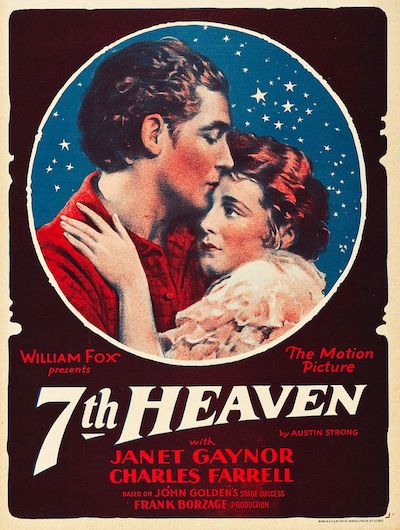
• Frank Borzage – 7th Heaven (1927)

    1921-1930Frank BorzageRomanceSilentUSA

    THE SCREEN
    In the William Fox screen version of Austin Strong’s play, “Seventh Heaven,” which was presented last night at the Sam H. Harris Theatre, you can once again meet those lovable characters—Chico, Diane, Papa Boule and Pere Chevillon—in that little patch of Paris within sight of the Eiffel Tower. This picture grips your interest from the very beginning and even though the ending is melodramatic you are glad that the sympathetic but self-satisfied Chico is brought back to his heart-broken Diane.Read More »

  • Martha Coolidge – Rambling Rose (1991)

    1991-2000DramaMartha CoolidgeUSA

    29f7c043f76a2bde437fd0d52a185152

    User at Imdb: This movie gives a eyeopening glimpse of the 1930’s and a hidden agenda of a very moralistic time. It is a charming story of the maid’s attempt to walk the line between her own natural inclinations and the societies expectations for her. Laura Dern offers a very realistic and convincing performance that marks her as a great character actress. The interaction with her own mother, in the supporting cast, shows a natural adaptation to a role that is rare in such a young actress. Duvall is wonderful in a role that demands a vast understanding of human emotion and character study of his part. The set and old automobiles lend a real authenticity to this period in history. It takes you back to a simpler time, but underscores all of the attitudes of the time. This is a movie to be enjoyed again and again at each opportunity. I highly recommend itRead More »

  • Chris Marker – Pictures at an Exhibition (2008)

    2001-2010Chris MarkerFranceShort FilmVideo Art

    Image Hosted by ImageShack.us

    Pictures at an Exhibition by Chris Marker. Its title, like Sans Soleil, is taken from a piece by Modest Mussorgsky.Read More »

  • Mike Wayne – Political Film: The Dialectics of Third Cinema (2001)

    2001-2010BooksMike WayneUnited Kingdom

    Free Image Hosting at www.ImageShack.us

    Third Cinema is a cinema committed to social and cultural emancipation. In this book, Mike Wayne argues that Third Cinema is absolutely central to key debates concerning contemporary film practices and cultures. As a body of films, Third Cinema expands our horizons of the medium and its possibilities. Wayne develops Third Cinema theory by exploring its dialectical relations with First Cinema (dominant,commercial) and Second Cinema (arthouse,auteur). Discussing an eclectic range of films, from Evita to Dollar Mambo, The Big Lebowski to The Journey, Amistad to Camp de Thiaroye, Political Film explores the affinities and crucial political differences between First and Third Cinema. Third Cinema’s relationship with Second Cinema is explored via the cinematic figure of the bandit (Bandit Queen, The General, Eskiya). The continuities and differences with European precursors such as Eisenstein, Vertov, Lukacs, Brecht and Walter Benjamin are also assessed. The book is a polemical call for a film criticism that is politically engaged with the life of the masses.Read More »

  • Walter Hugo Khouri – O Prisioneiro do Sexo (1978)

    1971-1980ArthouseBrazilEroticaWalter Hugo Khouri

    Image Hosted by ImageShack.us

    29f7c043f76a2bde437fd0d52a185152

    Quote:
    Marcelo tries to convince his wife to join his erotic games. The temptation of sexual freedom seems too much for her.Read More »

  • Marcel Carné – Le Quai des brumes aka Port of Shadows [+Extras] (1938)

    1931-1940DramaFranceMarcel Carné

    29f7c043f76a2bde437fd0d52a185152

    Synopsis
    Down a foggy, desolate road to the port city of Le Havre travels Jean (Jean Gabin), an army deserter looking for another chance to make good on life. Fate, however, has a different plan for him, as acts of both revenge and kindness render him front-page news. Also starring the blue-eyed phenomenon Michèle Morgan in her first major role, and the menacing Michel Simon, Port of Shadows (Le Quai des brumes) starkly portrays an underworld of lonely souls wrestling with their own destinies. Based on the novel by Pierre Mac Orlan, the inimitable team of director Marcel Carné and writer Jacques Prévert deliver a quintessential example of poetic realism and a classic film from the golden age of French cinema.Read More »

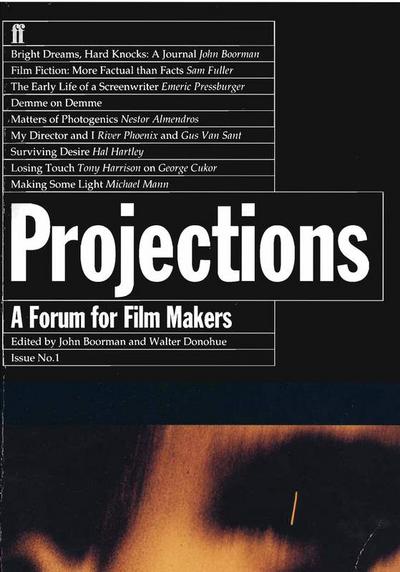
  • John Boorman and Walter Donohue – Projections No1 (1991)

    1991-2000BooksJohn BoormanUnited Kingdom

    Edited by John Boorman and Walter Donohue
    Projections is a forum for practitioners of the cinema to write about their work. The first issue includes a journal compiled by John Boorman which records his responses to the events and trends of 1991, and their implications for the future of cinema. Like his Emerald Forest diary, Money into Light, it is a fascinating mix of anecdote, personal reflections, thoughts on the nature of cinema, and comments on the practical business of making films.Read More »

  • John Boorman – Projections No.9 (1999)

    1991-2000BooksJohn BoormanUnited Kingdom

    Contents
    Foreword by John Boorman, vi
    Introduction by Michel Ciment, vii

    1 Robert Bresson: L’Argent, I
    2 Eric Rohmer: Conte d’ete, 13
    3 Claude Chabrol: La Ceremonie, 18
    4 Alain Resnais: On connait la chanson, 26
    5 Louis Malle: Au revoir les enfants, 33
    6 Alain Cavalier: Therese, 51
    7 Claude Sautet: Un Coeur en hiver, 64
    8 Maurice Pialat: Van Gogh, 70
    9 Bertrand Tavernier: Un Dimanche ala campagne, 83
    10 Claude Miller: Garde a vue, 93
    11 Patrice Leconte: Ridicule, 103
    12 Marcel Ophuls: Hotel Terminus, 111
    13 Otar Iosseliani: Les Favoris de la lune, 123
    14 Olivier Assayas, 132
    15 Catherine Breillat: 36 fillette, 138
    16 Jean-Pierre Jeunet: Delicatessen, 144
    17 Robert Guediguian: Marius et Jeannette, 152
    18 Arnaud Desplechin: La Sentinelle, 160
    19 Manuel Poirer: Western, 167
    20 Jacques Audiard: Un Heros tres discret, 175
    21 Mathieu Kassowitz: La Haine, 183Read More »

  • André Antoine & Léonard Antoine & Albert Capellani – Quatre-vingt-treize aka Ninety-Three (1921)

    1921-1930André AntoineDramaFranceSilent

    Image Hosted by ImageShack.us

    29f7c043f76a2bde437fd0d52a185152

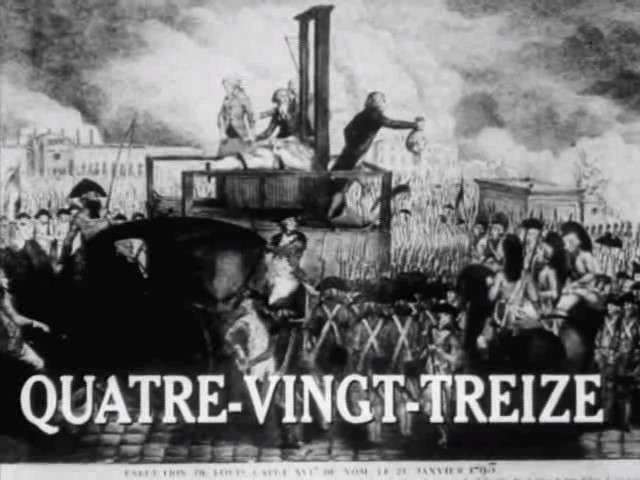
    “Quatre-vingt-treize (Ninety-three, 1914/1921) by Albert Capellani & André Antoine with Paul Capellani, Henry Krauss and Philippe Garnier

    The story takes place in Brittany in 1793 during the Terror. While the Marquess of Lantenac (P. Garnier) joins the Chouans (royalist insurgents), his nephew Gauvain (P. Capellani) becomes a soldier in the Revolutionary army. The third character is the former priest, Cimourdain, who becomes the head of the Revolutionary army. He was the one who opened Gauvain’s eyes to the new ideas by giving him Rousseau to read. In this adaptation of Victor Hugo’s novel the destiny of the three characters are heading for collision. The film shooting was stopped abruptly by the beginning of WWI. A few years later, André Antoine took over as Capellani was unavailable to finish it as he was in America. The film didn’t came out until 1921. Obviously, in the space of 7 years, cinema had moved forward dramatically and Quatre-vingt-treize was undoubtedly dated when it came out.Read More »

Back to top button