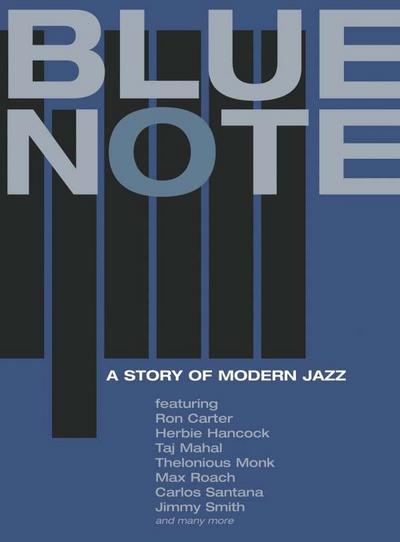
The artists list on this DVD reads like a Who’s Who of the best international jazz musicians of all times. It features Art Blakey, John Coltrane, Herbie Hancock, Thelonious Monk and Sonny Rollins — musicians whose names have become synonymous with the great Jazz Age in the 1950s and 60s. With Carlos Santana, Cassandra Wilson and André Previn and jazz experts like Joachim Ernst Berendt and Bertrand Tavernier, the list of interviewees and artists on this DVD becomes encyclopaedic. But how many people have heard of Alfred Lion and Frank Wolff, to whom we owe the recorded memory of our Jazz legends? These two Jewish Germans emigrated from Nazi Germany to New York in 1939 and promoted Jazz Music, which at the time had received little serious attention from mainstream America. Without money or connections and speaking little English, the two men began to record practically unknown musicians, following their own taste and judgement, and thus establishing the legendary Blue Note label.Read More »
-
Julian Benedikt & Andreas Morell – Blue Note – A Story of Modern Jazz (1997)
Documentary1991-2000GermanyJulian Benedikt and Andreas MorellMusical -
Jules Herrmann – Liebmann (2016)
2011-2020DramaGermanyJules HerrmannQueer Cinema(s)Quote:
The teacher Antek Liebmann moves to the French countryside to leave his former life in Germany behind. He soon gets a job and finds himself in a new relationship. But the strange energy of a near-by artists residency and an unexpected visitor from Germany make him realise he cannot escape his memories. He has to find his own way to confront the ghosts of his past.Read More » -
Antoine Cuypers – Préjudice (2015)
2011-2020Antoine CuypersBelgiumDramaQuote:
During a family meal, Cedric, 32, learns that his sister is expecting a baby. While the news is met with sincere excitement by the whole family, for Cedric — who still lives with his parents – it resonates strangely, mixed with a certain resentment. Cedric, whose simple dream – a trip to Austria – is subject to discussion, will turn his resentment into anger and then fury. During the family celebration, he will try to establish, in front of everyone, the prejudice that he says he is the victim of. Between denial and paranoia, revolt and false pretences, how far is a family willing to go to keep its equilibrium? When must it start to suppress the right to be different?Read More » -
Athina Rachel Tsangari – Chevalier (2015)
2011-2020ArthouseAthina Rachel TsangariComedyGreeceQuote:
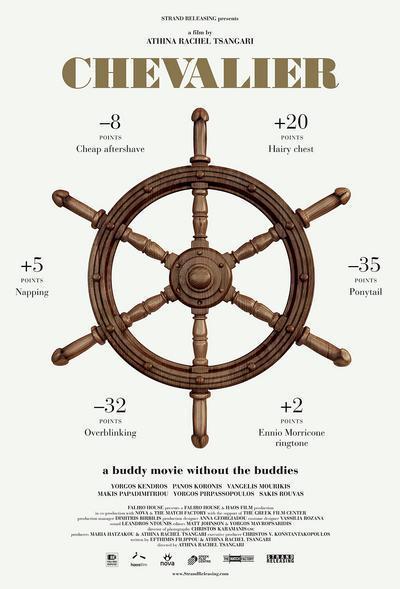
Manhood-measuring contests — in every imaginable sense of the phrase — are taken to brazenly literal extremes in “Chevalier,” the long-awaited third feature from Greek multi-tasker Athina Rachel Tsangari. Markedly different in focus and emotional temperature from her 2010 breakthrough, “Attenberg,” this committedly deadpan comedy of manners, morals and men behaving weirdly boasts a contained conceit seemingly ripe for unfettered absurdism: On a luxury yacht in the Aegean Sea, six male acquaintances embark on a rigorous series of personal and physical challenges, mercilessly grading each other to determine who is “the Best in General.” That Tsangari resists escalating the conflict, counting on subtle political insinuations to emerge as these perplexing social Olympics wear on, will leave as many viewers enervated as amused, but it’s an expertly executed tease.Read More » -
Noboru Tanaka – Edogawa Ranpo ryôki-kan: Yaneura no sanposha AKA Watcher in the Attic (1976)
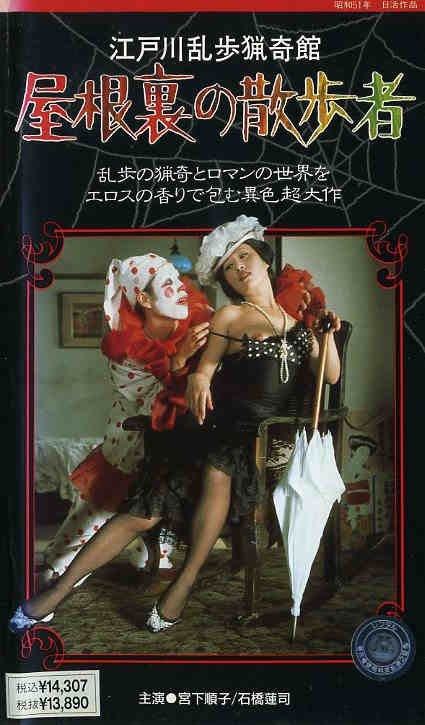
1971-1980CrimeHorrorJapanNoboru TanakaWatcher in the Attic is a 1976 Japanese film in Nikkatsu’s Roman porno series, directed by Noboru Tanaka and starring Junko Miyashita.
In 1923 Tokyo Lady Minako is the owner of a shabby boarding house with a collection of bizarre characters for tenants. Gōda, one of her tenants, spends most of his time in the attic spying on the other tenants through holes he has drilled into the ceiling. During one of his peeping sessions, Gōda witnesses the murder of one of the tenants at the hand of Lady Minako. Gōda becomes obsessed with Lady Minako, and determines to commit a grotesque murder in order to prove to her that he is her soul mate. He kills another tenant – a priest – by dripping poison into his mouth through the ceiling. A series of grotesque murders follow. The film ends apocalyptically with the Great Kantō earthquake which kills both of them during their intercourse. Read More »
-
Robert Houston & Kenji Misumi – Shogun Assassin (1980)
1961-1970ActionAsianJapanKenji MisumiRobert HoustonA sort of remake of Lone Wolf and Cub for the western market condensing the series in one film. In 1980, Americans David Weisman (producer) and Robert Houston (director) stumbled upon the Japanese Lone Wolf and Cub films (in turn based on a hugely successful manga comic book), and realised that while Western Audiences at the time would lap up the violent battles, they might not be ready for the Chanbara genre’s comparatively slow pacing and period politics. They decided to take the best bits of Lone Wolf and Cub parts 1 and 2, and add their own dubbing and simplified plot. Shogun Assassin was born, and is probably responsible to this day for the Chanbara movie’s arrival in the West. Best approached as an introduction to the Lone Wolf and Cub legend.Read More »
-
Allan King – Warrendale (1967)
1961-1970Allan KingAmos Vogel: Film as a Subversive ArtCanadaDocumentaryQuote:
King’s feature debut, Warrendale, about a collection of volatile children from the titular Toronto-based rehabilitation center, has been compared to the works of Pennebaker, Maysles, and Rouch within the cinema vérité and Direct Cinema movements. But King’s approach to capturing the children’s emotional ebbs and flows as they experience anger, guilt, and finally tragedy, seems arguably more human, hypnotically attuned to the delicate sensitivities of people’s movements and sounds. As the adult caregivers attempt to build trust with these damaged children, King focuses on the intimate moments of counseling, reassurance, and discourse structuring the narrative. That these sequences often devolve into hysterical fits and seizures makes the film all the more forceful, showing the dark undercarriage of childhood trauma without any buffer or safety net. The film’s striking emotional centerpiece, a family-style meeting between counselors and children about the sudden death of the house cook, is a breathtaking display of collective heartbreak and rejuvenation that creates a frenzy of repressed rage. In a single moment, King’s camera becomes engulfed in an emotional war zone, pinned down but never overwhelmed by honest, raw expression, always able to capture the small moments on the fringes of the frame.Read More » -
Joseph-Marie Lo Duca & Kenneth Anger – A History of Eroticism (1966)
1961-1970BooksJoseph-Marie Lo Duca and Kenneth AngerKenneth AngerUSAJoseph-Marie Lo Duca was an Italian-born journalist, novelist, art critic, and film historian best known as the co-founder in 1951 of the influential French magazine Cahiers du Cinéma with André Bazin, Jacques Doniol-Valcroze and Léonide Keigel. Lo Duca was born in Milan, Italy to a family of Sicilian origin. Fascinated from an early age with reading and writing, he published his first novel, La sfera di platino (“The Sphere of Platinum”) in 1927. In 1942, having assembled a wealth of rare documents and objects related to cinema, Lo Duca established the Musée Canudo at the Palais de Chaillot in Paris with the goal of founding the International Museum of Cinema in Rome. The project for the Rome museum, however, did not survive the war. In 1948, he published Le dessin animé (“The Animated Cartoon”) with a preface by Walt Disney. His Histoire du cinéma (1942) was translated into twelve languages while Technique du cinéma (1948) became a noted reference work.Read More »
-
Lucy Carter – Auschwitz: The Forgotten Evidence (2004)
2001-2010DocumentaryLucy CarterUnited KingdomWhen an Allied photo-reconnaissance plane flew over southern Poland in the summer of 1944, following a bombing raid on 20 August, it took extraordinary images of the Nazis’ most evil extermination camp: Auschwitz Birkenau. From these photos, it is possible to see in detail how the SS organised their factory of death in which about 12,000 people were being murdered daily. But the pictures were not analysed at the time. Instead they were simply filed away.Read More »