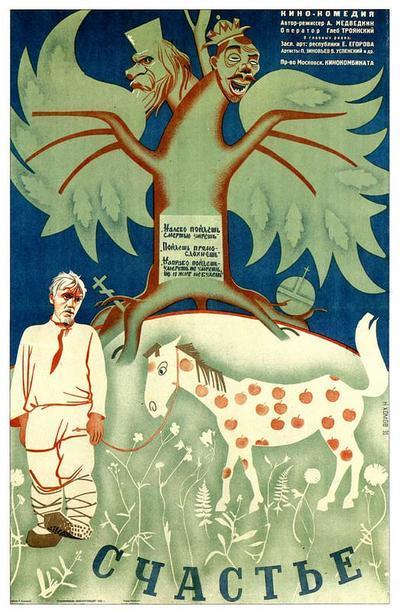
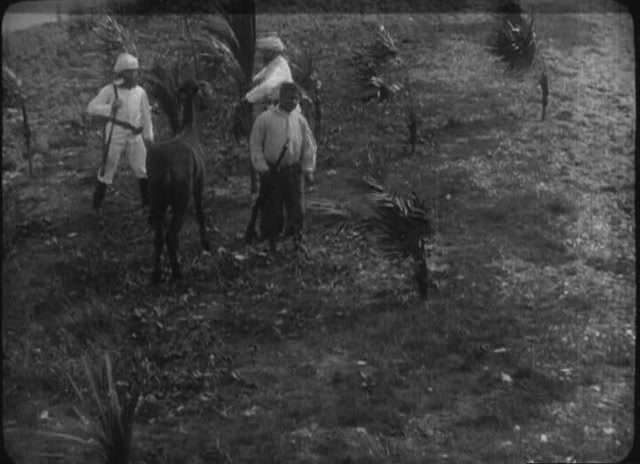
Aleksandr Medvedkin’s Happiness, as rowdy as any Soviet silent movie, is a comic parable composed of equal parts of Tex Avery and Luis Buñuel. It satirizes the plight of a Soviet farmer who finds himself providing for the state, the church, and his peers at the expense of his personal satisfaction. A hapless young prole, Khmyr, is tasked by his wife with the goal of going out in the world and finding happiness, lest he end up dead and dissatisfied after a lifetime of toil, like his father. Through stylistic exaggeration and a systematic attack on pre- and post-Revolutionary Russia’s dearest institutions, the movie achieves a wide-ranging, and deeply wounding, attack on the limitations placed on personal freedom in Russian societyRead More »
-
Aleksandr Medvedkin – Schastye aka Happiness (1932)
1931-1940Aleksandr MedvedkinComedySilentUSSR -
Viggo Larsen – Løvejagten AKA The Lion Hunt (1907)
1901-1910AdventureDenmarkSilentThe Birth of CinemaViggo Larsen
Synopsis
Two big game hunters are on safari in the jungle with their African guide. They observe zebras, ostrich and a hippopotamus, and catch a small monkey for a pet. During the night they are awakened by a lion which kills a small goat and then the hunters’ horse. The hunters shoot the lion as it stands by the water on a beach. They discover another lion and shoot it also. The lions are gutted and skinned. The happy hunters sit and smoke cigarettes afterward.Read More » -
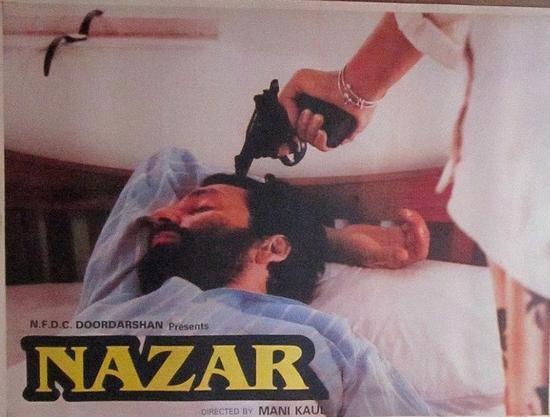
Mani Kaul – Nazar AKA The Gaze (1990)
1981-1990DramaIndiaMani KaulSYNOPSIS
From the back of the case:
After his wife’s death, the husband recalls their first meeting and marriage. She was much younger than him. She used to pawn some things to an antique shop to make a little money. The husband is increasingly intrigued by her mindset. As things develop, he finds out that she was an orphan living with two aunts. The film explores their complex life in a manner unusual for Indian cinema.Read More » -
Abel Gance – La Roue (1923)
Drama1921-1930Abel GanceFranceSilentFlicker Alley says…
Quote:
Never before released in the United States, this monumental French film is one of the most extraordinary achievements in the whole history of cinema. Written and directed by Abel Gance (Napoleon, J’Accuse), three years in production, and for its time unprecedented in length and complexity of emotion, La Roue pushed the frontiers of film art beyond all previous efforts. Said Gance, “Cinema endows man with a new sense. It is the music of light. He listens with his eyes.”Read More »
-
Lucio Fulci – Murderock – uccide a passo di danza AKA Murder Rock (1984)
1981-1990GialloItalyLucio FulciMystery

SYNOPSIS
The brutal worlds of murder and dance school competitions are thrown together in yet another lurid Lucio Fulci giallo. When an insane hatpin murderer terrorizes a prestigious New York dance school, mercilessly poking nubile young women deep into their competitive little hearts. Is it one of the students, jealous of competitive placement? Is it the voyeuristic headmaster, who watches the students through his many lurid security cameras? Perhaps it’s even a jealous boyfriend? (DVDActive)Read More » -
Lucio Fulci – I Maniaci aka The Maniacs (1964)
1961-1970ComedyItalyLucio FulciPlot Synopsis by Robert Firsching
A minor comedy from Italian filmmaker Lucio Fulci (Zombi 2; L’Aldila), this anthology is of interest primarily to cult devotees for marking the notorious director’s only collaboration with legendary “scream queen” Barbara Steele (La Maschera del Demonio). Lushly photographed and filled with popular comedians of the era (including Franco Franchi and Ciccio Ingrassia, who made several of their “Franco and Ciccio” comedies with Fulci), the film’s sketches spotlight various manias. As might be expected, nymphomania gets an extended treatment, with all the requisite mugging, leering, and smarmy asides common to Italian comedies of the period, as well as a lengthy parade of songs, many scored by Ennio Morricone, and some international burlesque performers. Enrico Maria Salerno and Walter Chiari lead a cast which includes Lisa Gastoni, Gaia Germani, Umberto d’Orsi, and Raimondo Vianello.Read More » -
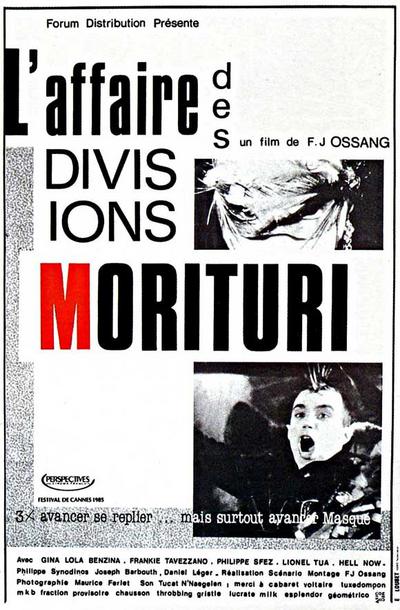
F.J. Ossang – L’affaire des divisions Morituri aka The Case of the Morituri Divisions (1985)
1981-1990ArthouseExperimentalF.J. OssangFranceSynopsis
The story about gladiators against a German background. One of them, Ettore, has become a star of the underworld. He ends up breaking down, caught in a role he can no longer fulfill. His last betrayal is to spill the beans to the press.Read More » -
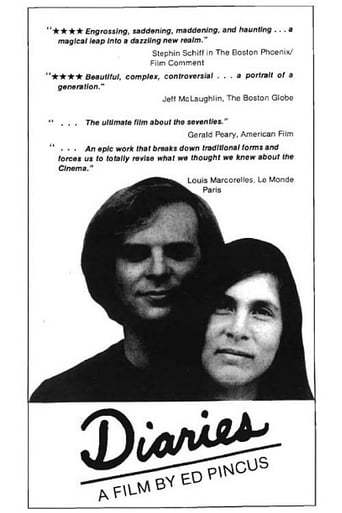
Ed Pincus – Diaries (1982)
1981-1990ArthouseDocumentaryEd PincusUSA200 minutes of cinema-verite on the life of documentarist Ed Pincus and his immediate family from 1971 to 1976.
Director of Black Natchez, Ed Pincus now lives with his wife Jane in Vermont and owns a flower farm. He recently returned to filmmaking for a documentary about Katrina, and thinks about new projects.Read More »
-
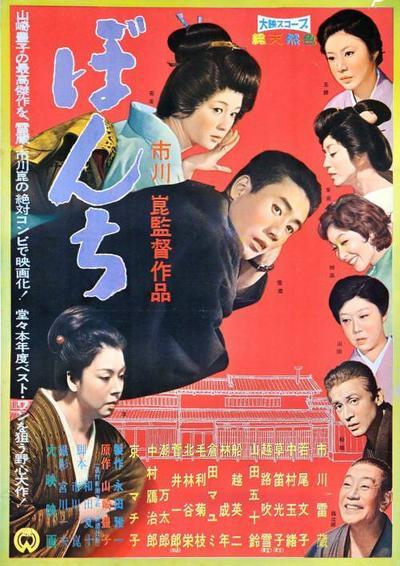
Kon Ichikawa – Bonchi (1960)
1951-1960AsianDramaJapanKon IchikawaWhere Ichikawa skewered patriarchal family values in Her Brother, in this savage satire he hoists the matriarchal system on its own apron strings. Raizo Ichikawa (“in his best role yet”-Variety) is the scion of an Osaka merchant family whose traditional power is matrilineal. Instructed by his overbearing mother and grandmother to give them an heiress for the family business, he stands by helplessly as wife after wife is thrown out of the house for producing sons. Driven to a life of dissipation-his mistresses also fail to produce daughters-in the end he is just too tired to care. Ichikawa’s frighteningly funny picture of the matriarchy’s efforts to perpetuate itself was received as antifeminist, if not downright misogynistic, but Joan Mellon suggests that the target once again is “the institution of the family [which] places its own survival ahead of the needs and feelings of individuals.” If this looks forward to The Makioka Sisters, so does Donald Richie’s comment, “We find this cruel matriarchal story…told in terms of the most transcendental beauty.”Read More »