

Quote:
“Maximum Shame” is an apocalyptic fetish horror musical chess sci-fi weird underground feature movie written and directed by cult filmmaker Carlos Atanes.Read More »
Quote:
“Maximum Shame” is an apocalyptic fetish horror musical chess sci-fi weird underground feature movie written and directed by cult filmmaker Carlos Atanes.Read More »

Quote:
The second part of Aki Kaurismäki’s “Finland” trilogy, the film follows a man who arrives in Helsinki and gets beaten up so severely he develops amnesia. Unable to remember his name or anything from his past life, he cannot get a job or an apartment, so he starts living on the outskirts of the city and slowly starts putting his life back on track.Read More »

Form Phases IV is the last film in Form Phases, the first series made by Robert Breer to lend movement to the abstract forms in his paintings. Breer was a self-taught practitioner of animated film, focusing particularly on the demystification of the screen space. This was a theme already touched on in the 1920s by Hans Richter, one of the references for avant-garde European cinema. Richter’s work, specifically his film Rhythmus 21 (also in the Museo Reina Sofía collection), the starting point of abstraction in film, was a decisive influence on Breer’s cinematographic output.
Here, Breer applied, in a particularly sophisticated way, the principle by which a static screen is animated by the appearance of a moving shape which then changes as another shape appears, and then disappears, leaving the screen blank, to return once more to its static state.Read More »

Filmmaker Manfred Blank (director of the excellent Pharos of Chaos) interviews Danièle Huillet and Jean-Marie Straub at some length about their then-current production, Klassenverhältnisse (Class Relations), in which he, himself, performed as an actor.Read More »

Quote:
Harun Farocki films Jean-Marie Straub and Danièle Huillet at work during the shooting of Klassenverhältnisse (Class Relations), a film based on Kafka’s unfinished novel, Amerika, in which Farocki himself plays the character, Delamarche. The film is both a tribute to the work of the two filmmakers, who define themselves as “artisans” in reaction against the film industry, and as he says, a self-portrait: at work, directed by the couple, he endlessly repeats his gestures and lines, like a worker up to the point of exhaustion.Read More »

The Lincoln Center wrote:
Straub and Huillet were frequently drawn to unfinished texts—Hölderlin’s The Death of Empedocles, Schoenberg’s Moses and Aaron—and for Class Relations, one of their supreme accomplishments, they turned to Kafka’s never-completed Amerika. “Kafka, for us,” Straub declared, “is the only major poet of industrial civilization, I mean, a civilization where people depend on their work to survive.” Kafka never did visit the America of his novel, so perhaps it’s fitting that the saga of Karl Rossmann, a teenage immigrant from Europe who arrives to a strange new land rife with swindlers and hypocrites, was largely shot in Hamburg. The style of Straub-Huillet, with their Brechtian performances, long takes, and static framing, is often characterized as “austere,” yet such a description belies the extraordinary richness of their images, the palpable weight of their direct-sound, and the invigorating clarity of their political commitment.Read More »

A group of Russian teenagers spend their summer at a summer camp. Mitia falls in love and gets so occupied with his own problems that he forgets the others.
—
L’action se situe dans un camp de pionnier appartenant visiblement à quelque administration ou organisation de bon niveau social. L’un des éducateurs est un sculpteur fort en littérature classique, grand amateur de Lermontov. Le héros principal Mitia Lopoukhine, surnommé Lopoukh, va subir l’influence du sculpteur qui lui fait découvrir la valeur et le sens de l’art. Il devient amoureux d’une jeune fille, Droubitch, qui lit des livres en trois langues… La mise en scène de la pièce de théâtre Mascarade de Lermontov doit permettre aux adolescents de mieux comprendre sentiments, passions et valeurs morales.
Read More »
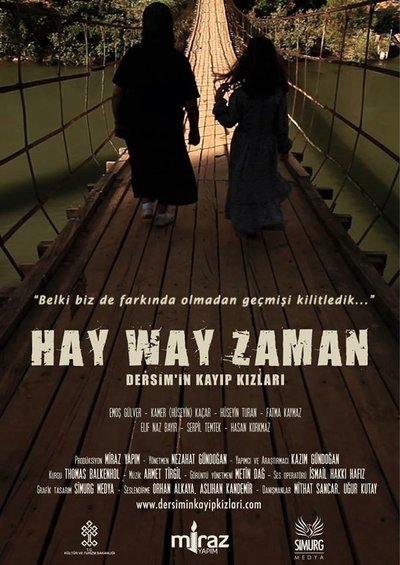
This is the story of Emoş Gülver, one of hundreds of women who decided to search for their roots after seeing the 2010 documentary “İki Tutam Saç: Dersim’in Kayıp Kızları” (Two Locks of Hair: The Lost Girls of Dersim), which recounted the stories of little girls who were separated from their parents in the late 1930s during a state intervention against the Dersim revolt in Tunceli.Read More »

With the memory of WW II still fresh in Japan in1960, the atmosphere is unsettled as the specter of renewed world nuclear conflict is once again in the air. When a US military aircraft carrying a nuclear weapon inexplicably explodes over a river crossing the line of demarcation between South and North Korea during South Korean military exercises in the area, tension between Cold War antagonists rise to new heights, involving Japan directly because of the American military bases they host. As accusations of blame are traded back and forth, the movie tracks the increasingly volatile situation through the eyes of a group of Japanese high school students and their families, a newspaper reporter and his idealistic nurse girlfriend, and a Christian troubadour and his invalid wife.Read More »