J. Steed@IMDb wrote:
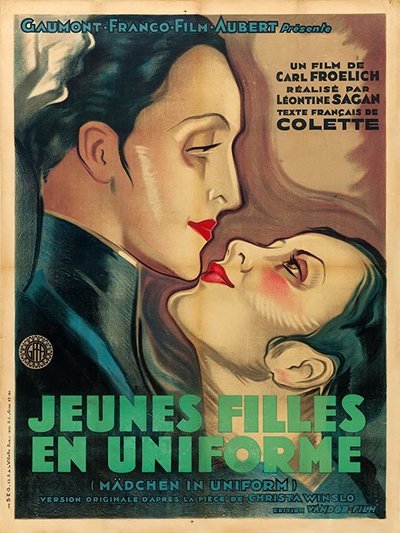
The original play “Gestern und Morgen” had its premiere in 1930 and was an immediate success. This prompted Carl Froelich to adapt the play for film. Both leading actress of the play Hertha Thiele (her first film) and the original director of the play Leontine Sagan (also her first film) were invited to join. The direction was split into direction of the cast and mise-en-scene by Leontine Sagan and overall direction by Carl Froelich; this means that Froelich was responsible for the overall quality of the film (in German: Künstleriche Oberleitung).Read More »

Weimar Republic cinema
-
Leontine Sagan & Carl Froelich – Mädchen in Uniform (1931)
1931-1940Carl FroelichDramaGermanyLeontine SaganWeimar Republic cinema -
Hans Richter – Die neue Wohnung AKA The New Apartment (1930)
1921-1930ArchitectureExperimentalGermanyHans RichterWeimar Republic cinemaThis film was made by Hans Richter for the first Basel habitat exhibition to show the innovative aspects of modern architecture.
The remastering of this film was made by the Fondazione Cineteca Italiana (therefore the titles are in Italian).
The film is originally silent but is here accompanied by a recent soundtrack.Read More »
-
Georg Wilhelm Pabst – Die Büchse der Pandora AKA Pandora’s Box (1929)
1921-1930DramaGeorg Wilhelm PabstGermanySilentWeimar Republic cinema
Pandora’s Box (German: Die Büchse der Pandora) is a 1929 German silent film based on Frank Wedekind’s plays Erdgeist (Earth Spirit, 1895) and Die Büchse der Pandora (1904). Directed by Austrian filmmaker Georg Wilhelm Pabst, the film stars Louise Brooks, Fritz Kortner and Francis Lederer. Brooks’ portrayal of a seductive, thoughtless young woman whose raw sexuality and uninhibited nature bring ruin to herself and those who love her, although initially unappreciated, eventually made the actress a star.Read More »
-
Géza von Bolváry – Ein Tango für Dich (1930)
1921-1930ComedyGermanyGéza von BolváryMusicalWeimar Republic cinema
This is Willi Forst’s second collaboration with director Géza von Bolvary, made shortly after the far better known “Zwei Herzen im Dreivierteltakt” (in which he didn’t have first billing, though). Again, the script is by Walter Reisch and the music is by Robert Stolz.
In “Ein Tango für Dich”, Forst plays Jimmy Bolt, who is working as a singer and dancer (and occcasionally as a waiter) at a varieté. The man may be talented, but he’s not exactly a big success, and things get complicated when a young orphan girl (Fee Malten) falls in love with the voice of another singer (Oskar Karlweis) but then mistakes Bolt for him…Read More »
-
Robert Siodmak & Edgar G. Ulmer & Billy Wilder – Menschen am Sonntag (1930)
1921-1930ArthouseBilly WilderEdgar G. UlmerGermanyRobert SiodmakSilentWeimar Republic cinema

Criterion wrote:
Years before they became major players in Hollywood, a group of young German filmmakers—including eventual noir masters Robert Siodmak and Edgar G. Ulmer and future Oscar winners Billy Wilder and Fred Zinnemann—worked together on the once-in-a-lifetime collaboration People on Sunday (Menschen am Sonntag). This effervescent, sunlit silent, about a handful of city dwellers (a charming cast of nonprofessionals) enjoying a weekend outing, offers a rare glimpse of Weimar-era Berlin. A unique hybrid of documentary and fictional storytelling, People on Sunday was both an experiment and a mainstream hit that would influence generations of film artists around the world.Read More » -
Ernst Lubitsch – Die Puppe AKA The Doll (1919)
ComedyErnst LubitschGermanySilentWeimar Republic cinema
Quote:
The Baron of Chanterelle (Max Kronert) demands that his nephew Lancelot (Hermann Thimig) get married to preserve the family line. A skittish and effeminate fellow, Lancelot does not wish to marry, so when his uncle presents him with 40 enthusiastic brides, he hides out with a group of monks. The gluttonous monks learn about Lancelot’s potential cash reward for his nuptials, so they cook up a plan: he can marry a doll…Read More » -
Fritz Lang – Frau im Mond AKA Woman in the Moon (1929)
Germany1921-1930Fritz LangSci-FiSilentWeimar Republic cinema

Synopsis:
Thirty years ago, at a scientific conference, Prof. Manfeldt presented his theory on the existence of gold on the Moon. It was greeted with laughter by the assembled academics. Today, Herr Helius has ambitious plans to build a spaceship… and take it to the Moon! Windegger, his chief engineer, will be going, and so will Prof. Manfeldt, now living in a cramped garret alone with his theory. But there are disagreements with the financiers who insist that their man Turner also accompany the flight… The unmanned Rocket H 32 brings back valuable information from the dark side of the Moon. Helius is upset by the news of Windegger’s engagement to the pretty Friede. And the financiers have a secret agenda: to control the world’s gold supply… Finally, the Spaceship “Friede” is ready as it rolls out on its gantry for takeoff. The staged rocket works as planned, but the acceleration is fierce. As they approach the Moon, they discover a stowaway on board, Gustav, a little boy…Read More » -
F.W. Murnau – Der Gang in die Nacht AKA Walking into the Night [+extra] (1921)
1921-1930DramaF.W. MurnauGermanySilentWeimar Republic cinema

Quote:
Dr Eigil Borne is engaged to Hélène, a girl who is madly in love with him. At Hélène’s birthday celebration, Eigil invites her to a cabaret, where he meets his other love, Lily, a passionate, fiery and funny dancer.Read More » -
Georg Wilhelm Pabst – Tagebuch einer Verlorenen AKA Diary of a Lost Girl [+extra] (1929)
1921-1930DramaGeorg Wilhelm PabstGermanySilentWeimar Republic cinema

Quote:
Thymiane is a beautiful young girl who is not having a storybook life. Her governess, Elizabeth, is thrown out of her home when she is pregnant, only to be later found drown. That same day, her father already has a new governess named Meta. Meinert, downstairs druggist, takes advance of her and gets Thymiane pregnant. When she refuses to marry, her baby is taken from her and she is put into a strict girls reform school. When Count Osdorff is unable to get the family to take her back, he waits for her to escape. She escapes with a friend and the friend goes with the Count while she goes to see her baby. Thymiane finds that her baby is dead, and the Count has put both girls up at a brothel. When her father dies, Thymiane marries the Count and becomes a Countess, but her past and her hatred of Meta will come back to her.Read More »

