Based on the true story of a band of gypsies in occupied Poland during World War II and their struggle againt the Nazi invaders. Half a million gypsies died as they fled in a vain attempt to escape. The film follows the story of Dymitr, a Polish gypsy violinist, as he tries to lead his family and friends to safety in Hungary. A tragic and moving film with a wonderful authentic soundtrack of Gypsy music.Read More »
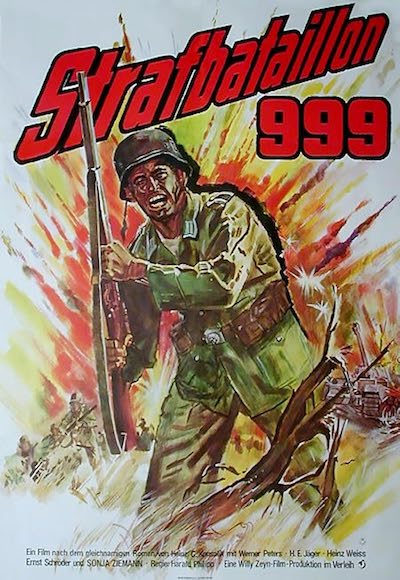
One of the worst of many inhuman aspects of World War II were the “penalty” battalions in the German army, dramatized in this excellent film about several men serving in these units. Director Harald Phillipp spares no ounce of realism in first relating what kinds of men are conscripted, and then how they are treated. One man’s crime was not returning to his unit on time, another did not follow unscrupulous orders, yet another supposedly mutilated himself in order to escape the draft. Once in a penalty battalion, the assignments and the superior officers are brutal. The men are sent to the most dangerous battle fronts, they are asked to de-mine without equipment, and no one balks at leaving them without weapons if a hasty retreat is in order. Sobering and well-photographed, the men’s stories are engrossing from beginning to end. allmovie.comRead More »
Fuller admitted that he was obsessed by war and that he wouldn’t have made war movies unless he’d seen combat (he did, with distinction). This movie plays like a gutsy draft of his cherished project, The Big Red One, and looks as if it could have influenced Terrence Malick’s The Thin Red Line (compare the steady destruction of the entrenched Japanese as the men advance on them). Merrill’s men are in Burma on a pitiless mission that we are dragged into emotionally, then almost physically, by Fuller’s up-front direction, as we gradually realize its suicidal nature.Read More »
Quote: The British Film Institute has been unable to locate a print of the film for inclusion in the BFI National Archive, and classes it as “missing, believed lost”. There is increasing interest by film historians in Gréville’s directorial career, with the same year’s Noose being particularly highly regarded. The current absence of But Not in Vain represents a crucial gap in Gréville’s filmography, and the BFI lists the film as one of its “75 Most Wanted” missing British feature films.Read More »
Yugoslav partisans grimly crop the hair of a village quintet of women believed to have consorted with the occupational Nazis. Four, for various reasons, have indeed – and their seducer is a lone, swaggering sergeant whom the partisans briskly emasculate. Escorted out of town by the sheepish Nazis, the forlorn ladies link up, patriotically and romantically, with a band of tough mountain guerrillasRead More »
Plot: In the conflict with the enemy in a already lost battle, at risk to die in vain, partisan Mitko Angelov, is leaving the battlefield. He boards on the train and goes to see his mother, who has just returned from internment. When he returned to the brigade, he was declared a deserter, disarmed and bound. Since he lost his weapon, the Commissioner sent him to patrol in action, to take a weapon from Germans. All partisans from the patrol were killed except Mitko and Vane, who was seriously wounded. Thinking that Vane is dead, Angelov returns was in the brigade. But the commander did not believe him, thinking that he had fled from the battle, and imprisons him in the basement. In the meantime, a wounded fighter Vane is showing up, and the story of the heroic struggle. But at the same time, a military court sentenced him to death for desertion.Read More »
Synopsis : After settling his differences with a Japanese PoW camp commander, a British colonel co-operates to oversee his men’s construction of a railway bridge for their captors – while oblivious to a plan by the Allies to destroy it. (imdb)Read More »
Quote: A quote from Bertolt Brecht ends this bitter and angry war film by Sam Peckinpah: “Do not rejoice in his defeat, you men. For though the world has stood up and stopped the bastard, the bitch that bore him is in heat again.” Peckinpah’s intense and belligerently non-commercial work, (based on the book by Willi Heinrich), is a World War II tale told from the German perspective, following a platoon of German soldiers in the Russia of 1943, when the German Wehrmacht forces had been decimated and the Germans were retreating along the Russian front. James Coburn is Steiner, a German corporal and recipient of the Iron Cross who feels that he owes his loyalty to his family and fellow soldiers and not to Hitler and the German war machine. But when a new commander, Captain Stransky (Maximillian Schell), takes over the platoon, Steiner and Stransky come into immediate conflict. Stransky is a career soldier, the complete opposite of Steiner, and a man who pledges himself heart and soul to Hitler and the war. But he envies Steiner for having been awarded an Iron Cross and deeply desires one himself. The problem is Stransky is a complete coward and recognizes that the only way he can be awarded an Iron Cross would be to get the bitter Steiner on his side.Read More »