Friedrich Ermler (1898-1967) remains one of the shadowy figures of the early Soviet cinema, known if at all for his psychological parable Fragment of an Empire. But he was a major force among the Leningrad filmmakers of the 1920s and ’30s, whose sympathies lay closer to youth and realism than to the monumental frescoes of the Moscow ‘masters.’ The Parisian Cobbler is impossible to hide from inquisitive looks and gossips in a small provincial town. Film tackled a controversial theme head-on: the sexual exploitation of women by party activists in the name of ‘free love.’ Hapermill worker, Young Communist Leaguer Katya and Andrei are not hiding their love. All of a sudden Katya’s radiant hopes break to pieces: Andrei is indignant to hear the news that Katya is expecting a baby. He does not want “to change diapers”, this “trivial life” will interfere with his plans to “build bright future”. Katya is befriended by a cobbler who, as a mute, knows what it is to be a social outcast. Ermler’s spare and uncompromising style reveals the extent to which realism was already on the agenda before it became a repressive slogan in the mid-thirties. As usual with Ermler, the film is not only about a problem, but is also about everyday life.Read More »
USSR
-
Friedrich Ermler – Parizhskii sapozhnik AKA The Parisian Cobbler AKA Paris Shoemaker (1927)
1921-1930DramaFriedrich ErmlerSilentUSSR -
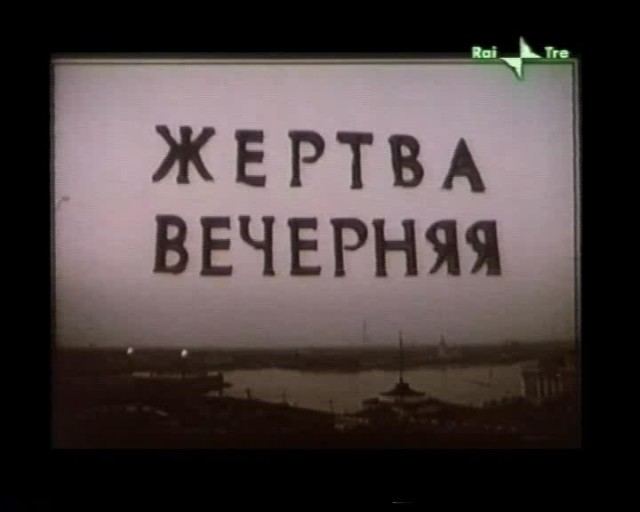
Aleksandr Sokurov – Zhertva vechernyaya AKA The Evening Sacrifice (1987)
1981-1990Aleksandr SokurovArthouseDocumentaryUSSRSokurov shows the official manifestation and fireworks on the 1st of May, one of the ritual celebrations of Soviet times, as a gathering of tired participants of a mass scene falling into pieces without the director’s orders and without any aims. Outbursts of joy without reason, mixed here and there with equally unmotivated signs of anxiety are given in brief sketches of a restless and pitiful crowd. A part instead of the whole, individual instead of common, a symbol growing up from details are the postulates of Eisenstein’s representation of the “people’s masses,” both the chorus and the protagonist of the Soviet official culture. Sokurov revises these postulates in the context of our time when the chorus has gone out of action, both in the aesthetic and in the social sense, and the protagonist is absent. However, both chorus and soloist are introduced into the picture of the festivity by the hand of the author: Sokurov puts a church canticle into the soundtrack of the film. It is an evening Orthodox prayer of repentance: “let my prayer be like incense before Thou, like my hands uplifted, an evening sacrifice.”Read More »
-
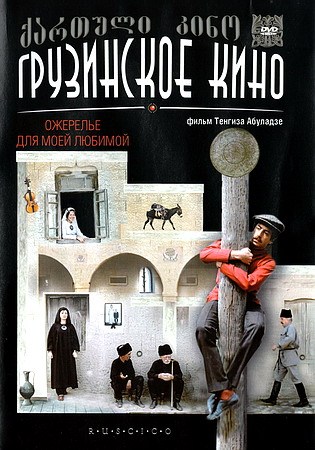
Tengiz Abuladze – Samkauli satrposatvis aka Necklace for My Beloved aka Ozherele dlya moey lyubimoy (1971)
1971-1980ComedyTengiz AbuladzeUSSRThree guys are living in a Dagestan aul, and all three are in love with the blue-eyed Serminaz. According to a mountaineers’ tradition, a young man seeking the hand and the heart of a beloved girl has to make her a present that she would remember for the rest of her life. The friends set out in search of the special gift…Read More »
-
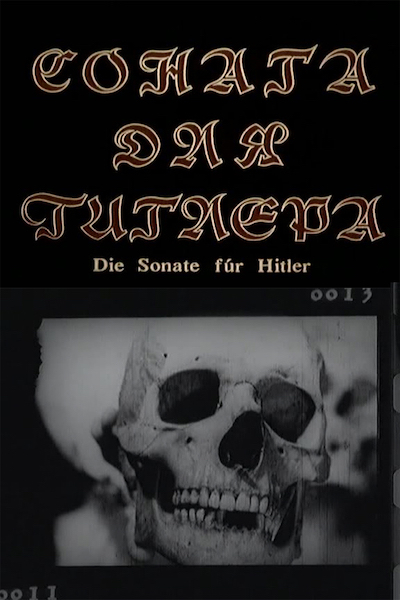
Aleksandr Sokurov – Sonata dlya Gitlera AKA Sonata for Hitler (1979 – 1989)
1981-1990Aleksandr SokurovArthouseShort FilmUSSRQuote:
Set to the music of Bach and Penderecki, Sonata for Hitler weaves together a bank of images from German and Soviet archive footage, drawing out a psychological dimension from the historical landscape at the end of World War II.Read More » -
Grigori Aleksandrov & Sergei M. Eisenstein – Oktyabr AKA October AKA Ten Days That Shook the World (1928)
Politics1921-1930Grigori Aleksandrov and Sergei M. EisensteinSergei M. EisensteinSilentUSSR

Description: Expanding on his editing experiments in Battleship Potemkin (1925), Sergei Eisenstein melded documentary realism with narrative metaphor to depict the pivotal events of the Russian Revolution in October (1927). Commissioned to commemorate the 10th anniversary of the 1917 October Revolution, Eisenstein focused on a few key events from February 1917 to October 1917. Underlining the symbolic importance of those episodes, Eisenstein constructed October as an elaborate “intellectual montage,” deriving meaning from the metaphorical or symbolic relationships between shots. Drawing out narrative time through cutting, Eisenstein turns an opening drawbridge into a sign of the divisive struggle in St. Petersburg. Similarly exaggerating the time that it takes provisional leader Kerensky to climb a palatial staircase, and intercutting shots of Kerensky with a Napoleon statue and a mechanical peacock, Eisenstein satirically reveals Kerensky’s imperial hubris and vanity. Read More »
-
Aleksandr Razumnyj – Mat aka Mother [Incomplete] (1919)
1911-1920Aleksandr RazumnyjDramaSilentUSSR -
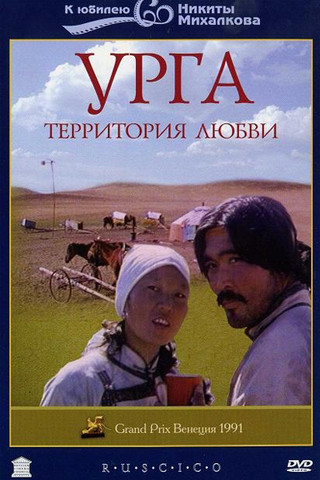
Nikita Mikhalkov – Urga AKA Territory of Love AKA Close to Eden [+Extras] (1991)
Drama1991-2000ArthouseNikita MikhalkovUSSRPlot Synopsis by Michael Betzold
Veteran Russian writer-director Nikita Mikhalkov’s film about the impact of modern civilization on an idyllic part of Mongolia won the Golden Lion at the Venice Film Festival and was nominated for an Oscar as Best Foreign Film. A farmer (Bayyartu) and his wife, who live in a rural part of Inner Mongolia, have three children. Chinese population control policies prevent them from having any more. The farmer sets out for the nearest town to obtain birth control. He comes upon a Russian truck driver (Vladimir Gostyukhin) who has ended up in a lake. The farmer takes the man back to his farm, and after initially being appalled at the lack of civilization, the Russian becomes enchanted with the peaceful life of the backwards countryside and decides to stay. But his presence presages big changes for the peasants.
Read More » -
Pavel Arsyonov – Lilovyy shar AKA The Purple Ball (1987)
1981-1990FantasyPavel ArsyonovSci-FiUSSRPlot
Alisa Seleznyova and her father professor Seleznyov are traveling in space. They meet their old friend archaeologist Gromozeka, who’s just discovered a planet all inhabitants of which died. It became known that they discovered a virus of hostility, got infected and killed each other. Gromozeka also discovered that they had left the virus on Earth 26000 years ago, and the virus is about to become loose. The only chance to save the Earth is to travel 26000 years back in time – to the epoch when witches, dragons and magicians lived along with usual people.Read More » -
Sergei M. Eisenstein – Ivan Groznyy I (Иван Грозный) AKA Ivan the Terrible Part 1 (1944)
Drama1941-1950ClassicsSergei M. EisensteinUSSR
From Turner Classic Movies:
On the day of his coronation as the first Tsar of Russia, the former archduke of Moscow, Ivan IV (Nikolai Cherkasov), finds himself inheriting a deeply troubled empire. The Russian people are divided into estranged clans including the Tartars and the aristocratic boyars, led by the evil, black-cloaked princess and Ivan’s aunt Euphrosinia Staritskaya (Serafima Birman).Read More »