USSR

  • Roman Balayan – Khrani menya, moy talisman AKA Guard Me, My Talisman (1986)

    1981-1990DramaRoman BalayanUSSR

    Quote:
    The setting for this off-beat drama of love and jealousy is the Pushkin Poetry Festival in Boldino. Liosha (Oleg Yankovsky) and his wife Tania (Tatiana Drubich) are walking through the plush forest around Boldino when a mysterious figure pops up from behind a tree and asks the couple a question on an esoteric point of Pushkin scholarship. From that strange beginning, the man, whose name is Klimov (Alexander Abdulov), starts to ease himself into the couple’s private space, and trouble ensues. Complementing this story is the festival itself, enactments of Pushkin’s works, and emotional debates among the festival-goers over the meaning of his poetry.Read More »

  • Aleksandr Sokurov – Moskovskaya elegiya aka Moscow Elegy (1987)

    Aleksandr Sokurov1981-1990DocumentaryDramaUSSR

    Quote:
    Originally produced to mark the 50th birthday of Andrei Tarkovsky (Solaris, Stalker), Moscow Elegy is a stunning documentary and subjective portrait of the legendary filmmaker by Alexander Sokurov, director of Russian Ark and Tarkovsky’s spiritual heir.Read More »

  • Lev Kulidzhanov – Kogda derevya byli bolshimi AKA When the Trees Were Tall (1961)

    Lev Kulidzhanov1961-1970DramaRomanceUSSR

    Plot:
    World War II veteran Kuzma Kuzmich Iordanov has become a heavy drinker with no interest in finding employment of any kind. He joins a collective farm, claiming to be the father of Natasha, a resident there, and is forced to analyze his life when he finds himself falling in love.Read More »

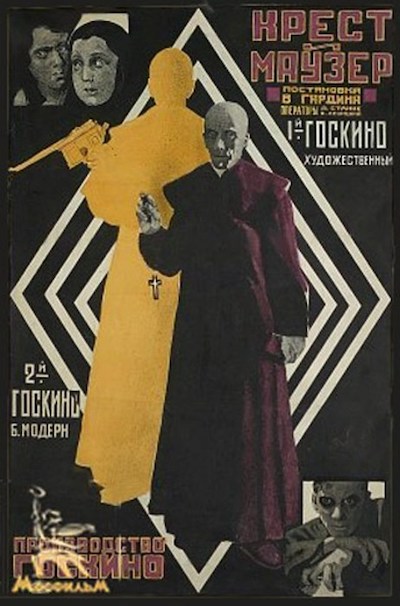
  • Vladimir Gardin – Krest i mauzer aka Cross and Mauser (1925)

    1921-1930DramaSilentUSSRVladimir Gardin

    A powerful and utterly brutal Soviet propaganda broadside levelled at the Catholic church.
    Compelling in its prolific use of facial close-up shots.

    Cast note:
    Krest I Mauzer marks the first film appearance of; Nikolay Kutuzov, who would later appear in Tarkovskys Andrei Rublev (1966) and in the film Viy (1967) and Alexei Pirogov, who would go on to become a Bolshoi soloist (1931-48).Read More »

  • Aleksey Balabanov – Ranshe bylo drugoe vremya AKA There used to be another time (1987)

    Aleksei Balabanov1981-1990DramaShort FilmUSSR

    This story, that takes place during one day, tells about male meanness and ever-hard female destiny… The action takes place against the background of the first hits of the young group “Nautilus Pompilius”…

    The first professional work of the director Alexey Balabanov, who at that time worked as an assistant at the Sverdlovsk Film Studio. The film was a teaching work, filmed while studying at the Higher Courses of Scriptwriters and Directors.Read More »

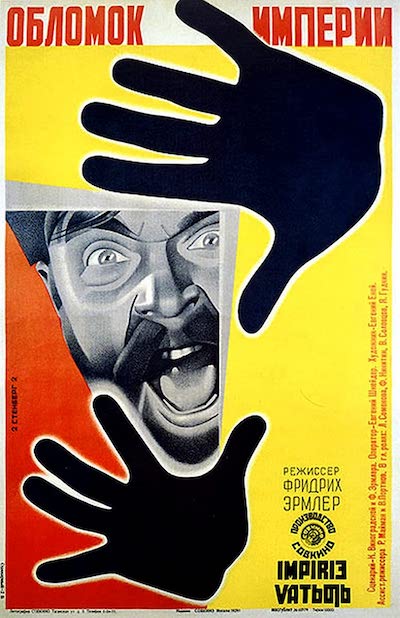
  • Fridrikh Ermler – Oblomok imperii AKA Fragments of Empire (1929)

    1921-1930Fridrikh ErmlerPoliticsSilentUSSR

    Synopsis:
    Fridrikh Ermler’s last silent feature, Fragment of an Empire, tells the story of a Russian non-commissioned officer, Ivan Filimonov (Fyodor Nikitin), who was shell-shocked, thought to be dead in the First World War and in loss of memory. Filimonov regains his memory in 1928, ten years after the Russian Revolution. Determined to find his wife and get his job back, he goes home to Saint Petersburg only to find out that his wife has remarried and his former employer has been replaced by a factory committee. The Saint Petersburg that he used to know also does not exist anymore. Renamed Leningrad and deprived of its status as capital, the city with its monumental buildings and statues of Lenin is foreign to Filimonov as is everything else in this new world created by the 1917 Revolution. As time goes by, however, he learns to appreciate the new ways. Although he is not reunited with his wife, he regains full control of his life. At the end of the film, Filimonov breaks the fourth wall and addresses the audience directly as he declares, in true Soviet propaganda fashion: “There is still much work to be done!”Read More »

  • Vadim Abdrashitov – Ostanovilsya poezd AKA The Train Has Stopped (1982)

    Vadim Abdrashitov1981-1990DramaUSSR

    A 1982 Soviet drama film directed by Vadim Abdrashitov and written by Aleksandr Mindadze. The last role of actor Anatoly Solonitsyn. Before the official premiere the film was shown in spring of 1982 at the Concert Hall of the Moscow Institute of Physics and Technology.

    This movie is a typical exanple of a production drama, a type of movies associated with artistic representation in cinema (mainly in the USSR) of social relations of participants in the sphere of industrial (agricultural, resource-mining, and so on) production. They were very popular in Soviet Union from 1930s till late 1980s.Read More »

  • Valeri Rubinchik – Dikaya okhota korolya Stakha AKA The Savage Hunt of King Stakh (1980)

    1971-1980HorrorUSSRValeri Rubinchik

    Quote:
    It was a dark and stormy night…. at the turn of the century and Bielarecki (Boris Plotnikov), a young ethnographer seeks shelter at Marsh Firs, a gloomy baronial manor set amidst Byelorussian marshes, while he conducts research into the myths and legends of the region. He discovers from the castle’s young and tragic owner, Nadzieja Jankowska (Yelena Dimotrova), that the place is haunted by two ghosts-the Little Man of Marsh Firs and the Lady in Blue-and that her family line was accursed centuries ago when ancestor Roman Jankowska denied the hand of his daughter to King Stach, whose ghost now rides with those of thirteen horsemen to drag Jankowska offspring and their servants to death in the surrounding marshes…Read More »

  • Lev Kuleshov – Neobychainye priklyucheniya mistera Vesta v strane bolshevikov AKA The Extraordinary Adventures of Mr. West in the Land of the Bolsheviks (1924)

    1921-1930ComedyLev KuleshovSilentUSSR

    Quote:
    Mr. West was the first feature film that Kuleshov made with a team of actors who had attended his Experimental Cine-Laboratory. For four years, this group had been doing preparatory work as they planned to reform the art of cinema with an eye on montage. Yet, for a long time, their ideas remained dry theory, because the workshop lacked resources to make films. The focus of the Cine-Lab’s practice was on acting études. Details of scenes were story-boarded, photographed, or “framed” by special viewfinders in order to visualize how they might look in an edited film sequence. Thanks to these exercises, the notion of montage that Kuleshov developed was inextricably linked to his ideas on acting and shot composition. Read More »

Back to top button