Japan

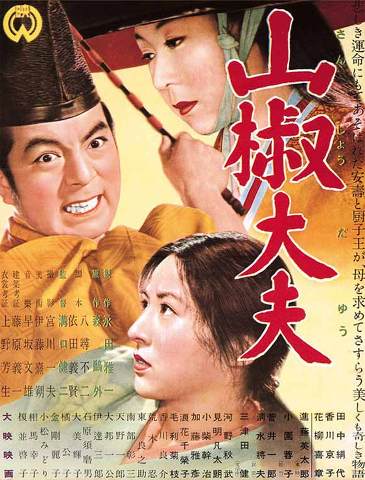
  • Kenji Mizoguchi – Sanshô dayû AKA Sansho the Bailiff (1954) (HD)

    1951-1960ClassicsDramaJapanKenji Mizoguchi

    29f7c043f76a2bde437fd0d52a185152

    Sansho Dayu… is the triumphant summation of Mizoguchi’s style and themes, as well as the most compassionate response imaginable to those atrocities which had been committed in then very recent years, in Japan and all over the world. It is the most humanist of films, but it asserts that humanism is powerless without politics, just as politics is purposeless without humanism. The last sequence is the most perfect ending in cinema, so broad in implication, so exquisite in form. The reunion of mother and son – the revelation of human love – is at once the most important thing in the world, and an event insignificant against the panorama of human suffering. The double perspective – never to see things in isolation, always in context – is assured by Mizoguchi’s style, and defines his art. Sansho Dayu is, in Gilbert Adair’s words, “one of those films for whose sake the cinema exists”.
    Alexander Jacoby, Senses Of Cinema.comRead More »
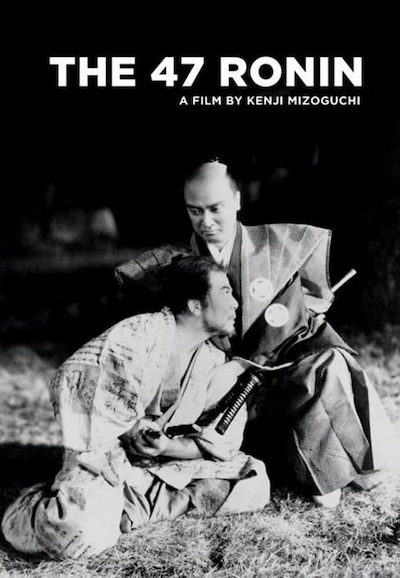
  • Kenji Mizoguchi – Genroku Chûshingura aka The 47 Ronin (1941)

    1941-1950ActionAsianJapanKenji Mizoguchi

    In 1701, Lord Takuminokami Asano has a feud with Lord Kira and he tries to kill Kira in the corridors of the Shogun’s palace. The Shogun sentences Lord Asano to commit suppuku and deprives the palace and lands from his clan, but does not punish Lod Kira. Lord Asano’s vassals leave the land and his samurais become ronin and want to seek revenge against the dishonor of their Lord. But their leader Kuranosuke Oishi asks the Shogun to restore the Asano clan with his brother Daigaku Asano. One year later, the Shogun refuses his request and Oishi and forty-six ronin revenge their Lord.Read More »

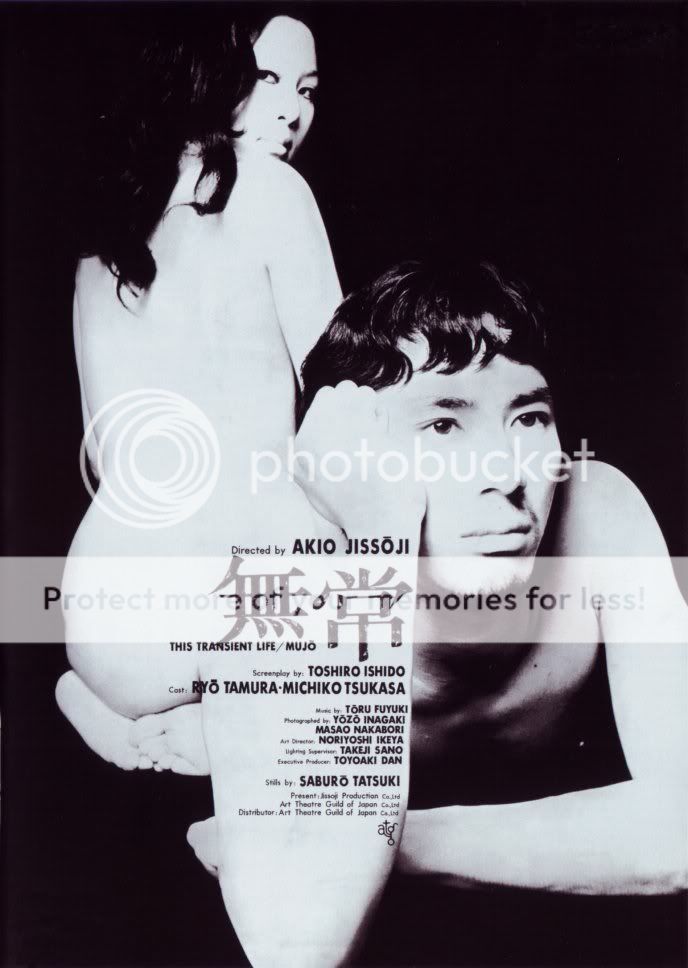
  • Akio Jissoji – Mujo aka This Transient Life (1970)

    1961-1970Akio JissojiAsianJapanPhilosophy

    http://i94.photobucket.com/albums/l83/Kane32/poster-1.jpg

    29f7c043f76a2bde437fd0d52a185152

    Synopsis
    This Transient Life tells the story of the siblings Masao and Yuri who live in a huge estate near Lake Biwa north of Kyoto. Masao refuses to go to university and is infatuated with Buddhist sculptures. Iwashita, a student who lodges at the house, and Ogino, a young priest and former classmate of Masao, are both in love with Masao’s beautiful sister Yuri, who rejects all proposals from her parents to marry her off. One day, while being alone in the big house and playing with No-masks, Masao and Yuri end up in a passionate embrace. Thus starts their forbidden relation that soon bears fruit. When Yuri gets pregnant the siblings plot a perfidious plan. Yuri seduces Iwashita only to be discovered by her parents, who then force Iwashita to marry her. Masao leaves for Kyoto to become an apprentice to the famous sculptor of Buddhist statues, Mori Takayasu. He starts a relation with the much younger wife of the impotent sculptor, who secretly enjoys watching them make love. A year later Masao briefly returns to his parents’ house.Read More »

  • Masaru Konuma – Toki niha Shoufu no youni AKA Sometimes Like a Prostitute (1978)

    Drama1971-1980EroticaJapanMasaru Konuma

    Sometimes… Like a Prostitute is a 1978 Roman Porno film directed by Masaru Konuma and starring singer Rei Nakanishi, whose hit song inspired the story.Read More »

  • Tadanari Okamoto – Tadanari Okamoto Film Works Vol 4 (1961 – 1995)

    1961-1970AnimationAsianJapanTadanari Okamoto

    29f7c043f76a2bde437fd0d52a185152

    Quote:
    Beginnings: 1932-1963

    To tell Okamoto’s story from the beginning, we have to make a short detour
    to talk about Tadahito Mochinaga, the legendary father of Japanese stop-motion
    animated filmmaking. Mochinaga had started out working under Mitsuyo Seo,
    and had left Japan for Manchuria just before the end of the war, where he found
    himself in demand for his animation knowhow. (To learn more about his fruitful
    China period, I refer you to an outstanding article on Mochinaga by Kosei Ono on AWN.)Read More »

  • Naoyuki Tomomatsu – Karei naru erogami-ke no ichizoku: Shinsô reijô wa denki shitsuji no yume o miru ka AKA Erotibot (2011)

    2011-2020CampJapanNaoyuki TomomatsuSci-Fi
    Erotibot (2011)

    Plot Synopsis
    Tamayo, a lovable girl, is taken care of by a prominent family. However, she is the love child of business tycoon and his lover but lives with him and his arranged wife’s family and granddaughter, Tsukiyo who hates Tamayo. Her crime lord father has arranged 3
    android bodyguards to protect her. The first android is handsome & has great skills.
    The second has beast-like strength, and the third is less skillful. One day the father gets hospitalized and his will is found. The will says that he is leaving his fortune solely to Tamayo. When Tsukiyo knows this she plots to regain her inheritance.Read More »

  • Koji Wakamatsu – 17-sai no fukei – shonen wa nani o mita no ka AKA Cycling Chronicles: Landscapes the Boy saw (2004)

    2001-2010ArthouseAsianJapanKoji Wakamatsu

    29f7c043f76a2bde437fd0d52a185152

    Kôji Wakamatsu’s Cycling Chronicles: Landscapes the Boy Saw (17-sai no fûkei – shônen wa nani o mita no ka) – a.k.a. “Cycle Chronicles – Landscapes the Boy Saw” and “17 and Life” – is scheduled to have its U.S. première at the 49th San Francisco International Film Festival (SFIFF) on April 27th at 8:45 p.m., and to subsequently be screened there on May 2nd at 6:00 p.m.. As was previously reported here and there on Twitch, the movie was screened at Regional Film Festival (Rîjonaru Firumu Fesutibaru) – “RiFF” for short – on October 31, 2004, and at the 26th PIA Film Festival in Sendai (Dai-26-kai Pia Firumu Fesutibaru in Sendai) – “PFF Sendai” for short – on November 23, 2004. It was released theatrically in Japan by Toshiki Shima’s Shima Films on July 30th of last year.Read More »

  • Yasuzo Masumura – Ongaku aka The Music (1972)

    1971-1980DramaJapanYasuzô Masumura

    29f7c043f76a2bde437fd0d52a185152

    Masumura has been one of the most intersting directors for many of us Japanese cinema buffs. His “Blind Beasts” is a real classic and a disturbing film, almost an archetype of movies dealing with dark sexual passions, abductions and growing affection to an abuser.

    Masumura’s much less known film “The Music” also deals with dark passions, but from a more pathological point of view. Our main character is Reiko, who has problems enjoying sex with her lover and who is also not able to hear music when it’s played on the radio. A psychiatrists tries to cure her and finds out a lot about her past. Reiko’s passions, fears and experiences are presented in drastic, exciting pictures and metaphors (a big, scary pair of scissors appears again and again ready to cut off legs and maybe other important part from the body titles), combined with a very haunting score. The characters act wild and breathless, you can almost smell their feelings.
    Even more interesting: The film is based on a novel by the famous writer Mishima Yukio, who wrote a lot of exciting books but who is also well known for his ritual act of public suicide in 1970 – 40 years ago.

    ———–
    Totorochi<Read More »

  • Nagisa Oshima – Asu no taiyo AKA Tomorrow’s Sun (1959)

    1951-1960AsianJapanNagisa OshimaShort Film

    http://img841.imageshack.us/img841/2051/snapshot20070329170615w.jpg

    29f7c043f76a2bde437fd0d52a185152

    As far as I know, this short film is Nagisa Oshima’s directorial debut. It seems to be in the form of a trailer for a film that doesn’t exist. It parodies the mainstream Japanese film genres of the time and is a rare glimpse at Oshima’s more playful side.Read More »

Back to top button