Quote:
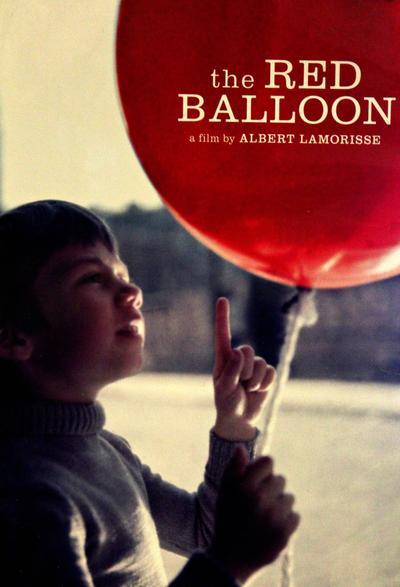
The story of a boy and his toy, The Red Balloon is widely praised for its narrative and visual “purity,” but not enough is said about the movie’s delightful manipulation. A quasi-silent comedy with musical cues straight out of the Charlie Chaplin tradition, Albert Lamorisse’s film plays a game with its audience, just as the little boy (Pascal Lamorisse) and his glowing red orb cling to, fall away from, and chase each other throughout the 34-minute running time. With its many stairs and sloping alleyways, the blue-gray Ménilmontant neighborhood of Paris is like a maze, constantly threatening to come in between the boy and his new pal, but like a magnet or a dog starved for attention, the balloon always comes back to him. He lets go of it on his apartment balcony and watches it fall to him downstairs. He directs it to “wait here” while he buys a treat at the local bakery. A group of neighborhood bullies chase the balloon through a perilously narrow corridor, throwing rocks as it tries to escape. The honeymoon is short-lived, but Lamorisse suggests that kids are always keenly attuned to the objects of the world around them: After the boy loses his red friend, a montage of balloons across the city shows them flying to his side and, in the final shot, launching him into the sky. For Lamorisse, then, the pleasures of childhood are as fleeting as they are ecstatic.Read More »
France
-
Albert Lamorisse – Le ballon rouge AKA The Red Balloon (1956)
1951-1960Albert LamorisseDramaFranceShort Film -
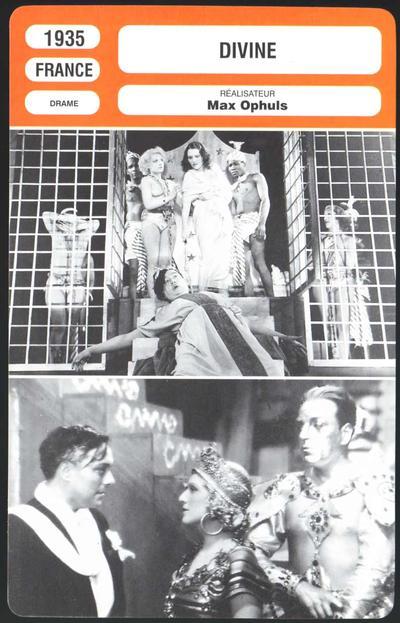
Max Ophüls – Divine (1935)
1931-1940ClassicsDramaFranceMax OphülsSynopsis:
Ludivine Jarisse is a young woman who lives a contented but unexciting life in the country. One day, she is visited by Roberte, an old friend who has made a career for herself as an actress at a Paris music hall, L’Empyrée. Roberte intends to take a break and invites her friend to take her place. Ludivine readily accepts, and soon becomes a musical hall diva under the name Divine, although she is at first reluctant to expose herself in the revealing costumes she is given. One of her colleagues attempts to take advantage of her naivety, but when she resists, he implicates her in a drugs trafficking affair. Divine remains untainted by all this vice and falls in love with an honest milkman, Antonin. He offers to marry her and she is finally able to leave the music hall to start a new life, back in the country.Read More » -
Claude Chabrol – Alice ou la dernière fugue aka Alice or The Last Escapade (1977)
1971-1980Claude ChabrolDramaFranceMysteryAlice, fleeing her boring boyfriend, arrives at a mysterious house which turns out very difficult to leave. A dreamlike cross between Alice in Wonderland and a Borges story – a veritable garden of forking paths. Quite unusual for Chabrol and little known today, but deserving a re-discovery.Read More »
-
Louis Delluc – L’inondation (1924)
1921-1930DramaFranceLouis DellucSilentSynopsis :
Dans un village paisible en bord du Rhône, Alban, jeune et honnête fermier, s’apprête à épouser la coquette et frivole Margot. Monsieur Broc, employé de mairie solitaire, retrouve sa fille adorée Germaine, devenue une charmante jeune femme. Germaine s’est éprise d’Alban. Lorsque celui-ci l’éconduit gentiment, elle s’effondre, fiévreuse, au grand désarroi de son père. La crue du fleuve inonde subitement le village et les alentours. Margot déclenche la colère d’Alban en fricotant avec son cousin Jean. Un soir elle disparaît. On la retrouve mystérieusement noyée.Read More » -
Sepideh Farsi – Le voyage de Maryam AKA The Journey of Maryam (2003)
2001-2010ArthouseDramaFranceSepideh FarsiA poignant and poetic piece exploring the nature of memory, longing, loss, and the people and places that make us who we are. Shot entirely from the vantage point of Maryam, the invisible heroine in search of her father, the film recalls the visual sophistication of Vertov or Farsi’s compatriot Kiarostami. However, in the end, a unique voice rises to the top befitting this intimate and personal journey through the neighborhoods, alleyways, and people of Tehran.Read More »
-
Maurice Pialat – La gueule ouverte AKA The Mouth Agape (1974) (HD)
1971-1980ArthouseDramaFranceMaurice PialatMonique Mélinand portrays a woman in the late stages of terminal illness. Her son Philippe (Philippe Léotard), Philippe’s wife Nathalie (Nathalie Baye), and her husband Roger (Hubert Deschamps) attempt to comfort her as she navigates through her ordeal. However, those two closest men in her personal life begin to get more involved in their relationships with multiple mistresses. Her husband flirts with customers in their clothing and haberdashery store while her son flirts with her nurses. The film incorporates elements of Mozart’s opera Così fan tutte to poetic effect, relating to these scenes. In the end scenes, she goes through several final, deeply emotional moments as the disease claims her life. (Wikipedia)Read More »
-
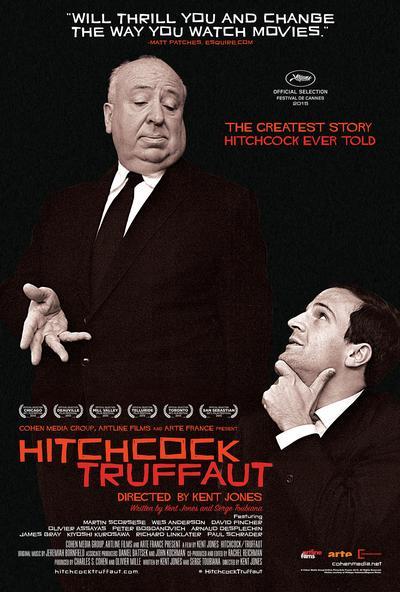
Kent Jones – Hitchcock/Truffaut (2015)
2011-2020DocumentaryFranceKent JonesFrom theguardian.com
In 1962, director François Truffaut conducted a series of in-depth interviews with Alfred Hitchcock, published in a lavishly illustrated book, which became something of a film-makers’ bible. Truffaut’s aim was to reclaim Hitchcock as an artist – an “auteur” rather than just an entertainer. Kent Jones’s documentary, which draws on audio tapes of those conversations along with new interviews with Martin Scorsese, David Fincher, Wes Anderson et al, is no less evangelising, arguing that Truffaut’s book should be viewed and valued on a par with his movies. The documentary certainly makes for fascinating viewing; although most cineastes will already know the source text inside out, it’s great to hear audio of these exchanges, and the new interviews that make up the bulk of the film are entertaining, erudite, and (most importantly) refreshingly enthusiastic.Read More » -
Andrzej Zulawski – Cosmos (2015)
2001-2010Andrzej ZulawskiArthouseDramaFranceBy Carlo Chatrian, pardolive.ch
For his return to directing 15 years after La Fidélité, Andrzej Zulawski has chosen one of the most difficult authors to adapt and a text that poses significant challenges, given its constant verbal invention and narrative deviations. Cosmos, written 50 years ago by Witold Gombrowicz, four years before his death, is one of those works that creates a kind of precipitous vertigo.
Zulawski is clear from the start: it only takes a few minutes for the viewer to realize this is no classic adaption of a bourgeois novel. Instead, young Witold’s arrival at the house where he will stay is the entrance to an out-of-the-ordinary universe. A world where sparrows are hanged, where strange arrows take shape on the ceiling, where the television that’s always on for every meal broadcasts incessant images of war, where seduction and repulsion go hand in hand. The thin thread of an investigation – discovering who is responsible for these signs – becomes a metaphor for talking about language. See, for example, the brilliant tirade from the “paterfamilias”.Read More »
-
Jean-Paul Civeyrac – À travers la forêt AKA Through the Forest (2005)
2001-2010ArthouseDramaFranceJean-Paul CiveyracQuote:
Jean-Paul Civeyrac’s latest feature, Through the Forest is composed of ten meticulously crafted shots, each running for six or seven minutes. Despite this formal rigor, the narrative has a free-flowing, dreamlike quality, taking twists and turns that may leave audiences occasionally puzzled, but also deeply absorbed.Atmosphere and mood are emphasized over plot, but the story essentially revolves around a young woman named Armelle who is mourning the sudden death of her boyfriend Renaud. She is surrounded by her two sisters, both of whom are troubled by her seeming incapacity to move on. After hearing Armelle describe the vivid dreams she’s been having, in which Renaud materializes to make passionate love to her, the more sympathetic of the sisters suggests she visit a medium to try to communicate directly with him. While at the medium’s, Armelle is shocked to glimpse a boy named Hippolyte, who bears an uncanny resemblance to Renaud.Read More »