An archeological finding and the stories it may contain. Made with great humor.
From Wikepedia: Parviz Kimiavi (Persian:پرويز کيمياوی; Born 1939, Tehran) is an internationally acclaimed Iranian (Persian) film director, screenwriter, editor and one of the most prominent figures of Persian cinema of the 20th century.
Kimiavi studied photography and film at l’École Louis Lumière (Louis Lumiere School of Cinematography) and IDHEC. His works gained critical success and won several prizes in important international events such as Berlin and Cannes.Read More »
Quote: Cityscape elaborates on the methods Snow used in the making of his ground-breaking 360-degree film La Région Centrale (1971). Taking the advice of his long-time friend, Graeme Ferguson, to produce it as an Imax film, Snow orchestrates new patterns of movement that exchanges the focus on landscape in La Région Centrale with the cityscape of Toronto.Read More »
24 Frames is an experimental project made by filmmaker Abbas Kiarostami in the last three years of his life. It is a collection of 24 short four-and-a-half minute films inspired by still images, including paintings and photographs.Read More »
”[The film] was planned to coincide with the fiftieth anniversary of Amy Johnson’s epic solo flight to Australia in 1930—to commemorate it and to comment on it. AMY! is neither a drama nor a portrait in the conventional sense, but an assembly of sounds and images which evoke the subject through historic documents and relics, re-enactments and metaphors. The film also asks the underlying question: What is a heroine? We want to enquire into the idea and image of the heroine, not in an explicitly theoretical way—though the film has a theoretical background—but by putting fragments on display to suggest both the frustrations from which heroism is born and to which it is condemned, and at the same time something of the exhilaration it provides for the heroine herself and for others. Formally, our points of reference are Maya Deren and Gertrude Stein.” (Laura Mulvey and Peter Wollen)Read More »
Quote: Marlon Riggs, with assistance from other gay Black men, especially poet Essex Hemphill, celebrates Black men loving Black men as a revolutionary act. The film intercuts footage of Hemphill reciting his poetry, Riggs telling the story of his growing up, scenes of men in social intercourse and dance, and various comic riffs, including a visit to the “Institute of Snap!thology,” where men take lessons in how to snap their fingers: the sling snap, the point snap, the diva snap. The film closes with obituaries for victims of AIDS and archival footage of the civil rights movement placed next to footage of Black men marching in a gay pride parade.Read More »
Synopsis The recurring theme of dance once again works its way into a Shirley Clarke project, as this short film features a performance that takes place across a multitude of environments. As a primary couple intimately interacts, Clarke tests herself as a filmmaker by enhancing the performance with camera movements and visual additions. Altering the setting and the atmosphere with the use of back-projection, this intriguing piece illustrates Clarke’s willingness to experiment on many levels.Read More »
Quote “This film by Bruce Baillie, completed in 1966 but unreleased until 2014, is contemporaneous with Castro Street, but is much more formally connected to All My Life or Still Life, also from the same year. In three sections with three different formal strategies, Baillie shares distilled moments of found natural beauty as he encountered them in the North Bay outside San Francisco. The first section features a study of plum blossoms, rendered in rich, multiple superimpositions that allow the white flowers to explode into a blizzard of visual complexity, framed by a panning shot of purple mountains. In the second section, Baillie allows us a furtive glimpse of the titular little girl, waving to cars with her dog on the side of the road, lost in her world and thoughts. Bruce#s framing remains unadorned, feeling no need to add to or take away from a beautiful piece of simple portraiture. The third section, of waterbugs on the surface of a pond, remind us how remarkable and sensitive Baillie’s camerawork can be, as he observes their graceful dances, and the subtle light and water effects they produce by their movements.” Mark ToscanoRead More »
Carl is having trouble writing. As the film progresses, his novelistic character develops into a real person who intervenes in his life with increasing menace. The lector Roy supports Carl but is marked by a severe illness. To escape his difficulties, Carl accompanies Jon and Liza on an architectural journey. Bela and Fred remain behind with Roy and are confronted with his approaching death. For his friends, his death becomes the motive to reconstruct their life spent together.Read More »
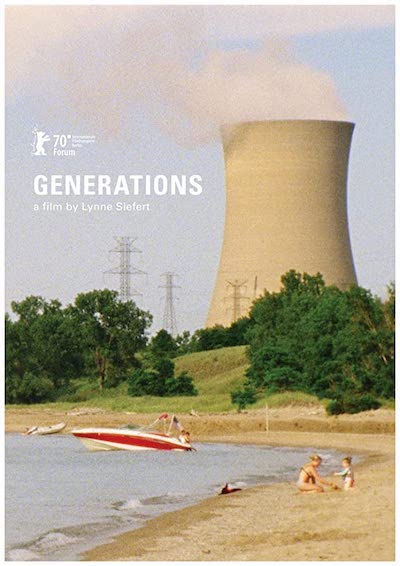
Thirteen static shots of coal-fired power stations across the United States, seen in rural landscapes, urban settings, sun or cloud and at all times of year. Whatever the location or season, there’s always at least one chimney belching out fumes.Read More »