Drama

  • Yakov Protazanov – Bespridannitsa AKA The bride without a dowry (1937)

    1931-1940DramaUSSRYakov Protazanov

    29f7c043f76a2bde437fd0d52a185152

    From allmovie: Filmed in 1937 (in fact: 1936), the Russian film “Without Dowry” was released in America in 1946, one year after the death of its director, Yakov Protazanov. Produced on a far-less epic scale than most Protazanov films, this is a merciless satire of the Russian dowry system in particular and the Czarist regime in general. The heroine (Nina Alisova) is promised in marriage to a bureaucrat (Victor Balikhin), who is interested only in receiving the girl’s dowry. Maintaining a gently comic tone throughout most of the proceedings, the story dovetails almost imperceptibly into tragedy. The musical score is based upon Tchaikovsky’s 5th, with a few Russian folk songs woven in.
    Read More »

  • Yakov Protazanov – Chelovek iz restorana aka The Man From Restaurant (1927)

    1921-1930DramaSilentUSSRYakov Protazanov

    29f7c043f76a2bde437fd0d52a185152

    Based on story by Ivan Shmelev.
    The movie action starts very close before February democratic revolution in Russia in 1917.
    Fate is cruel to waiter of capital city restaurant Skorohodov: his son dies on front, his wife perishes from grief, his daughter is excluded from grammar school because of lack of money to pay tuition.
    Skorohodov decides to rent one of rooms in his poor apartment to a decent young man named Sokolin who is working as a courier in war industry committee .
    The lodger and a girl fall in love with each other and soon decide to get married.
    In meantime the father appoints his daughter as a violiinist in restaurant orchestra.
    But rich factory owner Karasev rudely molests young blonde violinist and through blackmail expects to make her his mistress.
    Read More »

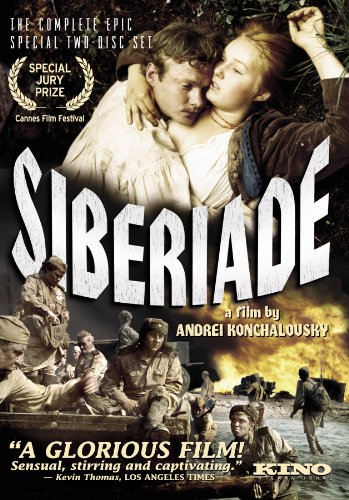
  • Andrei Konchalovsky – Sibiriada aka Siberiade (1979)

    1971-1980Andrei KonchalovskyDramaEpicUSSR

    29f7c043f76a2bde437fd0d52a185152

    Amazon.com
    This ambitious 1979 Russian film attempts no less a feat than the encapsulation of the tumultuous history of Russia in the 20th century. Written and directed by Andrei Konchalovsky (Runaway Train, Tango and Cash), the film weaves an engrossing tale of three generations of two Russian families in the remote region of Siberia, each trying in their own way to find fulfillment in their lives as they seek to reconcile themselves with the ever-changing landscape of their homeland. Sandwiched between the chaotic events of the First and Second World Wars, as well as the Russian Revolution of 1917, the people of the small village find themselves at the cusp of great changes, from communications to the expanding infrastructure and the changes that brings, to the discovery of oil and the riches and perils that come with it. Konchalovsky juxtaposes archival footage with stunning cinematography and contrasts the assaultive changes of the modern world with the timeless impulses of family and the enduring need to adapt and survive. Reminiscent of such great films as Giant and 1900, Siberiade is a visually adept and stunningly effective epic about the price of a country’s history on its people. —Robert Lane
    Read More »

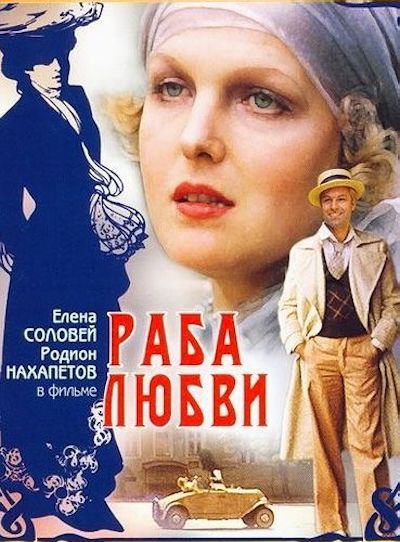
  • Nikita Mikhalkov – Raba lyubvi AKA A Slave of Love (1976)

    1971-1980DramaNikita MikhalkovUSSR

    Plot Synopsis by Hal Erickson (from allmovie.com)
    Nikita Mikhalkov examines the plight of the filmmaker operating in an uncertain political climate in his irony-laden seriocomedy Slave of Love. The time is 1918, at the height of the Bolshevik revolution. A small group of filmmakers are hurriedly trying to complete a silent melodrama while the world changes all around them. As production progresses, leading lady Elena Solovei metamorphoses from self-centered movie star to committed revolutionary. Normally described as “Chekhovian,” director Mikhalkov borrows a few pages from Pirandello. With Slave of Love he gained his first serious international attention.Read More »

  • Nikita Mikhalkov – Neskolko dney iz zhizni I.I. Oblomova AKA A Few Days in the Life of I.I. Oblomov (1979)

    Drama1971-1980ArthouseNikita MikhalkovUSSR

    Synopsis:
    St. Petersburg, mid 19th century: the indolent, middle-aged Oblomov lives in a flat with his older servant, Zakhar. He sleeps much of the day, dreaming of his childhood on his parents’ estate. His boyhood companion, Stoltz, now an energetic and successful businessman, adds Oblomov to his circle whenever he’s in the city, and Oblomov’s life changes when Stoltz introduces him to Olga, lovely and cultured. When Stoltz leaves for several months, Oblomov takes a country house near Olga’s, and she determines to change him: to turn him into a man of society, action, and culture. Soon, Olga and Oblomov are in love; but where, in the triangle, does that leave Stoltz?Read More »

  • Paul Morrissey – Women in Revolt (1971)

    Drama1971-1980ComedyPaul MorrisseyUSA

    29f7c043f76a2bde437fd0d52a185152

    Vincent Canby @ The New York Times, Feb 17, 1972 wrote:
    Probably no man, not even Norman Mailer, will ever have the last word on women’s liberation, but until ones does, perhaps the Andy Warhol-Paul Morrissey “Women in Revolt” will do. The movie is called a comedy, but it can be more accurately described as a madcap soap opera whose three manic heroines are played by female impersonators—which may be interpreted as the ultimate put-down of women’s lib, as well as the ultimate endorsement.

    More particularly, “Women in Revolt” ( as did “Trash” ) recalls Hollywood movies of the 1930’s and 1940’s, especially those slushy romances in which Alice Faye, Frances Langford and Patsy Kelly compromised everything except their virtue in their pursuit of husbands.Read More »

  • Paul Mazursky – Bob & Carol & Ted & Alice (1969)

    Drama1961-1970ComedyPaul MazurskyUSA

    Quote:
    Documentary film-maker Bob Saunders and his wife Carol attend a group therapy session that serves as the backdrop for the opening scenes of the film. Returning to their Los Angeles home, the newly “enlightened” couple chastise their closest friends, Ted and Alice, for not coming to grips with their true feelings. Bob insists that everyone “feel” rather than intellectualize their emotions, and Carol pronounces “that’s beautiful” after anyone says anything even remotely personal. Ted and Alice humor their friends, but it is obvious that there is a good-natured sexual tension at work within the foursome.Read More »

  • José Padilha & Felipe Lacerda – Ônibus 174 AKA Bus 174 [+Extras] (2002)

    2001-2010BrazilDocumentaryDramaJosé Padilha and Felipe Lacerda

    29f7c043f76a2bde437fd0d52a185152

    Review (by Jamie Russell,) :

    Life is cheap in this searing Brazilian documentary about the real-life hijacking of a bus in Rio de Janeiro in June 2000 by a homeless, drug-addicted street kid named Sandro do Nascimento. Broadcast live on Brazilian television, the four-hour stand-off let the nation watch as its incompetent, poorly trained police force struggled to contain the explosive situation. A stunning indictment of Brazil’s social meltdown, this startling documentary plays like City Of God – except this time the bullets are real.

    The hijacking itself is a catalogue of errors: the police failed to seal off the bus, letting camera crews and Joe Public wander within inches of its windows while Sandro stalked around inside with a .38 revolver. As a result, SWAT team snipers were told not to shoot because the event was being broadcast live on national television.
    Read More »

  • Tengiz Abuladze – Natvris khe aka The Wishing Tree (1976)

    1971-1980ArthouseDramaTengiz AbuladzeUSSR

    This adaptation of Giorgi Leonidze’s short stories sees twenty-two episodes coalesce into one phantasmagoric narrative. Set in pre-revolutionary Georgia, it follows a young woman forced into marriage by her village elders despite her love for another man. Drifting poetically from one incident to the next, this gorgeously sustained pastorale from one of Georgia’s great auteurs creates a sense of the rich tapestry of Georgian village life, and the tragic consequences of community dispute.Read More »

Back to top button