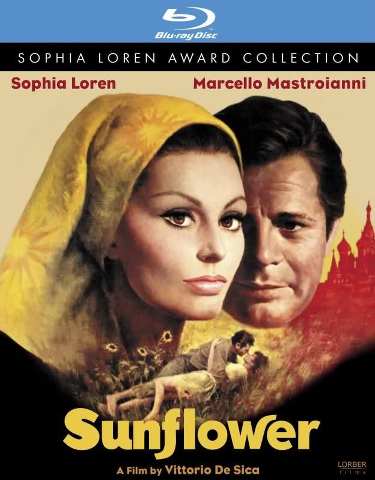

Sunflower, or as it is known in Italian I Girasoli, is a movie about how time continues to march on after war whether or not a person’s life does. Casualties on the battlefield is one way in which we discuss how brutal and total a war’s destruction was, but Sunflower offers another way to look at things: the collateral damage, which pertains not just to those civilians who are accidentally killed but to those whose lives are shattered by being in the general area. It makes the horrors of World War II in Italy accessible to us by focusing on how time marches on and leaves behind the broken emotional pieces of a man and a woman.
Vittorio de Sica, the maestro behind such classics as Marriage Italian Style and Yesterday Today and Tomorrow, directs this Italian film with his two favorite stars, Sophia Loren and Marcello Mastroianni, in a story that blends harsh neo-realist imagery with sentiment, touches of comedy and melodrama. Admittedly, the film could easily come across as overtly melodramatic, even sophomoric. And I could see where others might view the film as such. But de Sica was a wonderful director, and combing these kinds of tones and dealing with these storylines was his bread and butter. For me, the melodrama and sentiment is part of the specific Italian flavor in his films. It is also of historical note to point out that Sunflower was the first Western film to be shot in the Soviet Union.Read More »