Perhaps just as integral to Nazi film history as Leni Riefenstahl was largely forgotten “Jew Suss” director Veit Harlan. This documentary explores the life and career of Harlan, the expert film artisan responsible for the controversial 1940 feature still regarded as the most anti-Semitic production ever made. Includes home movies, archival footage, and interviews with family members who grapple with Harlan’s dark legacy.Read More »
Quote: This is the second part of Stefans Jarl’s Mods trilogy. The films depict the story of Kenta and Stoffe, but at the same time tells the story of Swedish society between the years 1968 and 1993. In A Respectable Life, we return to Kenta and Stoffe eleven years later. Both have created a family. Kenta has done his best and now has a more stable life. Stoffe, however dies during recording, after an overdose of heroin.Read More »
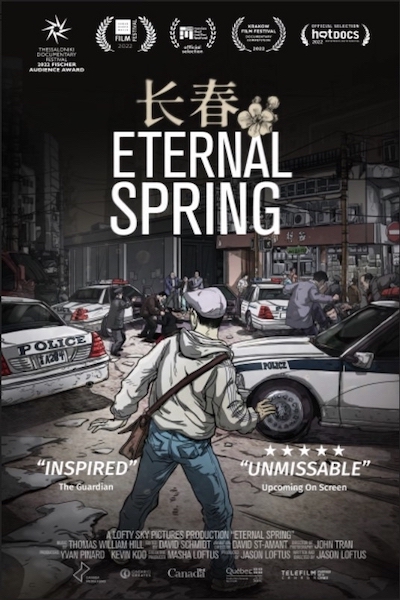
In March 2002, a state TV signal in China gets hacked by members of the banned spiritual group Falun Gong. Their goal is to counter the government narrative about their practice. In the aftermath, police raids sweep Changchun City, and comic book illustrator Daxiong (Justice League, Star Wars), a Falun Gong practitioner, is forced to flee. He arrives in North America, blaming the hijacking for worsening an already violent repression. But his views are challenged when he meets the lone surviving participant to have escaped China, now living in Seoul, South Korea.Read More »
Renowned scholar, linguist, and political activist Noam Chomsky explores the dark side of media. Learn to cut through propaganda, defend against manipulation, and control what you consume.
Dive into the invisible powers of media with Noam Chomsky. One of the most influential thinkers of our time, he’s challenged the mainstream narratives of media, corporations, and governments—for generations. Now he’s connecting his long-standing theories to the issues we care most about today. Get his cutting insights into the powers and perils of social media, AI, and disinformation in a society set up to manipulate.Read More »
Initially a made-to-order documentary on Spain, the film becomes an open-ended work-in-the-making about the creative process. “Settling in the Spanish capital to make a documentary, Hanoun sketches out for us the different steps involved in making a film. The author turns his hesitations, his doubts and difficult working conditions into the constituents of his work”.Read More »
Made while director Kaori Oda was studying at Béla Tarr’s Film.Factory in Sarajevo, Aragane is, on the surface, a documentary about a Bosnian coalmine. As Oda takes us underground, the surroundings are illuminated solely by the available light of the miners’ headlamps, creating a state of sensual semi-blindness that both attunes us to the dangers of the mine and — with the beams cutting arcs of light through the blackness and casting shadows on the cavern walls — becomes an organic metaphor for the roots of cinema itself. It is not surprising that commentators have drawn similarities between Oda’s work and that of Harvard’s renowned Sensory Ethnography Lab: as in such films as Leviathan and Manakamana, in Aragane Oda attempts to understand her subjects through an embodied presence that moves beyond distanced knowledge and towards intimate entanglement.Read More »
Quote: In the powerful documentary “Mahmoud Darwich,” Simone Bitton interviews the famed Palestinian poet about his art, life, and relationship with his homeland. Bitton explores the connection between the poet and the land of which he writes but has not been allowed to visit. His life and the development of his art is retraced, from his experience as a young man living in Jerusalem, to exile in Beirut and Tunis, where he became an active supporter of the Palestinian Liberation Organization, and finally to Paris, where he currently resides and cloisters himself in his work.Read More »
Synopsis A film autobiography of Mao Tse-tung, leader of China from 1947 through until his death in 1976, drawn exclusively from his own writings, diaries, speeches and personal notes. Incorporates footage never before seen outside of China.
A film-détournement biography of Mao Tse-tung in which the life of the recently deceased Great Helmsman is told in his own words, using quotes culled from various Red Guard publications. The rise to power of the film’s namesake appears as the inevitable outcome of a dialectical logical. Or so the voice-over might lead one to believe. If the usual practice of détourned films is for the soundtrack to undermine the image, here the reverse occasionally takes place. The images critique Mao’s words. They show that which, even in the official visual record of the times, the narrative elides. The film is dedicated to Li Yhi Zhe, the nominal author of a famous Democracy Wall critique of the Maoist state.Read More »
Bernardo Bertolucci’s first and only documentary, La via del petrolio consists of three episodes produced by the director in October-November 1965 to recount the complete “oil journey”, from exploration to extraction, shipment and transportation to the refinery in pipelines.Read More »