Quote:
The issue of War widow representation in Israeli cinema is one of the most complex for the local industry for it seems to be unique and with a very local and specific iconography.
The war Widow is a difficult character to digest. Because this is an especially painful topic in Israel, its mode of representation is almost always problematic.
Gila Almagor in Tofano’s “siege” is one of the first characters of the “modern” war widows to appear on Israeli cinema screens.
The human and social complexity of the status of widows was not represented adequately and personally until her complex and fine appearance in this film.
It was mostly Preceded by cliches of heroic women who have sacrificed for the nation with characters to which it was very difficult to get attached, nor to their personal grief.Read More »
Arthouse
-
Gilberto Tofano – Matzor aka siege (1969)
1961-1970ArthouseDramaGilberto TofanoIsrael -
Mauro Bolognini – Mosca addio aka Farewell Moscow (1987)
1981-1990ArthouseDramaItalyMauro BologniniLiv Ullman stars as real-life Russian Jewish dissident and astronomer Ida Nudel, who was denied permission to emigrate and then sent to a labor camp after protesting in Moscow in 1980. Starting off as a romance, turning into a grim political thriller, and then veering into tragedy, director Mauro Bolognini’s melancholy film offers another one of the director’s portraits of strong-willed women who are persecuted by history. The film isn’t particularly well-known, and it’s almost never seen nowadays. But any Ennio Morricone fans will immediately recognize the film’s haunting score, one of the composer’s greatest works.Read More »
-
Jean-Luc Godard – Pierrot le Fou (1965)
1961-1970ArthouseDramaFranceJean-Luc GodardQuote:
A man leaves his bourgeois comfort and wife for a life of adventure and for a girl involved in smuggling, leaves his name Ferdinand for a nickname, Pierrot, leaves his boredom for crazy love, society Paris for “wild” France… to eventually tune himself up with his visions and ideals.Read More » -
Alain Tanner – Dans la ville blanche aka In the White City (1983)
1981-1990Alain TannerArthouseClassicsSwitzerlandQuote:
“Dans la ville blanche” was a turning-point in Tanner’s career as a director. Bringing him renewed public acclaim, it’s most striking aspects are silence, stark poetry and sombre melancholy.
It also marked a change in his aesthetic approach. Although escape and the desire for solitude had always been key Tannerian themes, they had previously been developed on a left-wing foundation and characterised by conversation and playful fantasy, a paradise of puns and facetious remarks in which his characters were at home. There is nothing of the kind in this film.
The Swiss director must have been inspired by his younger days in the merchant navy in imagining this portrait of a sailor (sublimely acted by Bruno Ganz) who abandons everything to merge body and soul into Lisbon. At the beginning of the film, Ganz remarks to a barmaid that the clock in her bar is not indicating the right time. She replies: “The clock is right. It’s the world that is wrong.”
An ode to Lisbon and the pursuit of freedom, the film won a César award for Best French Language Film in 1984.
Read More » -
Ingmar Bergman – Persona [+Extras] (1966)
1961-1970ArthouseDramaIngmar BergmanQueer Cinema(s)SwedenQuote:
Persona is arguably Ingmar Bergman’s most challenging and experimental film. Elisabeth Vogler (Liv Ullman) is an accomplished stage actress who, in the middle of performing Elektra, ceases to speak. Sister Alma (Bibi Andersson), the young nurse assigned to care for her, learns that there is nothing physically or even psychologically wrong with Elisabeth – she has simply, consciously decided not to speak. Alma (the name, not accidentally, is the Spanish word for soul) describes her initial impressions of Elisabeth as gentle and childlike, but with strict eyes. She takes Elisabeth to the attending physician’s remote summer house to facilitate her recuperation. At first, the two seem ideally suited: a talkative, candid, and inexperienced nurse, and a sophisticated, enigmatic, and silent patient. They take long walks, bask in the sun, and read together. It is obvious that their isolation has cultivated a sense of intimacy between them, albeit one-sided.Read More » -
Michelangelo Antonioni – La signora senza camelie AKA The Lady Without Camelias [+Extras] (1953)
1951-1960ArthouseDramaItalyMichelangelo AntonioniClara Manni (Lucia Bosé, so good in Antonioni’s A Story of a Love Affair), a Milan shop girl, is discovered on the street and used for a bit part in a movie. That single part brings her immediate celebrity, and with the coaxing of her producer, Gianni, she becomes a screen sex symbol. She has great success in several sex comedy vehicles, but Gianni decides to push her into the world of the art film in order to attain artistic legitimacy and respect. She never wishes for this, since money is never an issue to her, but she is pushed head first into a production of Joan of Arc. The film is brutally attacked by the critics, and Clara’s dignity and identity are thrown into question in the harrowing final shot.Read More »
-
Samuel Beckett – Quadrat 1+2 (1982)
1981-1990ArthouseFranceSamuel BeckettTV
Quote:
‘Quad’, the first in a series of minimalist experimental television plays made by Beckett in the 1980s for the broadcaster Süddeutscher Rundfunk, operates with a serial game involving the motional pattern of four actors, but equally accommodating four soloists, six duos, and four trios. Four actors, whose coloured hoods make them identifiable yet anonymous, accomplish a relentless closed-circuit drama. Once inside the square, they are condemned to monotonously and synchronously pace the respectively six steps of the lengthwise and diagonal lines it contains, in part accompanied by varying drumbeat rhythms.Read More » -
Diego Rísquez – Orinoko, nuevo mundo (1984)
1981-1990ArthouseDiego RísquezExperimentalVenezuelaThe Orinoko: main character in the film. The first part is set during the pre-conquest and is represented as an earthly paradise. A shaman has precognitive visions: go to Columbus and the Catholic missionary in 1498.Read More »
-
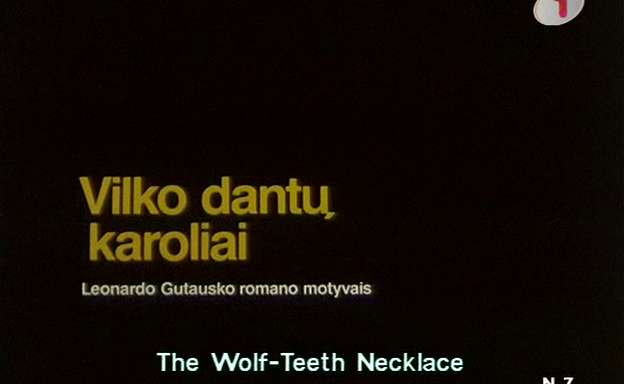
Algimantas Puipa – Vilko Dantu Karoliai aka A Wolf Teeth Necklace (1997)
1991-2000Algimantas PuipaArthouseLithuania
Quote:
“A famed Lithuanian painter expresses the torment of his youth through his paintings. But lately, even his work provides no solace, for he falls into a deep mid-life crises and can find no inspiration. This grim, earnest and arty drama looks back upon his formative years, the joy of which were destroyed by Stalin’s policies. The darkness began for him when his father was arrested for being an enemy of the state and sent to a Siberian prison. The boy and his remaining family become social pariahs, and the only way his mother can support them is to prostitute herself to the local police and politicians. Eventually the young painter is sent to the countryside, but even there, he cannot escape the fear and oppression. To cope, he becomes hard and cynical; his mother too changes dramatically and when the father finally returns home, he finds himself among virtual strangers.”Read More »