Arthouse

  • Alex Ross Perry – The Color Wheel (2011)

    2011-2020Alex Ross PerryArthouseComedyUSA

    29f7c043f76a2bde437fd0d52a185152

    SYNOPSIS:
    JR has broken up with her professor. She enlists her nervous and obnoxious younger brother Colin to take a short road trip in order to help move out her belongings. They bicker and fight, with one another and pretty much anybody they encounter, before being brought to a place of togetherness and understanding as a result of being pushed away by everybody in their lives except one another.Read More »

  • Aleksandr Sokurov – Skorbnoye beschuvstviye aka Anaesthesia Psychica Dolorosa aka Mournful Unconcern (1987)

    1981-1990Aleksandr SokurovArthouseDramaUSSR

    29f7c043f76a2bde437fd0d52a185152

    Quote:
    Mournful Unconcern (Russian: Скорбное бесчувствие, translit. Skorbnoye beschuvstviye) is the third produced film by Alexander Sokurov, completed in 1983, but the fourth released one, as it was banned by Soviet authorities until perestroika in 1987. The film, set during World War I, is inspired by Bernard Shaw’s play Heartbreak House. Professional actors (Zamansky, Osipenko, Sokolova and others) were used alongside amateur actors, like in most early Sokurov films, and many of the trademarks of his cinematographic style were already apparent.
    Read More »

  • Amir Naderi – Cut (2011)

    2011-2020Amir NaderiArthouseJapan

    Free Image Hosting at www.ImageShack.us

    29f7c043f76a2bde437fd0d52a185152

    Quote:
    Cut, by Iranian expatriate Amir Naderi, is a brilliantly offbeat homage to Japanese cinema,” blogs Kieron Corless for Sight & Sound. “It opens on a rootop in Tokyo, where keeper-of-the-flame filmmaker protagonist Shuji projects classic films to a group of friends. The rest of the time he spends haranguing the citizens of Tokyo through a megaphone about the destruction of ‘pure cinema’ by crass commercial fodder, and visiting the graves of Japanese masters Ozu, Mizoguchi and Kurosawa. The film then takes, via the death of his brother at the hands of the yakuza, what seems at first a strange but wonderful detour. Shuji must now clear, in just two weeks, a massive debt that his brother accumulated to finance Shuji’s films; the unexpected method he hits on to do so opens up frightening perspectives on the depths of his devotion to cinema, in the most masochist way imaginable.Read More »

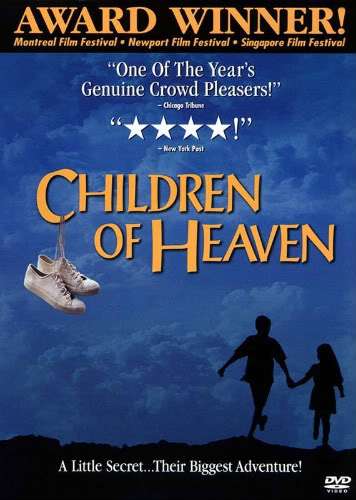
  • Majid Majidi – Bacheha-Ye aseman AKA Children Of Heaven (1997)

    1981-1990ArthouseDramaIranMajid Majidi

    Free Image Hosting at www.ImageShack.us

    29f7c043f76a2bde437fd0d52a185152

    Movie Review
    The Children of Heaven (1997)
    FILM REVIEW; For a Pair of Sneakers, Longing, Lies and a Plan
    By JANET MASLIN

    The young hero of Majid Majidi’s ”Children of Heaven” is played by Mir Farrokh Hashemian, a desolate-looking boy with huge brown eyes and a way of sending tears suddenly rolling down his cheeks. Those tears well up with some regularity during this film about 9-year-old Ali, his younger sister Zahra (Bahareh Seddiqui) and their scheme for sharing a pair of his tattered sneakers. The children want to hide the fact that Zahra’s shoes have been lost because this will be a hardship for their parents. The family’s carefully detailed poverty, which reflects the filmmaker’s own childhood experience, colors everything that happens in this story.

    Events in the film are seen through the children’s ingenuous eyes, as is so often and artfully the case in Iranian films. (A child’s-eye view is, among other things, helpful in circumventing Government censors.) But in the more honest, less manipulative films that this one resembles — especially the graceful work of Jafar Panahi (”The White Balloon,” ”The Mirror”) — what the young characters observe is liable to be more surprising than it is here. In ”Children of Heaven,” life is sweet despite countless hardships, and no reality beyond the economic intrudes upon a fairy tale atmosphere. Only through heavy-handed emphasis does the quest for new sneakers take on any greater meaning.Read More »

  • Joachim Trier – Oslo, 31. august (2011)

    2011-2020ArthouseJoachim TrierNorway

    29f7c043f76a2bde437fd0d52a185152

    Anders will soon complete his drug rehabilitation in the countryside. As part of the program, he is allowed to go into the city for a job interview. But he takes advantage of the leave and stays on in the city, drifting around, meeting people he hasn’t seen in a long while. Thirty-four-year-old Anders is smart, handsome and from a good family, but deeply haunted by all the opportunities he has wasted, all the people he has let down. He is still relatively young, but feels his life in many ways is already over. For the remainder of the day and long into the night, the ghosts of past mistakes will wrestle with the chance of love, the possibility of a new life and the hope to see some future by morning. Read More »

  • Davide Manuli – Girotondo, giro intorno al mondo (1998)

    1991-2000ArthouseDavide ManuliExperimentalItaly

    29f7c043f76a2bde437fd0d52a185152

    Quote:
    Angelo is an orphan who grew up with a nomad woman. He reacts to his pain over the death of his best friend for overdose, thanks to the encounter with Serena. She survives being a prostitute, but she has not lost hope. Angelo moves along an axis of characters in a desolate and poetic day without end.Read More »

  • José Luis Guerín – En la ciudad de Sylvia AKA In the City of Sylvia (2007)

    2001-2010ArthouseDramaJosé Luis GuerínSpain

    Synopsis
    It’s summer and a young foreigner saunters through the streets of this city of street cars and canals.
    A lone wanderer, the hypotheses surrounding him will be changing: An artist, at leisure, a simple tourist, a parasite, paranoid, in love…?
    Lodged at an old, family-run hotel, he walks through the city, observing, writing and drawing –sketching gestures and expressions caught at random on the street.
    In the evenings he haunts a night club called “Les Aviateurs”.
    He peers through the open windows of certain façades.
    He revisits one of them at different times of day, here and there making out minor domestic contents, more insinuated than seen.
    A certain mystery floats over the nature of his intentions, with attitudes reminiscent of those of a voyeur or even a psycho-killer…Read More »

  • Abbas Kiarostami – Like Someone in Love (2012)

    2001-20102011-2020Abbas KiarostamiArthouseJapan

    29f7c043f76a2bde437fd0d52a185152

    Synopsis
    An old man and a young woman meet in Tokyo. She knows nothing about him, he thinks he knows her. He welcomes her into his home, she offers him her body. But the web that is woven between them in the space of twenty-four hours bears no relation to the circumstances of their encounter.
    Festival de Cannes.com

    Reviews
    According to Martin Scorsese, “cinema is a matter of what’s in the frame, and what’s out.” The Iranian filmmaker Abbas Kiarostami applies this axiom with particular rigor. In the first scenes of Mr. Kiarostami’s latest feature, “Like Someone in Love,” we are very much aware of what is not in the frame. We are in a Tokyo bar, listening to a series of conversations that involve a woman we cannot see… he structure of the film is, by Mr. Kiarostami’s standards, fairly straightforward, even conventional: it has a teasing start, an expository middle and a startlingly (though not unpredictably) dramatic end. And yet every shot — everything you see, and everything you don’t — imparts a disturbing and thrilling sense of discovery.
    Read More »

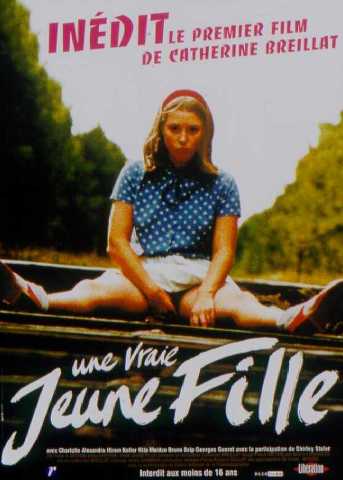
  • Catherine Breillat – Une vraie jeune fille AKA A Real Young Girl (1976)

    1971-1980ArthouseCatherine BreillatDramaFrance

    29f7c043f76a2bde437fd0d52a185152

    “Une Vraie Jeune Fille, Catherine Breillat’s first feature film, was shelved for 25 years, apparently because the moral/aesthetic disgust couldn’t be overcome at the time. It was released for the first time this year, and immediately re-ignited the scandal occasioned by Breillat’s last feature, Romance.”
    – Kay Armatage, Toronto International Film Festival Catalogue

    The story centres on Alice Bonnard, a young girl attending Saint-Sulvien Girl’s College, and takes place during a summer in the turbulent sixties. Alice comes homes to spend her holidays with her parents in the Landes region. They run a sawmill where they employ a young man, Jim. Business isn’t going well, although Mr. and Mrs. Bonnard are too proud to admit it and Jim’s nonchalant attitude about his job doesn’t help things. Alice is attracted to Jim, but she’s too scared to let him know it, believing that as far as he’s concerned she doesn’t exist. Her tumescent sexuality begins to obsess her. She becomes fascinated with the excretions, juices and smells of her own body as well as with the slimy oozings and putrid detritus of the natural world. The film gives few clues to distinguish the girl’s fantasies from the events of her life. This is fitting, as the entire film revolves around the girl and her own perceptions. The heightened realism of the direction and cinematography produces a text that refuses either to accuse or to exploit.
    (from link)Read More »

Back to top button