Arthouse

  • Jean Pierre Lefebvre – Q-bec My Love, ou Un succès commercial (1970)

    1961-1970ArthouseCanadaComedyJean Pierre Lefebvre

    29f7c043f76a2bde437fd0d52a185152

    Quote:
    This film, a kind of sketch, is directed with total freedom, without any concession to any kind of censorship. It seeks to remind the viewer that voyeurism stems from the way we look at things and human beings, not from the things and human beings themselves.Read More »

  • Károly Makk – Macskajáték AKA Cat’s Play (1974)

    1971-1980ArthouseDramaHungaryKároly Makk

    29f7c043f76a2bde437fd0d52a185152

    Quote:
    Karoly Makk’s contemplative film about two unmarried sisters who cast wistful glances back at their lives, yet still believe in hope and love. Told in the form of an epistolary novel, and utilizing vivid images to convey the character’s innermost thoughts, the film is a serious, stylistically daring, and deeply involving drama. As with Makk’s previous international success, Love, the director exhibits an extraordinary skill at drawing emotionally compelling performances from his talented female leads. In the end, Cat’s Play opposes the bleakness of the outside world with themes of passion, love, and loyalty.Read More »

  • Eric Steel – Kiss the Water (2013)

    2011-2020ArthouseDocumentaryEric SteelUnited Kingdom

    29f7c043f76a2bde437fd0d52a185152

    Quote/
    “I read the obituaries in The New York Times first thing every day. I know I am not alone in this. It is a melancholy devotion, and slightly occult, and allows me to wander outside my own skin, and to wonder how a life’s essence can be captured in miniature, immortalized in a few words.Read More »

  • Kidlat Tahimik – Bakit dilaw ang gitna ng bahag-hari? AKA Why Is Yellow the Middle of the Rainbow? (1994)

    1991-2000ArthouseAsianKidlat TahimikPhilippines

    29f7c043f76a2bde437fd0d52a185152

    `An entry in the Encyclopedia of Philippine Art published by the Cultural Center of the Philippines, offers a clue as to the genesis of this monumental movie. Two movies are mentioned: the first, I am Furious (Yellow), “a collage of events leading up to the 1986 EDSA [People’s Power Revolution] uprising ”, and its sequel I am Curious (Pink). Both titles are references to the movies I Am Curious (Yellow) and I Am Curious (Blue) by Swedish director Vilgot Sjömans which provoked controversy due to their sex scenes in the late 1960s. In Tahimik’s piece, “yellow” refers to the color that was to become the standard color for protests against the Marcos regime. Both these movies were later integrated as episodes in Why is Yellow at the Middle of the Rainbow? which, in turn, was to give rise to a new genre called ‘Never-ending docu’ at international festivals.Read More »

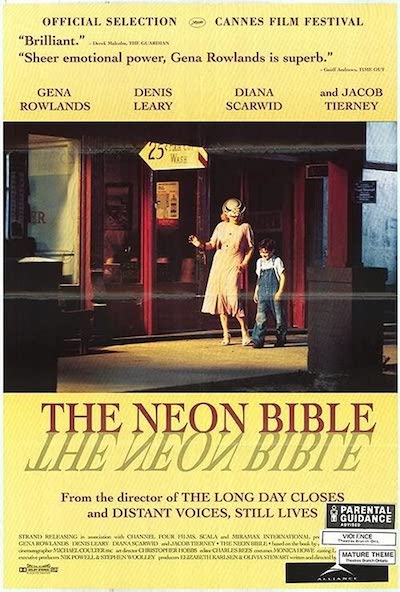
  • Terence Davies – The Neon Bible (1996)

    1991-2000ArthouseDramaTerence DaviesUnited Kingdom

    Jonathan Rosenbaum wrote:
    After showing himself a master at juggling autobiographical material in Distant Voices, Still Lives and The Long Day Closes, both dealing with his childhood in Liverpool during the 50s, Terence Davies adapts a novel by John Kennedy Toole about growing up in the rural deep south in the late 30s and 40s—and it’s remarkable how persuasively he handles this milieu while making it wholly his own. Two substantial assists are provided by Gena Rowlands (starring as the narrator-hero’s disreputable aunt, a onetime torch singer) and the ‘Scope format, both of which boost some of the mythological possibilities in the material.Read More »

  • Mitl Valdez – Los confines (1987)

    1981-1990ArthouseDramaMexicoMitl Valdez

    29f7c043f76a2bde437fd0d52a185152

    Quote:
    Mitl Valdez’s film Los confines (1987) is an adaptation of several works of fiction by the Mexican author Juan Rulfo. The director chose to adapt two short stories (“Talpa” and “¡Diles que no me maten!”) and an episode from the author’s first novel, Pedro Páramo. Valdez’s intent was to “capturar el sentido” of the Jaliscan author or, in other words, to remain faithful to certain elements of his writing while adjusting them to the filmic medium.Read More »

  • Semyon Aranovich & Aleksandr Sokurov – Altovaya Sonata. Dmitriy Shostakovich AKA Viola Sonata. Dmitriy Shostakovich (1981)

    1981-1990ArthouseDocumentarySemyon Aranovich and Aleksandr SokurovUSSR

    Free Image Hosting at www.ImageShack.us

    29f7c043f76a2bde437fd0d52a185152

    Quote:
    The life and work of the great Russian composer Dmitriy Shostakovich is presented in this documentary through rare images and audios from many archives, at one time censored by the Soviet government. A brief take on his life, from his transition as an early prodigy to a first rate artist, his celebrated compositions and the final years with a declining health.Read More »

  • Various – The Dream Machine (1980 – 1983)

    ArthouseDerek JarmanExperimentalQueer Cinema(s)United KingdomVarious

    29f7c043f76a2bde437fd0d52a185152

    review of Dream Machine from link
    Burroughs’ Dream Machine On Film… Nearly., 26 March 2004
    6/10
    Author: scottanthony from Dorset, England

    In theory: a short non-narrative film made to commemorate the visit of Burroughs and Gysin to the UK. In practice: four shorts (directed by Jarman, Kostiff, Maybury and Wyn Evans) broken up by footage of Gysin gazing at said machine.Read More »

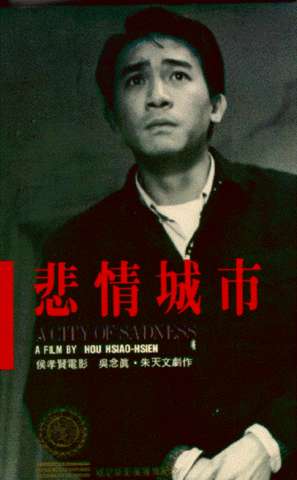
  • Hsiao-Hsien Hou – Beiqíng chéngshì AKA A City of Sadness (1989)

    1981-1990ArthouseDramaHsiao-hsien HouTaiwan

    29f7c043f76a2bde437fd0d52a185152

    Quote:
    A City Of Sadness opens with a credit sequence-shot of total darkness as the solemn voice of Emperor Hirohito is heard over a radio broadcast announcing the unconditional surrender of Japan on August 15, 1945. The setting is then faintly illuminated by the warm glow of candles to reveal an anxious Taiwanese household that is preparing for the imminent birth of a child in the midst of a power failure. As the electricity is restored, the audible agony of the expectant mother gives way to the sound of a crying infant. The apparent metaphor is then reinforced in the subsequent intertitles that reveal that the concubine of Lin Wen-heung (Chen Sown-yung) had given birth to a son whom they name Kang-ming, meaning ‘light.’ However, as the film chronicles the lives of the Lin family during the turbulent four years between the Japanese withdrawal from Taiwan after 51 years of occupation in 1945, to the secession of Taiwan from mainland China in 1949, the hopeful and optimistic tone of the film’s introductory sequence seemingly proves untenable.Read More »

Back to top button