Quote:
Jessy, age 12, dreams of becoming a wrestler. Already, life is a daily fight; home is chaotic and his innocence is quickly disappearing. Reality hits hard in Hochelaga-Maisonneuve, a poor area of Montreal, but it can’t compete with the Friday night wrestling that gives Jessy the courage to escape his destiny. “Le Ring” tells the story of a little fighter determined to make his own way.Read More »
Arthouse
-
Anaïs Barbeau-Lavalette – Le ring aka The Fight (2007)
Drama2001-2010Anaïs Barbeau-LavaletteArthouseCanada -
Khavn – Ruined Heart: Another Lovestory Between a Criminal & a Whore AKA Pusong wasak: Isa na namang kwento ng pag-ibig sa pagitan ng kriminal at puta (2014)
2011-2020ArthouseKhavnMusicalPhilippinesSynopsis : Somewhere in Manila, a crime boss rules with an iron fist. He uses religion and violence to stay in power. What superstition and razzle dazzle don’t accomplish, his goons do. To his most loyal henchman he gives the task of guarding his woman, who is headstrong and impulsive, and often gets into trouble. Before long, she falls in love with the henchman, and the star-crossed lovers decide to leave town. Fighting ensues. It is while on the run that they finally get to know each other for the first time…Read More »
-
Grzegorz Królikiewicz – Tanczacy jastrzab AKA Dancing Hawk (1978)
1971-1980ArthouseDramaGrzegorz KrólikiewiczPoland“The Dancing Hawk” refers to the son of a peasant who senses he can climb to the job in troubled times by playing his cards right. His slavery to work match his ambitions, and gradually he reaches the social position he desires. But the costs have included a dehumanized soul and a loss of a moral conscience. People have had to pay for his advancement, including those nearest to him. The downfall is equally painful: either imprisonment or the easy wasy out are offered as the alternatives.Read More »
-
Seiichiro Yamaguchi – Kitamura Toukoku: Waga fuyu no uta AKA Tokoku Kitamura: My Winter Song (1977)
1971-1980ArthouseDramaJapanSeiichiro YamaguchiTokoku Kitamura (1868-1894) is a Romantic poet and an advocate of liberalism in the Meiji era. This biopic is centered on New Year’s Day of 1894, when Kitamura is recovering from a suicide attempt. Japan is then under the spell of fervent patriotism because the government wants to build up public support for a war with China. Kitamura’s literary friends and militant comrades come to visit. They wonder why Kitamura wants to kill himself. Kitamura at first refuses to receive them, then he sits down with them and looks back on his days as a civil rights militant, his stormy love life and his ardent but destructive desire to live literature to the full.Read More »
-
Grzegorz Królikiewicz – Fort 13 (1983)
1981-1990ArthouseGrzegorz KrólikiewiczPolandNightmarish and claustrophobic film from Grzegorz Królikiewicz, one of the most formally radical and innovative Polish filmmakers, yet also one of the least known. Sadly not included in the Polish boxed set of his work, the film shares a little in common with Trier’s Befrielsesbilleder and Lopushansky’s Letters From A Dead Man, along with Ryszard Czekala’s Czlowiek i chleb. Shot almost entirely in darkness with obfuscated framing, it’s difficult to capture film’s unusual beauty in still images, but the densely oppressive atmosphere is overwhelming.Read More »
-
Leos Carax – Pierre ou, Les Ambiguïtés [Pola X TV Cut] (1999)
1991-2000ArthouseDramaFranceLeos CaraxSynopsis:
Pierre, a young man of privilege, whose anonymously-published novel is a hit and who’s about to marry his blond cousin, Lucie, abandons all when a dark-haired vagrant tells him her secret late one night in the woods: that she is Isabelle, his sister, abandoned by their father. Pierre breaks off with Lucie and his doting mother, heading for Paris with Isabelle, intent on knowing the dark side of human nature. He begins a novel, sending chapters under a pseudonym to his publisher; his relationship with Isabelle moves beyond the fraternal; and, in winter, the frail Lucie comes to live with them. Family jealousies mount, and Pierre may have discovered despair instead of the truth.Read More » -
Michel Soutter – La lune avec les dents AKA The Moon with Teeth (1967)
Drama1961-1970ArthouseMichel SoutterSwitzerland
The international cinematic new wave came bursting into the Swiss cinema through the work of Michel Soutter, whose La lune avec les dents (The Moon with Teeth) became practically a manifesto of the movement. Michel Soutter was one of the first directors of New Swiss Cinema who has made fiction films and he cofounded the Groupe 5 with Tanner and Goretta. The film follows William, thirty-ish, out of work and looking for a new life after apparently having been thrown out of his previous one. He meets up with Noelle, who seems intrigued by his restlessness – until her economist boyfriend shows up. Yet plot details do little to convey the power of the film, which lay in its capturing the anarchic texture of William’s life – a life whose lack of direction was read as a rebuke of the Swiss myth of orderliness and self-satisfaction.Read More »
-
Nigel Wingrove – Visions of Ecstasy (1989)
United Kingdom1981-1990ArthouseExperimentalNigel Wingrove

Synopsis
Visions of Ecstasy is a 1989 short film that became the only work to be refused a certification by the British Board of Film Classification on the grounds of blasphemy. The film, which was directed by Nigel Wingrove, was banned because it featured sexualised scenes of Saint Teresa of Ávila with the body of Jesus on the cross. It contains a fantasy scene in which the figure of St Teresa of Avila caresses the body of the crucified Christ and apparently has sex with him. The BBFC felt that any release of the film could be liable for prosecution under the common law offence of blasphemous libel.Read More » -
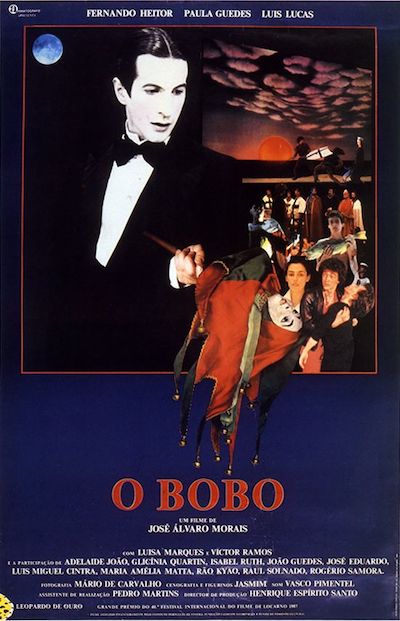
José Álvaro Morais – O Bobo AKA The Jester (1987)
Arthouse1981-1990CultJosé Álvaro MoraisPortugalQuote:
The initial project for this film, an adaptation of Alexandre Herculano’s O Bobo, became, over time, a reflection on literary work and its contemporary representation. The film reflects, as it develops, the passage of time (hassled by endless production difficulties, the moviemaking process was extremely long) and the transformation in Portuguese society in the years following the April 25th Revolution, in 1974. A fundamental film in Portuguese cinema of the last 30 years.Read More »