

Relatives of an eccentric millionaire gather in his spooky mansion on the 20th anniversary of his death for the reading of his will.Read More »
Relatives of an eccentric millionaire gather in his spooky mansion on the 20th anniversary of his death for the reading of his will.Read More »

The escape of a man during the Spanish Inquisition.
The only film directed by actor Gaston Modot,
the merciless tale of Villiers de l’Isle-Adam “Conte cruel”Read More »

This movie shows us one day in Berlin, the rhythm of that time, starting at the earliest morning and ends in the deepest night.Read More »

Quote:
The history of the city symphony is dominated by artists who identified as progressives and radicals, or in some rare cases, such as that of Walter Ruttmann, artists whose politics appear to have undergone a rather startling transformation, from a position that was at least centrist or moderate, to one that was far to the right of center. Stramilano (1929), directed by Corrado D’Errico (1902-41) and produced by the company of the Za Bum music hall by Mario Mattoli and Luciano Ramo for instituto LUCE, was not only Italy’s first contribution to the city symphonies cycle, it was also the earliest example of such a film to emerge from a fascist nation. Read More »
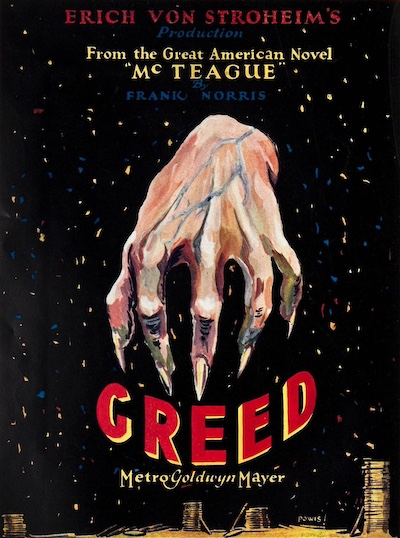
The first rough cut of Greed allegedly ran around 8-9 hours. Von Stroheim submitted a 5 hour version to MGM, who eventually cut it down to 2+ hours after Irving Thalberg – who had fired von Stroheim when they both worked at Universal – was placed in charge of post-production following the Metro/Goldwyn merger. Von Stroheim disowned this version of the film, but it is the only surviving version known to exist. Even in its truncated form, Greed is considered to be one of the greatest films ever made.Read More »
Quote:
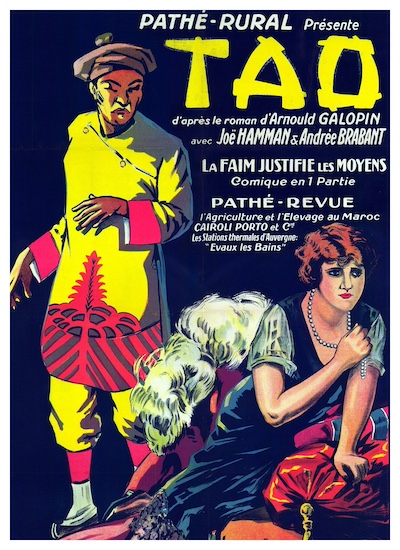
Jacques Chauvry, the new government delegate for a French protectorate in Cambodia, meets the young Soun who, due to a series of circumstances, will become heir to land that houses a large oil field. Tao , an evil mestizo, along with his minions, tries to get hold of these lands, terrorizing the locals by appearing disguised as the “spirit of evil”.Read More »

Quote:
Adapted from Émile Zola’s novel of the same name, Marcel L’Herbier’s L’Argent [Money] is an opulent classic of late-silent era cinema. Filmed in part on location at the Paris stock exchange, it reveals a world of intrigue, greed, decadence, and ultimately corruption and scandal when business dealings and amorous deceit combine. Business tycoons Saccard and Gunderman lock horns when the former attempts to raise capital for his faltering bank. To inflate the price of his stock, Saccard concocts a duplicitous publicity stunt involving the unwitting aviator Hamelin and a flight across the Atlantic to drill for oil, much to the dismay of his wife Line.Read More »

PLOT: Ludivine, a lttle tomboy, takes on the too polite Delphin. Being caught, and punished, she wants him and his father to be dead. When the latter dies, she feels guilty and takes Delphin under her wing.Read More »

Film-maker Vladimir Yerofeyev (1898-1940) was a pioneer of expedition cinema in the Soviet Union, advocating for increased attention and investment in edifying non-fiction films made to win the interest of broad audiences. Pamir. Roof of the World, 1927, is his second feature film, and the first resulting from an expedition (his debut that same year, Za poliarnym krugom [Beyond the Arctic Circle] was a co-edited compilation film). In summer 1927, a trek to the mountainous Pamir region, known as the “Roof of the World”, in present-day Kyrgyzstan and Tajikistan, was organized by the Sovkino studio in co-operation with the Geological Committee. Yerofeyev worked with prominent geologist Dmitrii Nalivkin and ethnographer Mikhail Andreyev; both scholars had extensively researched the area and contributed to the planning for the crew’s journey.Read More »