Paul Bildt

  • Helmut Käutner – Ludwig II: Glanz und Ende eines Königs AKA Mad Emperor: Ludwig II (1955)

    1951-1960ClassicsDramaGermanyHelmut Käutner

    Synopsis:
    King Ludwig II of Bavaria is frustrated, having to accept parliament’s will to join Bismarck, rather he his cultured Habsburg friends, in wars. His love-life being as fruitless, he seeks comfort in art. But building fairytale castles and an even grander opera for his musical idol Wagner proves so expensive, his cabinet ends up resorting to formally challenging his mental health, plausible as his beloved brother Otto contracted schizophrenia earlier. Tragedy now lurks in Ludwig’s prison-castle.
    — IMDb.Read More »
  • Slatan Dudow – Unser täglich Brot AKA Our Daily Bread (1949)

    Slatan Dudow1941-1950GermanyPolitics
    Unser täglich Brot (1949)
    Unser täglich Brot (1949)

    Quote:
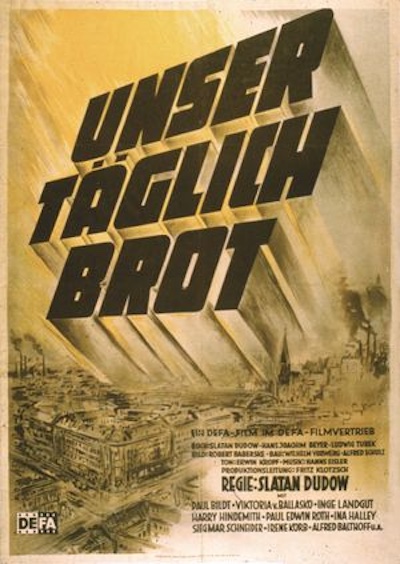
    A story about a family after the Second World War. The petty bourgeois cashier Karl Weber of Berlin observes from a distance how his son Ernst participates in the building of a new socialist society. Karl does not understand Ernst’s visions, instead he confides in his other son Harry. However, Harry becomes involved in illicit business and Karl quickly realizes that it would be best to join his son Ernst in the citizen-owned factory. With this film, director Slatan Dudow (1903-1963) continued the traditions of proletarian German film from the Weimar Republic. As with his first feature film Kuhle Wampe, from a screenplay by Bertolt Brecht, Dudow wanted an art that “cultivates the viewer’s psyche.” His postwar films were intended to make the viewers realize the importance of supporting the “new order” in East Germany. Our Daily Bread became known as a premiere film of its day under the rubric of “socialist realism.” Slatan Dudow’s work was convincing mainly through his detailed descriptions of socialist everyday life. Music by Hanns Eisler was the centerpiece of contemporary review. After coming back from his exile in America, the composer created a score that challenged, thrilled, and focused. Berlin’s world of ruins is captured in almost documentary fashion.Read More »

  • Bertolt Brecht & Carl Koch – Mann ist Mann AKA A Man’s a Man AKA Man Equals Man (1931)

    Bertolt Brecht1931-1940Carl KochDramaGermanySilent

    quote:
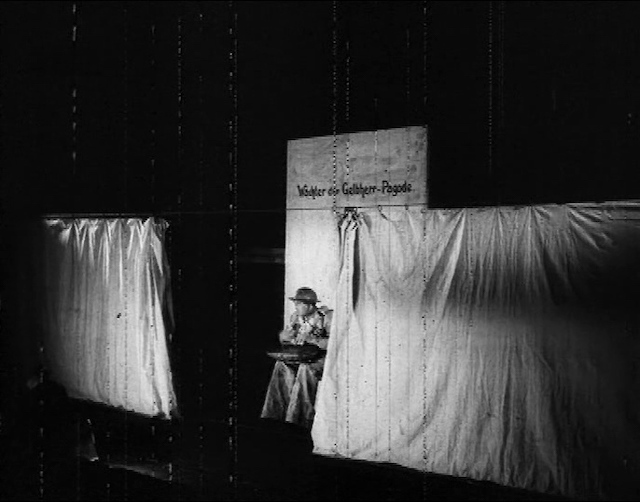
    Stage play directed by Berthold Brecht, filmed by Carl Koch, about a civilian who is press-ganged into a machine-gunner’s squadron and transformed into the perfect soldier.

    Man is Man, a tragi-comedy written in 1927, a work of Brecht’s youth that marks his entry into epic theatre. How can Man manage to adapt to all the different roles that the industrial society of the 20th Century demands, in an apparently intransigent call for change ? Galy Gay is this unorthodox hero who starts out as a messenger and becomes an active soldier under nauseating pressure from dubious soldiers. French critic Bernard Dort noted that the construction and dismantling of Widow Begbick’s refreshments carriage in this play take place at the same time as the transformation of Galy Gay into Jeramiah Jip. The mobility of the location, theatrically points to the instability of the characters in the epic form. Thomas Ostermeier seized upon the theme of deconstruction, and has his actors play furiously with the different states of reality.Read More »

  • Kurt Maetzig – Der Rat der Götter AKA Council of the Gods (1950)

    Drama1941-1950GermanyKurt MaetzigPolitics

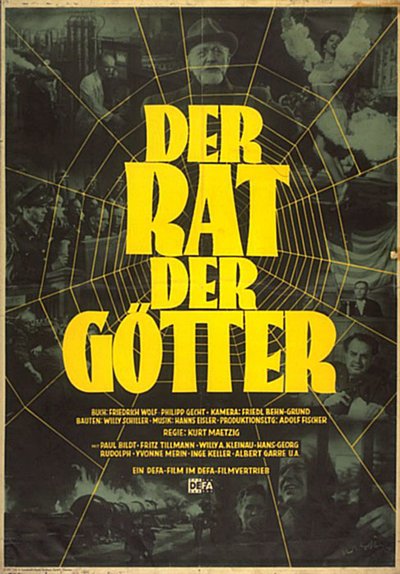
    1933, the bosses of a large German chemical concern pave the way for Hitler’s rise to power: Thus begins the story line of the feature film Der Rat der Götter (The Council of the Gods), which deals with the history of I.G. Farben. The film adheres throughout to the Communist theory of fascism. Hitler is largely unidimensional: a creature of capital. Thus the story continues: While the directors assist Germany’s military buildup, they continue to cultivate their business dealings with the U.S. company Standard Oil in order to have joint control of the world market.Read More »

  • Kurt Maetzig – Der Rat der Götter AKA Council of the Gods (1950)

    1941-1950DramaGermanyKurt MaetzigPolitics

    1933, the bosses of a large German chemical concern pave the way for Hitler’s rise to power: Thus begins the story line of the feature film Der Rat der Götter (The Council of the Gods), which deals with the history of I.G. Farben. The film adheres throughout to the Communist theory of fascism. Hitler is largely unidimensional: a creature of capital. Thus the story continues: While the directors assist Germany’s military buildup, they continue to cultivate their business dealings with the U.S. company Standard Oil in order to have joint control of the world market. Some directors now carve out careers with the Nazis, while the engineer Dr. Scholz, who comes from a working-class family, has nothing but scientific progress in mind. Read More »

  • Paul Verhoeven – Das kalte Herz AKA The Cold Heart (1950)

    Germany1941-1950ClassicsFantasyPaul Verhoeven

    Peter Munk, a poor charcoal burner, lives with his mother in The Black Forest. Poverty prevents him from marrying Lisbeth, the girl he loves. When he comes across the Little Glass Man, the good spirit of the forest, the young man asks him for assistance. His wish is granted and he becomes rich. But the fool soon loses all his money after gambling at the inn. In desperation, he asks Dutch Michael, the evil spirit of the forest, to help him to become rich again. The mean giant agrees and gives Peter all the riches in the world, but on one condition: the young man will exchange his heart for a cold stone. He can now marry Lisbeth but can a heart of ice make you and the others happy…?Read More »

Back to top button