Playing on the legend of ghosts returning in the form of cats to seek vengeance for their deaths, Kuroneko [Black Cat from the Grove] tells the tale of a mother and daughter, raped and killed by marauding samurai, and their supernatural revenge.Read More »
Synopsis: Mr. Mito (Shuji Sano), a Tokyo businessman, is demoted and sent to Osaka. There, he finds lodging in the titular inn, and makes the acquaintance of many of the town’s citizens. Notable among them are the maids at the inn, a hard-drinking geisha, and a mysterious woman Mito encounters at the mailbox. In Japan, director Gosho’s name is synonymous with melancholy and finding laughter through tears; An Inn at Osaka bears up that reputation. The struggle to stay afloat in life, especially financially, is a running theme of the film, as all of the characters struggle with looming poverty and gnawing loneliness, but it all ends with a kind of quiet triumph.Read More »
Quote: Almost a decade before Imamura’s Vengeance Is Mine, Shindo crafted this fascinating documentary-inspired portrait of a serial killer that drew upon the actual events of a troubled nineteen-year old who went on a murderous rampage, killing four people with a pistol stolen from an US navel base. Shindo’s meticulous research into the background of the anti-social youth, including extensive interviews with his mother and acquaintances, brings a rare authenticity of unexpected detail to a film that also reads as an astute critique of American imperialism and reckless tabloid journalism.Read More »
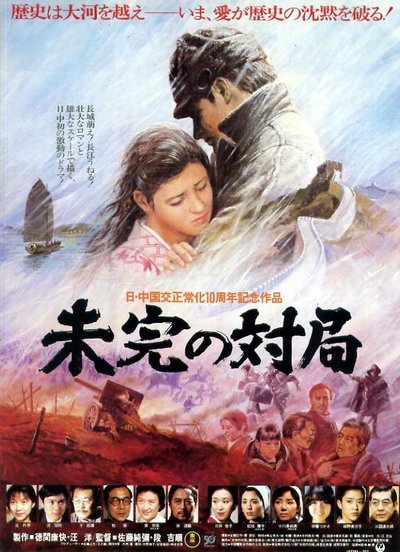
Quote: “The Go Masters” begins and ends with the same game of Go, but 32 years separate the opening and closing moves. In between, there is war and heartbreak, death and disease, doomed lovers, families separated by fate and united by chance. The movie is a melodrama on an epic scale, an Asian “Gone With the Wind,” filled with romance and action but built on a foundation of Eastern philosophy.Read More »
Synopsis: In the Fourteenth Century, during a civil war in Japan, a middle-aged woman and her daughter-in-law survive in a hut in a field of reed killing warriors and soldiers to trade their possessions for food. When their neighbor Hachi defects from the war and returns home, they learn that their son and husband Kichi died while stealing supplies from farmers. Soon Hachi seduces the young widow and she sneaks out of her hut every night to have sex with him. When the older woman finds the affair of her daughter-in-law, she pleads with Hachi to leave the young woman with her since she would not be able to kill the warriors without her help. However, Hachi ignores her request and continues to meet the young woman. Read More »
Quote: Veteran Japanese filmmaker Kaneto Shindo was 82 when he directed this meditation on life, death, and loss. Following the passing of her husband, elderly former actress Yoko Morimoto (Haruko Sugimura) travels to her summer home in the mountains of Central Japan. Upon her arrival, her servant Tokoyo (Nobuko Otowa) has sad news for her — her long-time gardener has recently committed suicide. Adding to Yoko’s sorrow is the arrival of Tomie, an old friend from her days in the theater, who is traveling with her husband Tohachiro Urshikuni (Hideo Kanze), also an actor. Read More »
Quote: Daigo Fukuryū Maru (第五福龍丸?, Lucky Dragon 5) was a Japanese tuna fishing boat, which was exposed to and contaminated by nuclear fallout from the United States’ Castle Bravo thermonuclear device test on Bikini Atoll, on March 1, 1954. Kuboyama Aikichi, the boat’s chief radioman, died half a year later, on September 23, 1954, suffering from acute radiation syndrome. He is considered the first victim of the hydrogen bomb of Operation Castle Bravo.Read More »
Shigeko, a recently widowed mother from Nagano,brings Hideo,her sixth-grade son,to live with his uncle in Tokiyo.Shigeko soon gets a job at the Mishima hotel.The shy Hideo doesn´t respond wellto his newsurroundings,preferring the companyof hisKabutomushi (helmet beetle ) to that of other people.He does,however,meet Junko,daughter of the woman who runs the Mishima and the two become goods friends.Junko´s mother has a patron who supports her and one day he comes to the city with his legitimate family. Junko feels inferior to his real children.Hideo too experiences the sorrow ot wathching his mother Shigeko prepare to go out with one of her patrons (Tomioka).Meanwhile,his beetle disappears and he depends more and more on Juko for companionship.hideo´s aunt sends him a replacement beetle.Elated,he runs to tell Junko,only to discover that she has left Tokyo and the Mishima has been sold.Saddened,Hideo brings his beetle to the roof of a building and looks out on the Tokyo skyline.Read More »
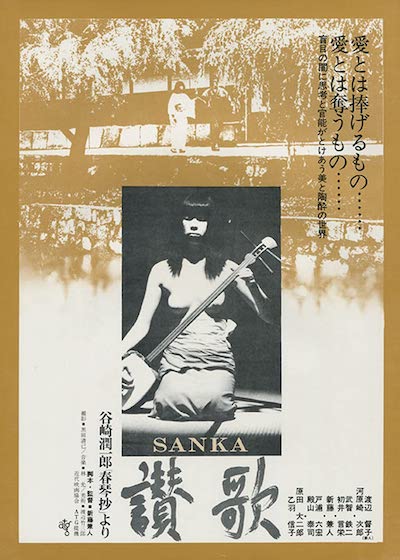
Shindo’s “Hymn” is one of many adaptions of Tanizaki’s classical novella ‘Shunkinsho’ (‘A Portrait of Shunkin’,1933). The story tells of the adoration of Sasuke for his mistress, the blind samisen-teacher Shunkin, who treats him imperiously and subjects him to cruel beatings. After an unknown intruder probably one of her pupils, who seeks revenge for her cruel behaviour, pours boiling water on the sleeping Shunkin’s face, Sasuke blinds himself in order not to behold her disfigurement. Sasuke’s sacrifice, made in response to Shunkin’s tacit wish, seals their life-long relationship.Read More »