Mariko Okada

  • Yoshishige Yoshida – Akitsu onsen AKA Akitsu Springs (1962)

    1961-1970DramaJapanRomanceYoshishige Yoshida

    The setting is postwar Japan in this standard melodrama from director Yoshishige Yoshida. Shinko (Mariko Okada) is a young teen living in Akitsu when she meets Shusaku (Hiroyuki Nagato). He is a student who comes to Akitsu just before the end of the war to try to regain his health, and Shinko helps take care of him. The couple fall in love, but when they both hear that Japan has surrendered, they attempt suicide together and fail. The two lovers separate as Shusaku leaves town in the aftermath of their failed attempt, then fate tragically intervenes nearly two decades later.Read More »

  • Yoshishige Yoshida – Mizu de kakareta monogatari AKA A Story Written with Water (1965)

    1961-1970ArthouseDramaJapanYoshishige Yoshida

    One of the leading lights of the Japanese New Wave, Kiju Yoshida (Eros + Massacre) broke with studio filmmaking for A Story Written With Water, his first independent production and the start of his signature style. Telling the story of a man torn between his fiancee and the familial bond of his mother, Yoshida creates a dazzling narrative that uses flashbacks to tell its story of obsession and desire. With the luminous Mariko Okada as the mother, the celebrated star of such masterpieces as Floating Clouds and Late Autumn, she would become Yoshida’s muse across a series of the director’s ‘anti-melodramas’. Yoshida’s singular visual flair and revolutionary exploration of film codes place him as one of the finest Japanese filmmakers of the postwar period.Read More »

  • Yoshishige Yoshida – Kagami no onnatachi AKA The Women in the Mirror (2002)

    2001-2010ArthouseDramaHiroshima at 75JapanYoshishige Yoshida

    For his latest film, Yoshida turned once more to melodrama as a means of sensitively engaging a difficult political issue, here the devastating legacy of the Hiroshima bombing. Mariko Okada stars, in her 154th film, as the eldest of three women trying to uncover the hidden family ties that may or may not bind them together. A shared memory of the Hiroshima disaster draws the three generations together in a search back to the very site of the atomic trauma that unites them, with Hiroshima standing in as a figure for the limit point of the national imagination. Among Yoshida’s more classical films, Women in the Mirror is an assuredly stylish late work that carefully balances the three women’s stories as interlocking pieces of a complex psychological and historiographic puzzle.Read More »

  • Kozaburo Yoshimura – Onna no saka AKA A Woman’s Uphill Slope (1960)

    Kôzaburô Yoshimura1951-1960ClassicsDramaJapan

    Quote:
    A Woman’s Uphill Slope follows the fortunes of Akie (Mariko Okada), a young woman who visits Kyoto after inheriting a shop that sells traditional sweets. Fascinated by the shop’s traditions, she abandons her plans to open a tailor shop and decides to stay. She soon falls in love with a married painter, Saburo Yaoi (Keiji Sada), who turns out to be her mother’s former lover.Read More »

  • Tadashi Imai – Fushin no toki AKA The Time Of Reckoning (1968)

    Tadashi Imai1961-1970AsianDramaJapan

    “The Time of Reckoning” transforms a screwball-comedy plot into a sober study of a successful businessman with serious relationship problems involving three women: his wife of ten years who announces she is pregnant by another man; a mistress who wants to have a baby with him; and an ex-lover who claims he fathered her son.Read More »

  • Jun’ya Satô – Ningen no shômei AKA Proof of the Man (1977)

    1971-1980CrimeDramaJapanJun'ya Satô
    Ningen no shômei (1977)
    Ningen no shômei (1977)

    When an American is murdered in a Japanese inn, Tokyo police Detective Munesue follows the trail of the killer to New York City. There he is joined by Detective Shuftan, and together they sort out the crime.Read More »

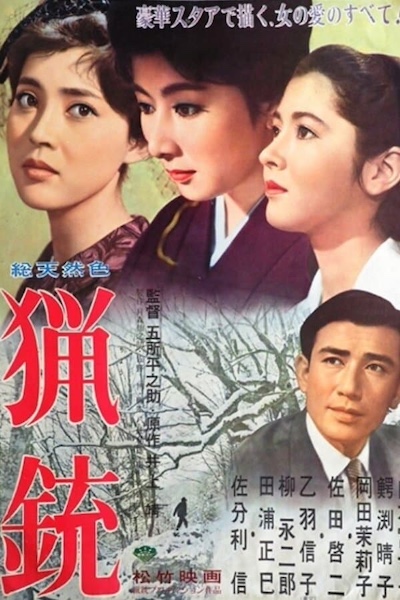
  • Heinosuke Gosho – Ryôjû AKA Hunting Rifle (1961)

    Heinosuke Gosho1961-1970DramaJapan
    Ryôjû (Hunting Rifle) (1961)
    Ryôjû (Hunting Rifle) (1961)

    A woman adopts the child of her husbands’ ill mistress and raises her as her own.Read More »

  • Yoshishige Yoshida – Kokuhakuteki Joyûron AKA Confessions Among Actresses (1971)

    1971-1980ArthouseDramaJapanYoshishige Yoshida

    Synopsis:
    The film’s narrative follows three leading actresses, all appearing in the same movie (but not appearing in the same shot until the end of the film), and all undergoing their own personal crises. It’s very formally worked out, through a series of carefully balanced dialogues with confessors, synchronized confrontation scenes, and staggered flashbacks. If Farewell was Yoshida’s self-conscious Resnais tribute, this is him in Bergman mode (Mariko Okada’s story even begins with her experience hysterical mutism, à la Persona), though the finished product is much livelier and more pungent than anything Bergman would have come up with (maybe Zetterling’s The Girls is a more apposite reference point). On another level, it’s also referencing a big old Hollywood melodrama, pastel panoramas in various shades of bitch (there are also nods to All About Eve).Read More »

  • Hiroshi Inagaki – Zoku Miyamoto Musashi: Ichijôji no kettô AKA Samurai II: Duel at Ichijoji Temple (1955)

    1951-1960ActionHiroshi InagakiJapanMartial Arts

    Synopsis:
    Hiroshi Inagaki’s acclaimed Samurai Trilogy is based on the novel that has been called Japan’s Gone with the Wind. This sweeping saga of the legendary seventeenth-century samurai Musashi Miyamoto (powerfully portrayed by Toshiro Mifune) plays out against the turmoil of a devastating civil war. The Trilogy (whose first part won an Academy Award) follows Musashi’s odyssey from unruly youth to enlightened warrior. In the second and most violent installment, Duel at Ichijoji Temple, Musashi beats a samurai armed with a chain and sickle and is later set upon by eighty samurai disciples—orchestrated by the sinister Kojiro—while the two women who love him watch helplessly.Read More »

Back to top button