

Explores Leni Riefenstahl’s artistic legacy and her complex ties to the Nazi regime, juxtaposing her self-portrayal with evidence suggesting awareness of the regime’s atrocities.Read More »
Explores Leni Riefenstahl’s artistic legacy and her complex ties to the Nazi regime, juxtaposing her self-portrayal with evidence suggesting awareness of the regime’s atrocities.Read More »

Leni Riefenstahl made her film debut in this “mountain film” by writer/director Arnold Fanck, and went on to appear in five more under his direction. In Der Heilige Berg she plays the professional dancer Diotima who finds herself the apex of a love triangle when she is pursued by two mountain climbers, Vigo (Ernst Petersen) and his unnamed older friend (Luis Trenker). Diotima is drawn to the elder climber but can’t refrain from encouraging Vigo’s attentions as well in a spirited skiing session. She has a moment of intimacy with Vigo, and when the friend sees them together he angrily challenges Vigo to a dangerous climbing tour. During the trek he causes Vigo to fall but repents and rescues him. Both men, however, soon become lost in the mountains, and they perish before Diotima and the rescue team can reach them.Read More »
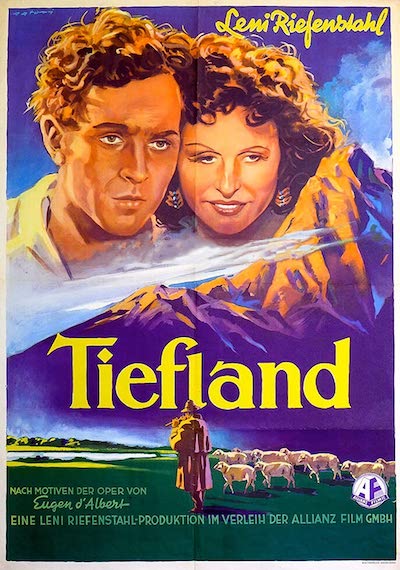
After spending the 1930s as the Third Reich’s principal cinematic chronicler, Leni Riefenstahl returned to fictional films with Tiefland. According to Riefenstahl, she had refused to make any more propaganda pictures–“for good reasons,” she explained enigmatically–choosing instead to direct a period romance, based on an old Spanish play and opera by Eugen d’Albert. Riefenstahl cast herself as the central character, Marta, a Spanish dancer who becomes the romantic bone of contention between humble shepherd Franz Eichberger and imperious marquis Bernhard Minetti. While the material seems to cry out for music, Riefenstahl plays the story straight, though much of the acting can certainly be described as operatic.Read More »

The White Hell of Piz Palü opens with the male protagonist, Dr. Johannes Krafft, who mountain climbs with his wife on their honeymoon. At the sight of an avalanche, he laughs arrogantly. Nature seems to retaliate, and moments later Dr. Krafft’s wife slips, plummeting down a small, deep crevice. The encounter with forces of nature initiates Dr. Krafft’s grief-driven search effort to rescue his wife.Read More »

Examines the forced participation of Sinti prisoners in the making of Leni Riefenstahl’s drama TIEFLAND. Nina Gladitz’ most controversial claim is that Riefenstahl knew these Sinti would be sent to Auschwitz. This led to court action and the film effectively being withdrawn. A rare film that supposedly was never screened again publicly after its 1982 TV premiere.Read More »

Quote:
After being commissioned by the 1936 Olympic Committee to create a feature film of the Berlin Olympics, Riefenstahl shot a documentary that celebrates the human body by combining the poetry of bodies in motion with close-ups of athletes in the heat of competition. The production tends to glorify the young male body and, some say, expresses the Nazi attitude toward athletic prowess. Miss Riefenstahl captures the grace of athletes during field hockey, soccer, bicycling, equestrian, aquatic and gymnastic events. Highlights are the Pentathlon and the Decathlon, which was won by American Glenn Morris; it ends with the triumphant conclusion of the games.Read More »

Quote:
After being commissioned by the 1936 Olympic Committee to create a feature film of the Berlin Olympics, Riefenstahl shot a documentary that celebrates the human body by combining the poetry of bodies in motion with close-ups of athletes in the heat of competition. Includes the marathon, men’s diving, and American track star Jesse Owen’s sprint races at the 1936 Olympic games. The production tends to glorify the young male body and, some say, expresses the Nazi attitude toward athletic prowess. Includes the lighting of the torch at the stadium and Adolf Hitler looking on in amazement as Jesse Owens wins an unprecedented four Gold MedalsRead More »

Plot
Der Sieg des Glaubens (English: The Victory of Faith) is the first documentary directed by Leni Riefenstahl, who was hired despite opposition from Nazi officials that resented employing a woman — and a non-Party member too. Her film recounts the Fifth Party Rally of the Nazi Party, which occurred in Nuremberg from August 30 to September 3 in 1933.Read More »

Synopsis
Junta is hated by the people in the village where she lives, especially by the women, who suspect her of being a witch. Only she can climb the nearby mountains to a cave high up, whence a mysterious blue light glows when the moon is full. Many young men of the village have died trying to follow her. She is driven out of town, and takes to living in the mountains. Eventually she shares the secret of the blue light with one man, and he betrays it.Read More »