Kazuo Hasegawa

  • Mikio Naruse – Tsuruhachi Tsurujirô AKA Tsuruhachi and Tsurujiro (1938)

    1931-1940DramaJapanMikio Naruse

    Quote:
    Almost a caricature of the classic backstage story of the stars who battle even though “they’re made for each other” — this time with duo legends Isuzu Yamada and Kazuo Hasegawa — but with an emotional restraint rare even for Japanese films of the period.Read More »

  • Kazuo Mori – Jirocho Fuji (1959)

    1951-1960ActionDramaJapanKazuo Mori

    Synopsis:
    One historical yakuza boss was Jirocho of Shimizu (1820-1893), born of the merchant class. One of the earliest versions of his life to make it to the screen was in the silent era, & which still survives, was the Shimizu no Jirocho Trilogy (1927) directed by Tsuji Kichiro, & starring Kawabe Goro as Jirocho.Read More »

  • Masahiro Makino – Matte ita otoko AKA The Man Who Waited (1942)

    1941-1950DramaJapanMasahiro MakinoMystery

    boblipton@IMDB wrote:
    At a popular resort during the Edo Period, a man is murdered. As everyone gossips about the matter and waits for the samurai in charge of the investigation to do something, honeymooning Hideko Takamine takes time out to solve the crime.Read More »

  • Kenji Misumi – Yotsuya kaidan AKA The Ghost of Yotsuya (1959)

    1951-1960HorrorJapanKenji Misumi

    This is another of the many versions of the famous story: a poor samurai causes the death of his ailing wife, who is first disfigured by poison (seemed far-fetched until the Yushchenko dioxine case), in order to marry a rich woman and enjoy a life of leisure. But the wife comes back as a vengeful ghost and the bad end unhappily as they should.Read More »

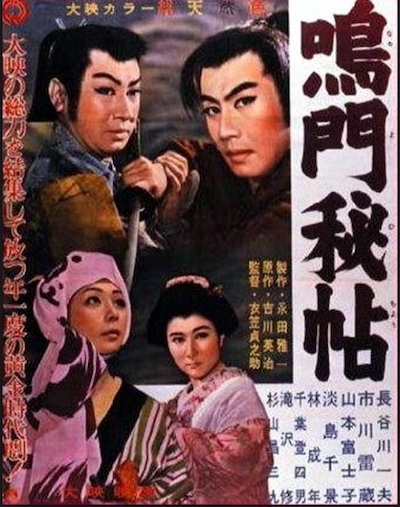
  • Teinosuke Kinugasa – Naruto hichô AKA Secret of Naruto (1957)

    Teinosuke Kinugasa1951-1960ActionDramaJapan
    Naruto hichô (1957)
    Naruto hichô (1957)

    Quote:
    From the pen of Yoshikawa Eiji comes this exciting story. The Naruto Strait separates Tokushima from the islands of Awaji and Honshu. On Tokushima the mad lord dreams of conquest and forges a bloody revolt against the Tokugawa shogunate. A mysterious swordsman named Noriyuki Gennojo has crossed Naruto’s waters to uncover the Awa clan’s secrets. He puts his life on the line after finding a testament of Awa’s secrets, written in blood by a dying man. Joining Noriyuki are a female ninja who loves him, and the beautiful daughter of an enemy who’s sworn to kill him. Awa’s defenders willl stop at nothing to prevent the blood-soaked letter from reaching the shogun.Read More »

  • Teinosuke Kinugasa – Yukinojo henge AKA An Actor’s Revenge (1935)

    Teinosuke Kinugasa1931-1940ClassicsDramaJapan
    Yukinojo henge (1935)
    Yukinojo henge (1935)

    Quote:
    Here is the 1935/1936 original version of “An Actor’s Revenge”, which was hugely popular at that time and a high point in Kazuo Hasegawa’s career. In fact, he even chose to remake this film as his 300th film work, helmed by Kon Ichikawa.

    The original film has 3 parts and runs 310 mins long, released. However, like most pre-1945 jidaigeki, it has been seized and re-edited by GHQ during the occupation era. And now, only this truncated version which runs only 97 mins exists.Read More »

  • Kunio Watanabe – Byakuran no uta: zenpen: kôhen AKA Song of the White Orchid (1939)

    Kunio Watanabe1931-1940DramaJapanWar
    Byakuran no uta zenpen kôhen (1939)
    Byakuran no uta zenpen kôhen (1939)

    1939 national policy film set in Manchuria.

    Quote:
    Song of the White Orchid was a co-production of Toho and Mantetsu, the railway that served the colonial region of Manchuria, and the first film in the Kazuo Hasegawa/Shirley Yamaguchi (Ri Koran) “Continental Trilogy.” Handsome Hasegawa (representing Japan) runs up against an impertinent Yamaguchi (representing the continent); not surprisingly, in the course of the film the woman comes around and realizes the benevolent intentions of the Japanese. In Song of the White Orchid Yamaguchi leaves Hasegawa, who plays an expatriate working for the railway, because of a misunderstanding. She joins a communist guerilla group plotting to blow up the Manchurian railway. Learning of the subterfuge that led to the misunderstanding, she renews her faith in Hasegawa—and by extension Japan—and tries to undermine the plot.Read More »

  • Yasujirô Shimazu – Watashi no niisan AKA My elder Brother (1934)

    1931-1940ClassicsJapanRomanceYasujirô Shimazu

    Quote:
    Kazuo Hasegawa has wild friends and hates being compared to his stepbrother, Reikichi Kawamura, who is steady, works hard at his taxicab business, and is amiable. That’s why he left home a year ago. Now he has heard his mother is ill, and wants to come home, but thinks she hates him. That’s nonsense, says Kawamura. Hasegawa agrees to reform. Just then two men come in and want to hire a cab. Everyone has gone home for the evening, so Hasegawa shows his willingness to reform by taking the fare. They drive to a distant house. They ask him to wait. While he does so, Kinuyo Tanaka pops out, begs him to help her escape. He does so. The two men are her step-brother, and the man everyone wants her to marry…. except her, of course.Read More »

  • Tamizo Ishida – Orizo nan henge AKA Seven Changes of a Paper Crane (1941)

    Tamizo Ishida1941-1950AdventureJapanMystery

    Maya Grohn wrote:
    The story is based on the serial novel by Tsunoda Kikuo, which was published in a magazine called “KING”, the most popular magazine of its time. This type of magazine was deemed too popular for serious literature lovers, who regarded it as beneath them. Once a girl, a long time ago, Maya could not understand it all, but through ageing I have begun to enjoy these thing in a quite different manner.Read More »

Back to top button