A mature lady approaches a young actor and offers him a great amount of money to get acquainted with her lonely daughter, who suffers of an incurable illness. Eventually a true romance emerges, as mother has secret feelings for the man, while he truly falls in love with the daughter. After the expected death of the daughter, the man leaves in grief rejecting the money, and the mature woman stays in deep loneliness, trying to cope with a double loss.Read More »
In this comedy-drama from Claude Chabrol, Magistrate Jeanne Charmant-Killman (Isabelle Huppert) doggedly investigates CEO Michel Humeau (François Berléand), who is accused of participating in massive corporate malfeasance. As her investigation leads her into the upper echelons of government, Jeanne becomes intoxicated by the power she is amassing. Though she faces threats by those whom she would see brought low and by the dissolution of her personal life and marriage, she will not relent.Read More »
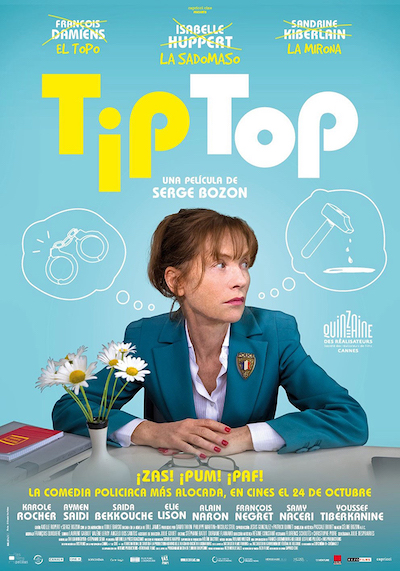
‘After an informer of Algerian origin is killed in Villeneuve, a nondescript little town in northern France, two senior police officers, Esther Lafarge and Sally Marinelli, are sent to investigate. Right from the start, Esther and Sally fail to hit it off with Robert Mendès, the detective who was the dead man’s police contact and whose cack-handed attempts to build bridges with the town’s immigrant community are as subtle as they are effective. Esther’s addiction to casual violence not only assists in her day job, it also adds spice to her love life, although the cuts and grazes she sustains in her off-duty hours are apt to be misinterpreted. Sally, by contrast, is a timid soul who, despite her admiration for Esther, has an aversion to any kind of physical contact. Read More »
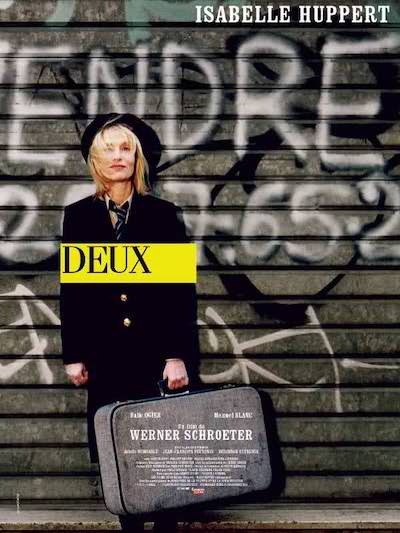
Quote: A young woman named Magdalena (Isabelle Huppert) retrieves a postcard that had been cast into the wind by her biological mother (Bulle Ogier) from a seaside town in Portugal and discovers that she has a twin sister named Maria. From this seemingly introspective opening premise on identity, connection, and history, Deux diverges into unexpectedly abstract, non-intersecting trajectories that involve a schoolgirl attraction with a fellow classmate, a mother’s wartime romance, a serial killer who leaves a tell-tale rose on the bodies of his victims, a lonely woman who adopts a fox as a household pet. Composed of asequential and dissociated vignettes, the film evokes the baroque tableaux of Sergei Paradjanov, the formalism of Rainer Werner Fassbinder, and fractured surrealism of Luis Buñuel infused with quasi-religious iconography and Actionism of Otto Mühl (most notably, in the image of disemboweled figures such as ornamental cherubs).Read More »
In 2012, the head union representative of a French multinational nuclear powerhouse becomes a whistle-blower, denouncing top-secret deals that shake the French nuclear sector. Alone against the world, Maureen Kearney fights government ministers and industry leaders to bring the scandal to light and defend more than 50,000 jobs.Read More »
This erotic drama about the incestuous relationship of a mother and daughter is based on the autobiography of Italian theater actress Piera Degli Esposti.Read More »
Rose, a 16-year-old girl who was abandoned by her parents and taken in by social services, and her fiancé, 22-year-old Michel, are enjoying their first great and innocent love affair in Paris in 1979, at the height of the popularity of the Le Palace nightclub. They are part of the trendy bunch who only live for partying and exuberance. At a party one evening, they meet Lucille and Hubert, a couple of fifty-something middle-class bohemians, who will take them under their wing and turn their lives upside down. Fact Burger (imdb)Read More »
Quote: Based on an introspective feminist book by Ingeborg Bachmann which I haven’t read but is described as a difficult fragmented work that exposes emotional reactions and stream-of-consciousness meditations on her identity vs. three men in her life, two lovers who try to control her or take over her identity, her obsessive love, and her scary father. The author, Bachmann, died in hospital after a fire in her house. Schroeter takes these real-life and written elements and applies his own treatment to the whole mess, showing scattered fragments of her life mixed with many and endless emotional breakdowns, fire and mirrors used as artsy symbols, a writer’s block, existential explorations on identity, some references to her interests in Wittgenstein, and various surreal imagery involving violinists, her father in a Nazi uniform, and lots of flames, all together in one jumbled emotional mess, like the inside of a schizophrenic woman’s mind. Unrewarding arthouse piece.Read More »