Fritz Lang

  • Fritz Lang – Cloak and Dagger (1946)

    1941-1950Fritz LangThrillerUSA

    The Harvard Film Archive writes:
    Released more than a year after V-J Day, Fritz Lang’s final anti-Nazi film follows Gary Cooper’s improbable nuclear scientist into war-torn Europe on a secret mission for the OSS. “The opposite of a James Bond,” writes Enno Patalas, “Cooper stumbles through a hostile world.” The character’s transformation from noble-minded rationalist to a realpolitik hero culminates in a remarkably brutal scene of hand-to-hand combat with a fascist agent. Lang would later complain that Warner Bros. excised his preferred ending of Cooper uncovering an abandoned Nazi bomb factory: a strikingly paranoid vision of the nuclear threat cut to fit the emerging Cold War eraRead More »

  • Fritz Lang – Frau im Mond AKA Woman in the Moon (1929)

    Germany1921-1930Fritz LangSci-FiSilentWeimar Republic cinema

    Synopsis:
    Thirty years ago, at a scientific conference, Prof. Manfeldt presented his theory on the existence of gold on the Moon. It was greeted with laughter by the assembled academics. Today, Herr Helius has ambitious plans to build a spaceship… and take it to the Moon! Windegger, his chief engineer, will be going, and so will Prof. Manfeldt, now living in a cramped garret alone with his theory. But there are disagreements with the financiers who insist that their man Turner also accompany the flight… The unmanned Rocket H 32 brings back valuable information from the dark side of the Moon. Helius is upset by the news of Windegger’s engagement to the pretty Friede. And the financiers have a secret agenda: to control the world’s gold supply… Finally, the Spaceship “Friede” is ready as it rolls out on its gantry for takeoff. The staged rocket works as planned, but the acceleration is fierce. As they approach the Moon, they discover a stowaway on board, Gustav, a little boy…Read More »

  • Fritz Lang – The Big Heat (1953)

    USA1951-1960CrimeFilm NoirFritz Lang

    Quote:
    One of the later examples of American film noir, The Big Heat is also one of the genre’s most underrated films. Director Fritz Lang utilized many of the elements typical to his other films: unseen yet gruesome violence, relentless pacing, and a hardboiled view of justice and revenge. The sad, realist film has an oppressive feeling of malignity. Glenn Ford is a perfect everyman cop, out for revenge against criminals as well as other cops. In this way, The Big Heat marks a significant transition between the crime movies of two different eras. Read More »

  • Fritz Lang – The Blue Gardenia (1953)

    1951-1960Film NoirFritz LangUSA

    by Steve-O of Film Noir of the Week
    After getting a Dear John letter from her boyfriend overseas, a young girl goes out on a blind date with a heel. She blacks out after drinking half-a-dozen mixed drinks but remembers fighting off the man with a poker. She goes into a panic when a police manhunt begins for her. A Los Angeles reporter tracks the mystery woman down before the police can get to her. But is she innocent?Read More »

  • Fritz Lang – The Woman in the Window (1944)

    1941-1950250 Quintessential Film NoirsFilm NoirFritz LangThrillerUSA

    Quote:
    Fritz Lang’s The Woman in the Window (1944) is a riveting melodrama that’s only improved with age. Edward G. Robinson delivers a memorable performance as an everyday Joe who suddenly finds himself entangled in a murder, but Lang’s sense of adventure is the real draw. One shot in particular – a single-take transitional moment near the end of the film – simply has to be seen to be believed. Look for Robinson leaning forward in a leather chair during what appears to be the picture’s tragic climax, then watch what happens next….and good luck determining how Lang did it.Read More »

  • Fritz Lang – Dr. Mabuse, der Spieler – Ein Bild der Zeit (1922)

    1921-1930Fritz LangGermanySilentWeimar Republic cinema

    Quote:
    One of the legendary epics of the silent cinema – and the first part of a trilogy that Fritz Lang developed up to the very end of his career – Dr. Mabuse, der Spieler. [Dr. Mabuse, the Gambler.] is a masterpiece of conspiracy that, even as it precedes the mind – blowing Spione from the close of Lang’s silent cycle, constructs its own dark labyrinth from the base materials of human fear and paranoia. Rudolf Klein – Rogge plays Dr. Mabuse, the criminal mastermind whose nefarious machinations provide the cover for – or describe the result of – the economic upheaval and social bacchanalia at the heart of Weimar – era Berlin. Read More »

  • Fritz Lang – M [Universum, 80th Anniversary Edition] (1931)

    Crime1931-1940Amos Vogel: Film as a Subversive ArtClassicsFritz LangGermany

    Quote:
    The horror of the faces: That is the overwhelming image that remains from a recent viewing of the restored version of “M,” Fritz Lang’s famous 1931 film about a child murderer in Germany. In my memory it was a film that centered on the killer, the creepy little Franz Becker, played by Peter Lorre. But Becker has relatively limited screen time, and only one consequential speech–although it’s a haunting one. Most of the film is devoted to the search for Becker, by both the police and the underworld, and many of these scenes are played in closeup. In searching for words to describe the faces of the actors, I fall hopelessly upon “piglike.”Read More »

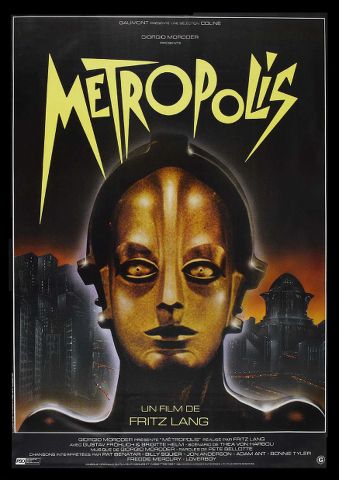
  • Fritz Lang – Metropolis [Full Version 2010] (1927)

    1921-1930ArthouseFritz LangGermanySci-FiWeimar Republic cinema

    29f7c043f76a2bde437fd0d52a185152

    “Metropolis is not one film, Metropolis is two films joined by the belly, but with divergent, indeed extremely antagonistic, spiritual needs. Those who consider the cinema as a discreet teller of tales, will suffer a profound disillusion with Metropolis. Whait it tells us is trivial, pretentious, pedantic, hackneyed romanticism. But if we put before the story the plastic-photogenic basis of the film, then Metropolis will come up to any standards, will overwhelm us as the most marvelous picture book imaginable.”
    — Luis Buñuel: Metropolis. In: Great Film Directors. Edited by Leo Braudy, Morris Dickstein. New York 1978, p. 590Read More »

Back to top button