Influenced and inspired by Jean-Luc Godard, some young french directors (Jean Eustache, Francis Leroi, Jean-Michel Barjol, Romain Goupil, Luc Moullet) are talking about their problems in producing less expensive and more free films in the french industry of cinema of the 60’s.Read More »
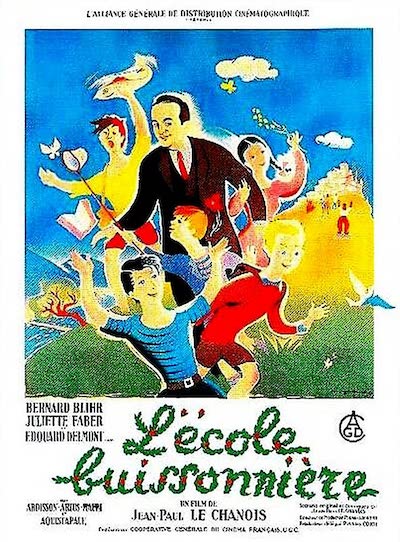
Synopsis Soon after the Great War, the Provence village of Salezes gets a new boys’ teacher: Mr. Pascal, a war hero with a diploma from a teachers’ college. He rejects old methods: boys’ sitting still with arms folded memorizing facts. He uses modern methods: he becomes their guide…Read More »
On the stage of Paris’s legendary Opéra Bastille, 30 dancers from non-traditional genres reprise and remix Jean-Philippe Rameau’s baroque masterpiece Les Indes galantes, offering a dynamic take on the landmark opera.Read More »
Quote: Vincent, a twenty-five year-old intern, lives in Rennes with his mother and his eighteen-year-old brother Bernard. In order to cheer up Bernard who has just failed his baccalauréat exam, the father invites him and his older brother to spend a holiday in his villa in Morocco, where he lives estranged from his ex-wife. Vincent and and Bernard decide to get there by sailboat, accompanied by Geneviève, Vincent’s fiancée. Vincent, who has never forgiven his father for leaving him when he was a child, remains hostile and withdrawn. Once in Agadir, they take part in a regatta during which Bernard gets to know Monika, a sexy uninhibited girl. But Monika is actually attracted to Vincent who, despite his dislike for any compromise of principle, finds himself torn between two women.Read More »
In Venice, a failed and alcoholic musician attends the concert of his teenage son, a precocious conductor who has never met him. Three years after “Prélude à la gloire”, in order to confirm the aura of child star Roberto Benzi, this new film embroiders a fictional story around filial bonds and the father’s remorse. While Roberto Benzi, as impressive as a conductor as he is a poor actor, does what he can, Jean Marais, leaving for the first time his usual part of young leading man, is quite impressive. With the help of excellent supporting actors: Fernand Sardou, Edouard Belmont and Jacqueline Porel, he allows the film to rise above its condition of melodramatic and conventional work. The direction of Georges Lacombe, sober and elegant, does not fail. The film, although less successful than its predecessor, is famous for having generated a good number of musical vocations among the young people of the time.Read More »
A la fin de l’été 84, Adrien, Alice, Hans et Laure vivent à Rome des histoires d’amour qui les poussent hors d’eux mèmes. Chacun va suivre obstinément son rève, sa quète, sa passion. Alice se perd dans l’alcool, Adrien dénonce sa maitresse à la police. Laure et Hans vont aller jusqu’aux limites d’une passion destructrice dans le huis-clos de leur chambre d’hôtel.Read More »
Summary: Broodthaers’s first film, Clef d’Horloge was made using a borrowed camera and some film stock that he had been given. It was shot at the Palais des Beaux-Arts, Brussels, in 1956, during an exhibition of works by Kurt Schwitters. The film is made in negative and positive and is based on several works that were on display. It premiered on 23 April 1958 at ‘Filmexprmntlfilm’, an experimental film convention in Brussels.
La Clef de l’Horloge, a so-called documentary about the poet, painter and uber-bricoleur Schwitters, is ‘rounded off’ by adding a love poem. The film shows close-ups of Das Sternenbild [The Constellations]. Starry skies and other similar constellations often reappear in later works and also recur in his films.Read More »