1970s

  • Yoshitaro Nomura – Suna no utsuwa AKA The Castle of Sand (1974)

    1971-1980AsianCrimeJapanYoshitaro Nomura

    Very intriguing film from whom many consider the Hitchcock of Japan, Yoshitaro Nomura.

    “Two detectives, Imanishi and Yoshimura, are assigned to the murder of a 60-year-old man whose body was found dumped in a railroad yard. It turns to be that of a former policeman, Miki; the murder now seems even more mysterious, as Miki was well liked by all and had been on holiday when he was killed. The detectives visit all the places to which Miki has traveled, with little luck, but then they read an account buried in a lengthy report of how Miki years before had befriended a destitute, leprous man and his young son. Amazingly, that boy had grown up to become Eiryo Waga, a rising star in the music world. Could such an eminent figure have anything to do with the murder? Read More »

  • Wim Wenders – Die Angst des Tormanns beim Elfmeter AKA The Goalkeeper’s Fear of the Penalty Kick (1972)

    1971-1980ArthouseDramaGermanyWim Wenders

    29f7c043f76a2bde437fd0d52a185152

    IMDB User Comments (Frank from Iceland):

    The Goalie s Anxiety at the Penalty Kick is the first collaboration of
    Wim Wenders and Peter Handke, a collaboration which produced Wings of
    Desire in 1987. In The Goalie, Handke and Wenders explore patterns of
    thought and their relation to reality.

    The main action of the film occurs in the first minute, where we get
    one view of how the Goalie misses blocking a penalty kick and loses
    the game for his team.

    Later, we get to hear him describe the action and we also get a view
    of the way it really happened, the videotaped highlights on the tv
    news. They are three wonderfully different plausible representations
    which each explain the result just as well. While only one explains
    the goalie’s anxiety before the penalty kick, all three allow for his
    anxiety afterwards.Read More »

  • Wim Wenders – Falsche Bewegung AKA The Wrong Movement (1975)

    1971-1980DramaGermanyWim Wenders

    Quote:
    A loose contemporary adaptation of Goethe’s Wilhelm Meister’s Apprenticeship, the middle installment of Wim Wenders’ “road movie trilogy” opens with a scene that’s pure Wenders — a young man gazes out his window while American rock rollicks out of the LP player, until he suddenly puts both fists through the glass, quietly sobbing. That’s Wilhelm (Rudiger Vogler), who grudgingly accepts that, if he’s ever to become the writer he wants to be, he has to overcome his dislike for people and venture out to accumulate experiences. In place of inspiration, the journey hooks him up with a group of fellow loners, the “dead souls of Germany”: an apathetic actress (Hanna Schygulla), an aged ex-Nazi whose nose bleeds from “remembering” (Hans Christian Blech), his mute street-performer travelling companion (a teenage, almost tomboyish Nastassja Kinski), a pudgy poet (Peter Kern), and a suicidally bereft industrialist (Ivan Desny). Read More »

  • Wim Wenders – Der Amerikanische Freund aka The American Friend (1977)

    1971-1980CrimeGermanyMysteryWim Wenders

    Quote:
    A convoluted and cloudy murder mystery, The American Friend succeeds because of, and in spite of, its myriad ambiguities. Ripley (Dennis Hopper) drops by Derwatt (Nicholas Ray), a painter who’s faked his own death so that he can sell his works at a premium. This is a lucrative partnership since Ripley passes on the pictures in Europe while Derwatt lives his life out in peace. In a Berlin auction house Derwatt’s latest work is snapped up for a mighty sum, pleasing Ripley. On the way out he briefly chats with the happy purchaser and his colleague Jonathan Zimmermann (Bruno Ganz), who plys his trade as a restorer/frame-maker. Jonathan appears quite aggressive, hinting that he “knows” about Ripley and mentioning that the blues of the picture are subtly different from those of earlier works. Back at his ostentatious villa, Ripley is asked to fulfil a debt by shifty-looking Raoul Minot (Gérard Blain). He requires someone totally innocent to undertake a contract killing, leaving no ties to Raoul.Read More »

  • Eddy Matalon – Et avec les oreilles qu’est-ce que vous faites? [+ Extra] (1974)

    1971-1980ComedyEddy MatalonEroticaFrance

    Two friends, Arthur and Jérôme, want to make a film. After much hesitation, they give up their primary aspirations and opt for a trendy theme: eroticism! Benefiting from a tidy sum of money, all they have to do is find the ideal cast. But the tandem is far from imagining that this somewhat crazy project will completely change their existence.Read More »

  • Rainer Werner Fassbinder – Die Dritte Generation AKA The Third Generation (1979)

    1971-1980ComedyCrimeGermanyRainer Werner Fassbinder

    Quote:
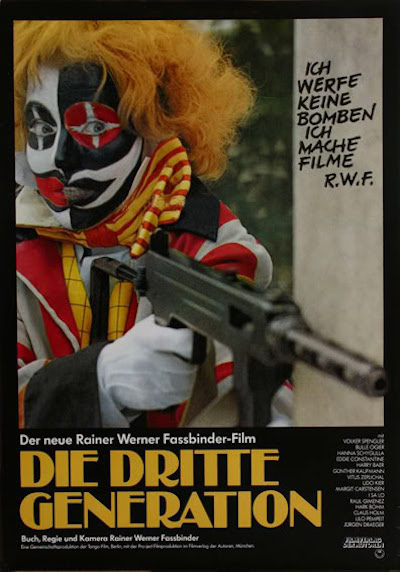
    “A comedy in six parts,” each introduced with a quote taken from a public bathroom wall (“Slave seeks master to train me as his dog,” etc.). The Kaiser Wilhelm Church dominates the Berlin skyline as seen from a glass-paneled, high-rise office, a shooting takes place on a monitor. Surveillance footage? No, the ending of The Devil, Probably. Each generation has the revolutionaries it deserves, after the Baader-Meinhoff affair you’re stuck with middle-class ninnies: leader Volker Spengler secretary Hanna Schygulla, schoolteacher Bulle Ogier, composer Udo Kier, housewife Margit Carstensen. The puppet master is the industrialist (Eddie Constantine) who heralds cinema’s utopian lies (“As long as films are sad, life isn’t”); his corporate must promote security equipment, so he manipulates the radicals into kidnapping him and sits back to enjoy the clown show.Read More »

  • Rainer Werner Fassbinder – Die Ehe der Maria Braun AKA The Marriage of Maria Braun (1979)

    1971-1980ArthouseDramaGermanyRainer Werner Fassbinder

    Quote:
    Maria (Hanna Schygulla) marries Hermann Braun in the last days of World War II, only for him to go missing in the war. Alone, Maria puts to use her beauty and ambition in order to find prosperity during Germany’s “economic miracle” of the 1950s. Rainer Werner Fassbinder’s biggest international box-office success, The Marriage of Maria Braun is a heartbreaking study of a woman picking herself up from the ruins of her own life, as well as a pointed metaphorical attack on a society determined to forget its past.Read More »

  • Rainer Werner Fassbinder – Welt am Draht AKA World on a Wire (1973)

    1971-1980GermanyRainer Werner FassbinderSci-FiTV

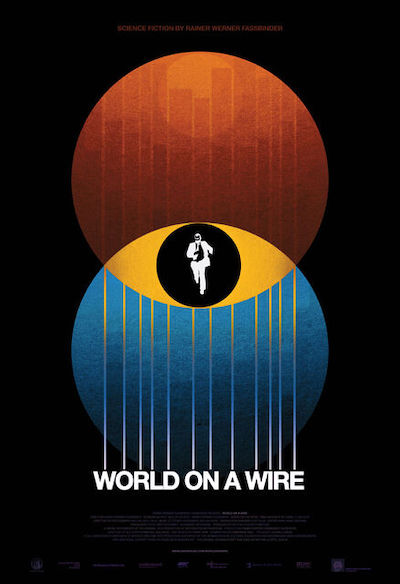
    Somewhere in the future there is a computer project called Simulacron one of which is able to simulate a full featured reality, when suddenly project leader Henry Vollmer dies. His successor Dr. Fred Stiller experiences odd phenomena. A good friend, Guenther Lause, disappears in the middle of a conversation and a week later nobody has ever heard of him. And those fits of dizzyness – Stiller cannot believe himself to be fool. There has to be an explanation for all this. Could Simulacron have something to do with it?Read More »

  • Rainer Werner Fassbinder – Frauen in New York AKA Women in New York (1977)

    1971-1980ArthouseDramaGermanyRainer Werner Fassbinder


    29f7c043f76a2bde437fd0d52a185152

    A film version of a play Fassbinder directed in Hamburg, Clare Booth Luce’s “The Women”. It gave Fassbinder an opportunity to indulge his passion for working with women – there are forty women in the play and no men.
    The play dates from the 1930s, and Fassbinder was accused by the critics of being anti-women (a frequent criticism of late). As usual, he chose to work “against” the text, and from this has constructed an entertaining and engaging play about love between upper-class women with nothing better to do than sneer at others when things go wrong with their lives and loves.
    (the above was taken from the appendix Filmography in: Fassbinder. Edited by Tony Rayns. Revised and expanded edition. bfi, London 1980, page 115)Read More »

Back to top button